

Key Takeaways
- Complete profile optimization, including accurate NAP details and strategic business category selection, can increase local search visibility by up to 70% in 2025
- High-quality visual content, including 360° virtual tours, increases customer engagement and conversion rates by nearly 45%
- Proactive review management strategies can boost your local search ranking and customer trust significantly
- Regular Google Posts with strong CTAs drive 38% more website visits and in-store traffic
- Using GBP’s advanced features, like appointment booking and messaging, can give you a competitive edge over 83% of businesses that underutilize these tools
Google Business Profile has evolved from a simple business listing into the cornerstone of local digital marketing. For small businesses looking to thrive in the increasingly competitive local landscape of 2025, mastering GBP optimization isn’t optional—it’s essential. With 97% of consumers discovering local businesses online before making purchase decisions, your GBP serves as your digital storefront, often making the first impression before customers ever visit your physical location.
Local SEO experts at RanksPro have found that businesses with fully optimized Google Business Profiles receive 7x more visits than those with incomplete listings. This comprehensive guide will walk you through cutting-edge strategies to transform your GBP from basic to extraordinary, helping your business stand out in local search results and drive real-world customer action.
Why Google Business Profile is Your Most Powerful Tool in 2025
The local search landscape has transformed dramatically, with Google Business Profile becoming the primary decision-making tool for consumers. Recent data shows that 82% of smartphone shoppers conduct “near me” searches, with 76% of those searches resulting in a same-day store visit. What’s more telling is that 28% of these searches result in a purchase, making your GBP optimization directly linked to your bottom line.
Google’s latest algorithm updates have prioritized local relevance even further, with properly optimized GBPs showing up in more varied search queries. The introduction of AI-driven features means your business information is being presented to potential customers in more contexts than ever before—from voice search responses to Google Maps suggestions and even in augmented reality applications.
With mobile-first indexing now the standard, businesses that fail to maintain a robust GBP presence are effectively invisible to a significant portion of their potential customer base. The businesses seeing the most success are those treating their GBP as a dynamic marketing channel rather than a static listing. To enhance their e-commerce experiences, businesses should continuously update and optimize their GBP.
The Essential GBP Optimization Checklist for 2025
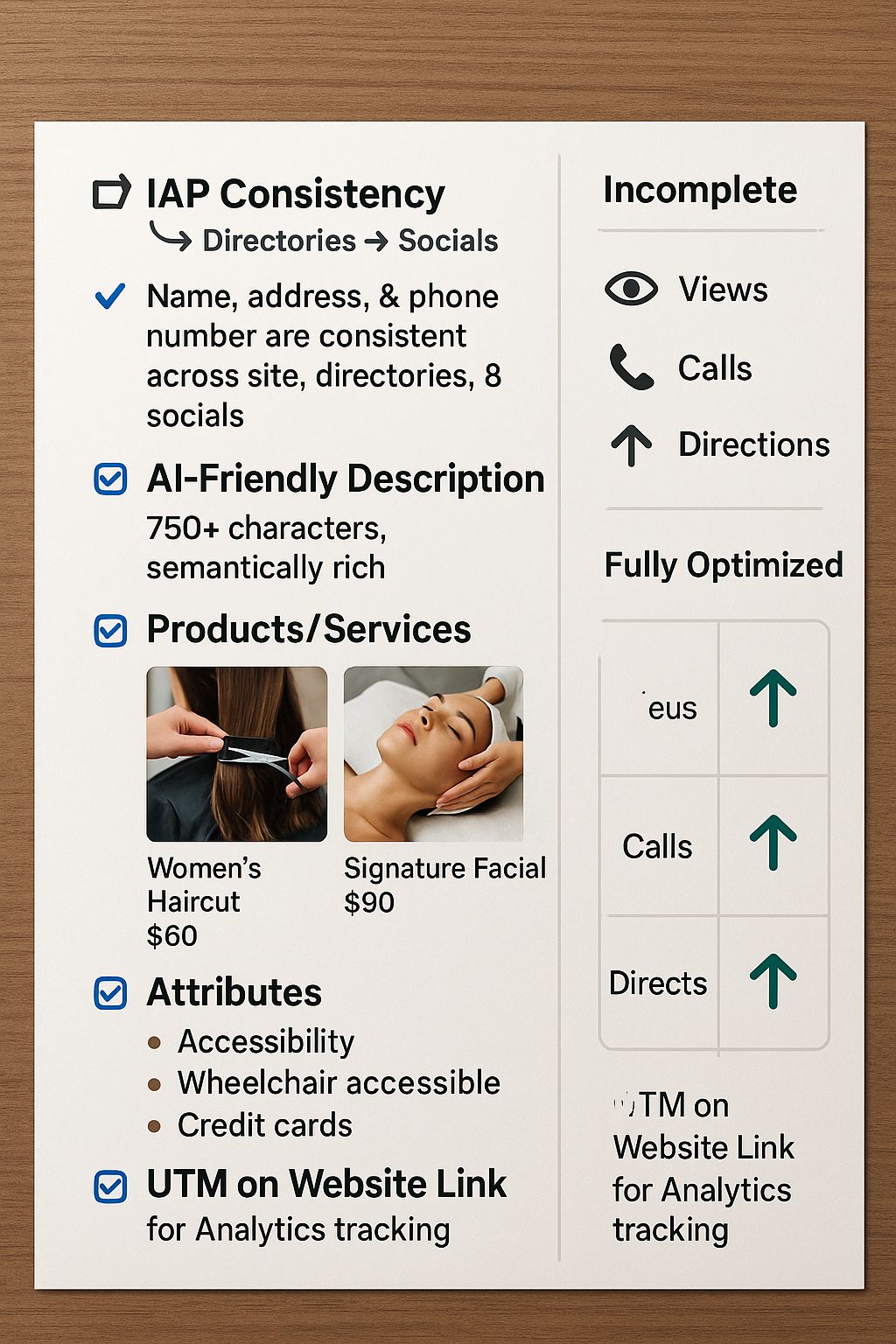
The foundation of GBP success starts with complete and accurate information. Think of your profile as a digital business card that needs to convey professionalism and trustworthiness at a glance. The following elements form your essential optimization checklist for maximum visibility.
Profile Completeness That Drives Results
A complete GBP profile receives 7x more clicks than incomplete listings. Start by ensuring every field is filled with accurate, up-to-date information. This includes your business name (exactly as it appears on your storefront), phone number, website URL, and physical address if applicable. For service-area businesses, define your service regions precisely to appear in relevant local searches.
In 2025, Google’s verification process has become more stringent to combat fake listings. Complete the verification promptly through the available methods—whether by postcard, phone, email, or instant verification for eligible businesses. Remember that unverified profiles have limited visibility and feature access.
Business Category Selection Strategy
Selecting the right business categories has become even more crucial with Google’s semantic search capabilities. Choose your primary category with extreme care, as it has the strongest influence on which searches your business appears in. In 2025, Google offers over 4,000 categories, so be as specific as possible—”Italian Restaurant” performs better than the generic “Restaurant” for relevant searches. For businesses looking to enhance their digital presence, consider enhancing e-commerce experiences to ensure your category choices align with your online strategy.
You can select up to 10 additional categories, but resist the temptation to add irrelevant ones. Each category should accurately represent services you actually provide. Google’s algorithms have become sophisticated at detecting category manipulation, which can trigger penalties. Regularly audit your categories as Google frequently adds new, more specific options that might better match your business.
- Primary category: Choose the most specific category that describes your core business
- Secondary categories: Add only relevant categories that represent actual services offered
- Review categories quarterly to identify new, more specific options
- Monitor competitors’ categories for industry benchmarking
- Avoid category stuffing, which can trigger algorithmic penalties
NAP Consistency Across All Platforms
NAP (Name, Address, Phone) consistency remains a fundamental ranking factor in 2025. Google cross-references your business information across the web, and inconsistencies create trust issues that can lower your rankings. Ensure your business name, address, and phone number are identical across your website, social media profiles, business directories, and any other online mentions. For more insights, check out this Google Business Profile Optimization Guide.
Use a NAP auditing tool to identify inconsistencies across the web. Even minor differences like “Suite” vs. “Ste.” or “Street” vs. “St.” can impact your local search performance. For businesses that have moved locations or changed phone numbers, diligently update all online references to maintain consistency and trust signals to search engines.
Business Description Optimization with AI-Friendly Keywords
Your business description serves dual audiences in 2025: potential customers and Google’s increasingly sophisticated AI. Craft a compelling 750-character description that naturally incorporates your primary keywords while providing valuable information about what makes your business unique. Focus on benefits rather than features, and avoid keyword stuffing, which is easily detected by Google’s natural language processing.
Include location-specific terms when relevant, but ensure they flow naturally within the text. With Google’s semantic search capabilities, using related terms and synonyms is more effective than repeating the same keyword. Update your description quarterly to reflect seasonal offerings, special achievements, or business evolutions that might attract new customers.
Expert Tip: Run your business description through natural language processing tools before publishing to ensure it reads naturally while still containing your strategic keywords. Remember that Google’s AI can now understand context and intent, not just match keywords.
Service and Product Catalog Updates
The Products and Services sections have become significantly more powerful in 2025, with Google displaying this information prominently in search results and knowledge panels. For service businesses, list each service category with detailed descriptions, pricing (if consistent), and photos where applicable. For retailers, regularly update your product catalog with current inventory, especially featuring seasonal or promotional items. For more insights on optimizing your profile, check out this Google Business Profile Optimization Guide.
Each product or service entry should include a high-quality image, accurate pricing, and a concise yet descriptive name. The description field provides an opportunity to naturally include relevant keywords and highlight unique selling points. Businesses that maintain comprehensive, up-to-date service and product sections typically see 32% higher engagement rates than those with minimal or outdated information.
In competitive industries, consider adding “custom offers” to highlight promotions, bundles, or special deals. These offers appear prominently in your Business Profile and can significantly increase click-through rates. For more insights on enhancing business profiles, explore strategies for enhancing e-commerce experiences. Remember to remove or update these offers once they expire to maintain profile accuracy and customer trust.
Visual Content Strategies That Boost Visibility
Visual content has become the most influential factor in consumer decision-making. Google’s visual recognition algorithms have advanced significantly in 2025, making image optimization crucial for local search success. Businesses with robust visual content see 42% higher engagement rates and significantly more website visits than those with minimal or low-quality images.
Google now uses image recognition to verify business legitimacy and categorization, making visual content a ranking factor rather than just an aesthetic element. The businesses that consistently refresh their visual content gain a substantial edge in the increasingly competitive local search landscape.
High-Impact Photo Requirements for 2025
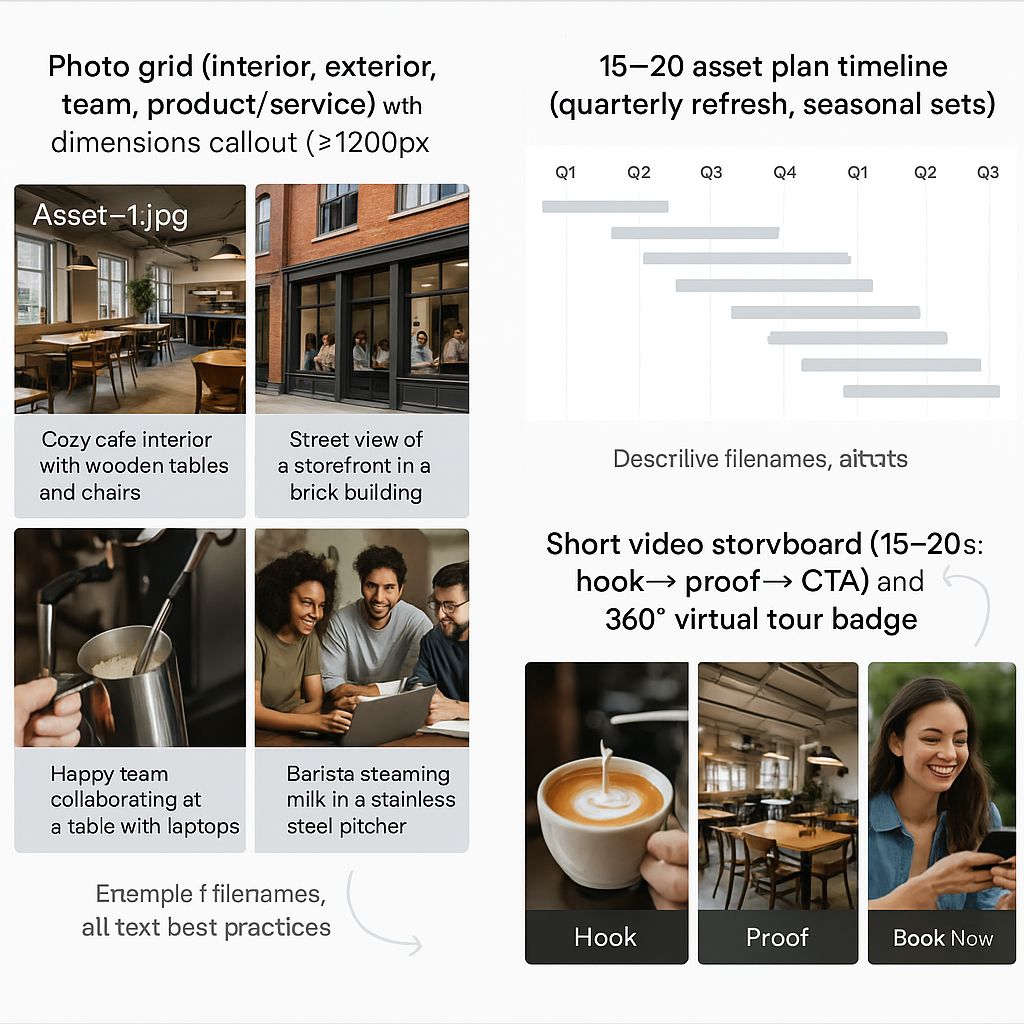
Google’s image quality standards have increased substantially, with the algorithm now favoring high-resolution, professionally shot images that accurately represent your business. The minimum requirement is now 15-20 high-quality images across different categories, with at least 5 interior shots, 5 exterior shots, 3 team photos, and 5 product/service images. These should be at least 1200px on the shortest side and optimized for mobile viewing without sacrificing quality.
Each image should be properly named with descriptive filenames that include your business name and relevant keywords before uploading. Add detailed alt text descriptions within your GBP dashboard to help Google’s AI understand what’s in each image, improving both search visibility and accessibility. The cover photo should be particularly compelling, as it’s often the first visual impression potential customers receive.
Refreshing your image library quarterly has been shown to increase profile views by up to 28%. Consider seasonal updates that showcase your business during different times of the year, highlighting special events, seasonal offerings, or holiday decorations to keep your profile current and engaging.
Video Content That Increases Engagement by 78%
Video has emerged as the most engaging content format on GBP, with profiles featuring video content receiving nearly twice the interaction rate of those without. Google now allows businesses to upload videos up to 30 seconds long, which appear prominently in profile previews and search results. Create a brief, high-quality video tour of your premises, demonstrations of your services, or customer testimonials to stand out from competitors.
The most effective GBP videos are short (15-20 seconds), professionally shot or stabilized, and include captions for accessibility. They should convey your unique selling proposition quickly and end with a clear call to action. Updating your video content quarterly keeps your profile fresh and gives returning visitors new information to engage with. For more on enhancing customer engagement, consider how e-commerce experiences can be improved through strategic video content.
Virtual Tour Implementation
Virtual tours have evolved from a luxury to a necessity in 2025, with Google reporting that listings with virtual tours receive 2x more interest than those without. The technology has become more accessible and affordable, with several GBP-compatible virtual tour providers offering streamlined solutions for small businesses. A comprehensive virtual tour allows potential customers to experience your space before visiting, building confidence and reducing uncertainty in the decision-making process.
For maximum impact, ensure your virtual tour is mobile-optimized and covers key areas of your business. Include hotspots that highlight special features, popular products, or unique aspects of your space. Businesses that update their virtual tours annually to reflect current layouts, seasonal decorations, or renovations see sustained engagement benefits compared to those with static, outdated tours.
Review Management Tactics for Higher Rankings
In 2025, reviews have become the most trusted form of social proof, with 94% of consumers stating that positive reviews make them more likely to use a business. Google’s algorithm weighs review quantity, quality, recency, and your response patterns when determining local rankings. A strategic review management system is no longer optional for businesses serious about local visibility.
How to Get 5X More Positive Reviews
The most effective review generation happens at the moment of highest customer satisfaction. Implement a systematic approach that identifies these key moments in your customer journey and prompts a review request. For retail, this might be at the point of delivery confirmation; for services, immediately following successful completion; and for restaurants, within 30 minutes of meal completion when the experience is still fresh.
Create a simple review shortlink (google.com/business/review/BusinessName) and share it through text follow-ups, email sequences, or QR codes on receipts or packaging. Train staff to personally request reviews from visibly satisfied customers, which can increase conversion rates by up to 70% compared to automated requests alone. Consider implementing a review reminder system that follows up with customers who haven’t submitted feedback within 48 hours of their initial interaction.
- Text message review requests receive 40% higher conversion rates than email requests
- Personalized review requests perform 62% better than generic templates
- Include a photo of the team member who served the customer when possible
- Make the request process as frictionless as possible—no account creation or multiple clicks
- Time requests strategically based on customer behavior data
Response Templates That Turn Negative Reviews into Opportunities
Responding to 100% of your reviews is now a significant ranking factor, with Google specifically mentioning response rate in their business guidelines. For positive reviews, a personalized thank-you that references specific details from their comment demonstrates attentiveness. For negative reviews, your response is even more critical—often influencing potential customers more than the negative review itself. Learn more about enhancing e-commerce experiences through effective review management.
Develop a framework of response templates for different review scenarios, but always personalize each response with specific details from the customer’s feedback. Address the reviewer by name, thank them for their feedback regardless of sentiment, acknowledge any legitimate concerns, explain steps you’re taking to address issues, and offer to continue the conversation offline when appropriate. This structured approach turns negative reviews into visible demonstrations of your customer service quality.
Response Framework for Negative Reviews:
“Thank you, [Name], for taking the time to share your experience. We sincerely apologize that we fell short on [specific issue mentioned]. At [Business Name], we pride ourselves on [relevant value proposition], and your experience doesn’t reflect our standards. We’ve already implemented changes to [address specific concern], and I’d appreciate the opportunity to discuss this further and make things right. Please contact me directly at [direct contact information]. — [Owner/Manager Name]”
Review Generation Automation
Review automation tools have become more sophisticated in 2025, with AI-powered systems that can identify the optimal timing for review requests based on customer behavior patterns. These systems can segment customers based on their interaction history and send personalized review requests through their preferred communication channels, significantly increasing conversion rates. For businesses looking to enhance their digital strategies, exploring e-commerce experiences can provide valuable insights into optimizing customer interactions.
The most effective automation systems integrate with your CRM, POS, or booking system to trigger review requests at precise moments in the customer journey. They can also identify potential negative feedback early through satisfaction surveys, allowing you to address concerns before they become public reviews. For multi-location businesses, these tools can centralize review management while still allowing location-specific customization.
When selecting a review automation tool, prioritize those with direct GBP integration, sentiment analysis capabilities, and robust reporting features. The investment typically pays for itself quickly through improved conversion rates and time savings compared to manual review management.
Google Posts That Drive Customer Action
Google Posts have evolved into one of the most underutilized yet powerful features of GBP. These mini-updates appear prominently in your Business Profile and provide timely information directly within search results. Businesses that publish Google Posts weekly receive 520% more actions on their Business Profile than those who don’t use this feature.
Steal our 90-day GBP content calendar (Posts, offers, events, and photo refreshes). Grab it at trycatalyst.com and plug it into your profile this week.
Post Types That Generate Maximum Engagement
Google has expanded the Post types available in 2025, each serving distinct marketing objectives. What’s New posts work best for general updates, business milestones, or behind-the-scenes content. Offer posts, which now support advanced scheduling and recurring options, are ideal for promotions, sales, or special deals. Event posts, with enhanced calendar integration, effectively promote workshops, classes, performances, or seasonal events. COVID-19 updates have evolved into Health & Safety posts, allowing businesses to communicate current protocols, hour changes, or capacity limitations.
The highest-performing posts combine compelling visuals, concise text (150-300 characters), and clear calls to action. Google’s algorithm favors posts with high engagement rates, making them visible to a wider audience over time. Experiment with different post types to identify which generate the most engagement for your specific audience and business category.
Content Calendar for Consistent Visibility
Consistency is key to maximizing the impact of Google Posts. Develop a quarterly content calendar that schedules at least one post weekly, with increased frequency during high-traffic periods or special promotions. Align your Google Posts calendar with your broader marketing initiatives, ensuring that promotions, events, and announcements are coordinated across all channels.
Diversify your post types to maintain audience interest, following a rotation of promotional, informational, and engagement-focused content. Consider creating themed series for different days of the week, such as “Tip Tuesday” or “Feature Friday,” to establish content patterns that customers come to expect. Monitor engagement metrics for each post type and adjust your calendar to favor the highest-performing formats.
For seasonal businesses, plan your content calendar to highlight different aspects of your offerings throughout the year. Garden centers might focus on spring planting in April, summer maintenance in July, fall cleanup in October, and indoor plants in January. This approach keeps your content relevant to customers’ current needs while showcasing your full range of products or services.
Top 5 GBP Management Platforms for 2025
The complexity of managing Google Business Profiles at scale has led to the development of sophisticated management platforms. BrightLocal continues to lead the field with its comprehensive suite of tools for multi-location businesses, offering automated posting, review management, and detailed analytics across hundreds of locations from a single dashboard. For small to medium businesses, Semrush’s GBP management tools provide exceptional value with AI-driven content suggestions and competitive analysis features that identify opportunities for visibility improvement.
Newer entrants like GBP Pilot have disrupted the market with their focus on automation and machine learning. Their platform predicts optimal posting times based on customer engagement patterns and automatically generates location-specific content that maintains brand consistency while addressing local audience preferences. For enterprise-level needs, Reputation and Yext offer robust solutions that integrate GBP management with broader digital presence management, though at premium price points that may be prohibitive for smaller operations.
AI-Powered Response Systems
Artificial intelligence has transformed how businesses manage customer interactions through GBP. Smart response systems now monitor your GBP messaging 24/7, using natural language processing to provide instant, contextually appropriate responses to customer inquiries. These systems can accurately answer frequently asked questions, provide business information, and even facilitate appointment bookings without human intervention.
The most advanced systems learn from previous interactions, becoming increasingly accurate over time. They can detect sentiment in customer messages and escalate complex or potentially negative situations to human team members when necessary. This hybrid approach ensures customers receive immediate attention while preserving the authentic human touch for situations where it matters most. For more insights on optimizing customer interactions, explore the latest updates on AI and SEO optimization tips.
Implementation is surprisingly straightforward, with most systems integrating directly with your GBP dashboard. After an initial training period where you provide sample responses to common questions, the AI begins handling routine inquiries while collecting data on customer interaction patterns. The ROI becomes evident quickly, as businesses report recovering up to 38% of previously lost leads from after-hours inquiries and reducing response times from hours to seconds.
|
AI Response System |
Best For |
Key Features |
Price Range |
|---|---|---|---|
|
DialogFlow |
Tech-savvy businesses |
Custom NLP, multi-language support |
$0-500/month |
|
ManyChat |
Retail & restaurants |
Visual builder, CRM integration |
$15-145/month |
|
Verloop |
Service businesses |
Appointment booking, sentiment analysis |
$99-299/month |
|
Drift |
B2B companies |
Lead qualification, meeting scheduling |
$400-1,500/month |
|
Intercom |
Enterprise solutions |
Advanced analytics, custom workflows |
Custom pricing |
Analytics Dashboards Worth Your Investment
The native GBP insights provide basic performance metrics, but serious optimization requires deeper analytics capabilities. Third-party dashboards like Localscore and DashThis aggregate data across multiple locations and competitors, providing context that the native dashboard lacks. These platforms can correlate GBP performance with website traffic, conversion rates, and even in-store foot traffic, creating a comprehensive view of your local marketing effectiveness.
30/60/90 Day Implementation Plan
Transforming your Google Business Profile requires a structured approach that builds momentum over time. Rather than making sporadic improvements, follow this systematic 90-day plan to achieve sustainable results. This methodical implementation ensures you’re addressing foundational elements before moving to advanced strategies, creating a virtuous cycle of optimization and improvement.
First 30 Days: Foundation Building
Begin by conducting a comprehensive audit of your current GBP, identifying gaps, inaccuracies, and opportunities for improvement. Verify and update all basic information, ensuring NAP consistency across all web properties and claiming any duplicate listings. Optimize your primary and secondary categories, business description, and attributes to accurately reflect your offerings. Gather and upload at least 20 high-quality images representing different aspects of your business, and respond to all existing reviews, both positive and negative.
Days 31-60: Engagement Amplification
With your foundation established, focus on activities that increase engagement. Implement a systematic review generation system, training staff and creating automated follow-up sequences to request feedback from satisfied customers. Begin publishing weekly Google Posts following a content calendar that includes a mix of updates, offers, and events relevant to your audience.
Develop a review response protocol with templates for various scenarios, ensuring all new reviews receive personalized responses within 24 hours. Enhance your visual content by adding videos and considering a virtual tour implementation if budget allows. Set up GBP messaging and create automated responses for frequently asked questions, with protocols for handling more complex inquiries.
Days 61-90: Optimization and Scaling
The final 30 days focus on refinement and advanced features. Analyze the performance data from your first 60 days to identify which types of posts, images, and review responses generate the most engagement. Implement product or service listings with optimized descriptions, images, and pricing information. Set up Q&A content proactively, addressing common customer questions before they’re asked. Begin monitoring competitors’ GBP activities and benchmarking your performance against theirs, identifying opportunities to differentiate your business or address gaps in your strategy. For further insights, consider exploring how enhancing e-commerce experiences can play a role in your optimization strategy.
How to Measure GBP Success in 2025
Effective optimization requires clear metrics to track progress and identify opportunities for improvement. While many businesses focus exclusively on ranking positions, a comprehensive measurement strategy examines multiple dimensions of GBP performance, from visibility to engagement to conversion. The most successful businesses track trends over time rather than fixating on day-to-day fluctuations, looking for patterns that reveal strategic insights.
Key Performance Indicators That Drive Business Growth
The most valuable GBP metrics directly correlate with business outcomes rather than vanity metrics. Track search impressions (how often your business appears in results), profile views (how often users click for more information), and website clicks, phone calls, and direction requests (actions that indicate high purchase intent). The action-to-impression ratio is particularly telling, measuring how compelling your profile is to searchers who encounter it. For more insights, consider exploring enhancing ecommerce experiences to improve these metrics.
Beyond the standard metrics, analyze the queries that trigger your profile appearances. Are you showing up for relevant, high-intent searches? How diverse are the search terms bringing visitors to your profile? Additionally, track review velocity (new reviews per month), average rating, and the sentiment distribution in review content to gauge reputation momentum.
Conversion Tracking Setup
Advanced GBP optimization requires connecting online actions to real-world conversions. Implement UTM parameters on your GBP website links to track visitors from your profile in Google Analytics, allowing you to measure bounce rates, time on site, and conversion actions from GBP traffic specifically. For phone calls, consider call tracking solutions that provide attribution data while maintaining NAP consistency, such as CallRail or CallTrackingMetrics with their GBP-friendly implementations.
ROI Calculation for GBP Optimization
To calculate the true return on investment for your GBP optimization efforts, establish baseline metrics before beginning your optimization program, then track improvements over time. Calculate the average value of a conversion from each action type (website visit, phone call, direction request), based on your historical conversion rates and average transaction value.
For example, if 10% of direction requests result in store visits, and 60% of store visitors make a purchase with an average value of $75, each direction request has an expected value of $4.50. By tracking increases in direction requests attributable to your optimization efforts, you can calculate the additional revenue generated. Compare this revenue increase to your investment in optimization (including time, tools, and external services) to determine your ROI.
Your Next Steps to GBP Dominance
The most effective GBP optimization isn’t a one-time project but an ongoing program of improvement and adaptation. Begin by implementing the 30-day foundation-building strategies outlined above, focusing on accuracy, completeness, and visual appeal. Set calendar reminders for weekly posts, monthly content refreshes, and quarterly comprehensive audits to maintain momentum.
Consider partnering with RanksPro for professional GBP management if you lack the internal resources to implement these strategies consistently. Their team of local SEO specialists can handle the technical aspects of optimization while you focus on delivering exceptional customer experiences that generate positive reviews and repeat business. With the right approach and consistent execution, your Google Business Profile can become your most powerful and cost-effective marketing channel in 2025 and beyond.
Frequently Asked Questions
The following questions represent the most common concerns business owners have about Google Business Profile optimization. These answers reflect the current best practices as of 2025 and address the strategic aspects of GBP management rather than just technical how-tos.
Understanding the nuances of GBP management can significantly impact your local search performance. These questions address both fundamental concepts and advanced strategies that will help you maximize your profile’s effectiveness in driving customer engagement and business growth. For a comprehensive guide, check out this Google Business Profile Optimization Guide.
Many business owners underestimate the ongoing maintenance requirements for an effective GBP. While setting up a profile is straightforward, achieving and maintaining visibility in competitive markets requires consistent attention to the elements discussed throughout this guide. For those in the e-commerce sector, enhancing e-commerce experiences can also play a crucial role in optimizing your GBP effectively.
The following answers provide actionable insights that you can implement immediately, regardless of your business size or industry. Each recommendation is based on data-driven best practices rather than speculation or outdated tactics.
How often should I update my Google Business Profile in 2025?
At minimum, publish one Google Post weekly and refresh your photos monthly to maintain engagement and relevance signals. Conduct a comprehensive audit quarterly to update seasonal information, refresh your business description with current offerings, and ensure all details remain accurate. Additionally, review and update your service/product listings whenever your offerings change and immediately update hours for holidays or special events.
The businesses seeing the best results follow a “little and often” approach rather than infrequent major overhauls. Five minutes daily for review responses, fifteen minutes weekly for posting new content, and an hour monthly for more substantial updates creates a manageable routine that yields significant visibility benefits over time.
Can Google Business Profile directly impact my website’s SEO?
Yes, your GBP performance directly influences your website’s organic search performance through several mechanisms. Google explicitly confirmed that a well-maintained Business Profile sends positive trust signals that benefit your website’s domain authority. Additionally, the engagement metrics from your GBP (high click-through rates, positive reviews, frequent actions) contribute to Google’s evaluation of your site’s relevance and authority for local-intent searches.
What’s the most effective way to handle fake or malicious reviews?
First, respond professionally to the review without admitting it’s fake, simply stating you have no record of their visit and inviting them to contact you directly to resolve their concerns. This response is for other potential customers who will see both the review and your handling of it. Simultaneously, flag the review through your GBP dashboard, selecting “This review is not relevant” or “This review contains prohibited content” depending on the situation.
For reviews that clearly violate Google’s policies (containing hate speech, personal information, or obvious spam), flagging usually results in removal within 3-5 days. For reviews that don’t explicitly violate policies but appear suspicious, gather evidence such as customer records showing no interaction with the reviewer or similarities with other suspicious reviews. Submit this evidence through the Google Business Profile support channels for manual review, which has a higher success rate than simple flagging.
Are paid GBP management tools worth the investment for small businesses?
For businesses managing a single location with limited competition, the native GBP dashboard provides adequate functionality for basic optimization. The investment in paid tools becomes worthwhile when you’re managing multiple locations, operating in highly competitive markets, or lacking the time for consistent manual updates. Entry-level tools like Semrush’s listing management ($20-30/month) or BrightLocal ($29-79/month) offer excellent value for small businesses looking to automate routine tasks and gain deeper performance insights.
The key to determining ROI is calculating the value of time saved and opportunities gained. If a $50 monthly tool saves you 5 hours of manual work and helps generate even 2-3 additional customers through improved visibility, it’s likely a worthwhile investment. Start with a free trial period and measure the impact on your key performance indicators before committing to a long-term subscription.
How do I optimize my GBP for voice search in 2025?
Voice search optimization for GBP centers on understanding how people naturally speak queries versus how they type them. Focus on conversational, long-tail phrases in your business description, Q&A section, and review responses. For example, include complete questions like “Where can I find affordable plumbing services in Chicago?” rather than just keyword phrases like “affordable Chicago plumbers.” For more insights on enhancing user interactions, check out this article on enhancing e-commerce experiences.
Ensure your GBP category selections are highly specific, as voice search often returns results based on exact category matches rather than keyword relevance. Maintain accurate and detailed structured data both on your website and GBP, particularly your NAP information and business hours, as voice assistants prioritize definitive data points when responding to queries.
The financial industry is rapidly evolving with the integration of new technologies. Companies are striving to create platforms that are not only secure but also user-friendly. One of the key aspects of this transformation is the focus on developing intuitive financial platforms that cater to the needs of modern consumers. These platforms aim to simplify complex financial processes and enhance user experience, making financial management accessible to everyone.
Own the Local 3-Pack in 30 days.
Get Catalyst Pr’s GBP Acceleration Kit—category tuning, NAP cleanup, AI-ready descriptions, photo/video checklist, weekly Post templates, review request flows, and UTM tracking setup.
Start free at Catalyst Pro >>

