
Key Takeaways
- Small businesses can compete with larger companies by leveraging AI marketing tools that cost less than $500 combined per month
- Content creation tools like Jasper and Canva Pro can reduce production time by up to 70% while maintaining quality
- Customer engagement AI tools provide enterprise-level personalization capabilities without requiring a large marketing team
- The right AI marketing stack can generate positive ROI within 60-90 days for most small businesses
- Implementing these essential AI tools requires minimal technical expertise but delivers maximum marketing impact
The marketing playing field has finally leveled. With affordable AI tools now available, small businesses can achieve results that previously required expensive agencies or large in-house teams. By strategically implementing the right tools, your SMB can automate repetitive tasks, generate high-quality content, and make data-driven decisions that drive real growth.
According to a recent study by Pipedrive, small businesses using AI marketing tools see an average 27% increase in lead generation and 31% improvement in customer engagement metrics. These aren’t marginal gains—they’re business-transforming results that directly impact your bottom line.
Why SMBs Need AI Marketing Tools in 2024
The Digital Marketing Advantage Gap
For years, enterprise companies dominated digital channels with massive budgets and specialized teams. The average Fortune 500 company spends over $7.5 million annually on digital marketing, with dedicated specialists for each channel. Small businesses, meanwhile, typically operate with one marketing generalist (often the owner) and limited resources, creating what I call the “advantage gap.”
This gap leads to inconsistent content production, delayed customer responses, and marketing decisions based on gut feeling rather than data. The consequences? Lower visibility, fewer leads, and stagnant growth compared to better-resourced competitors.
How AI Levels the Playing Field
Artificial intelligence has fundamentally changed this dynamic by democratizing access to sophisticated marketing capabilities. Tasks that once required dedicated specialists can now be automated or enhanced through affordable AI tools. Content creation that previously took days can be completed in hours. Customer interactions that demanded constant attention can be intelligently automated.
Pipedrive’s suite of AI-powered tools exemplifies this shift, giving small businesses enterprise-grade capabilities without enterprise-level investments. Their integrated approach combines sales and marketing automation to create a seamless customer journey from first touch to closed deal, all powered by intelligent AI that learns from your business data.
The ROI of a $500 AI Marketing Stack
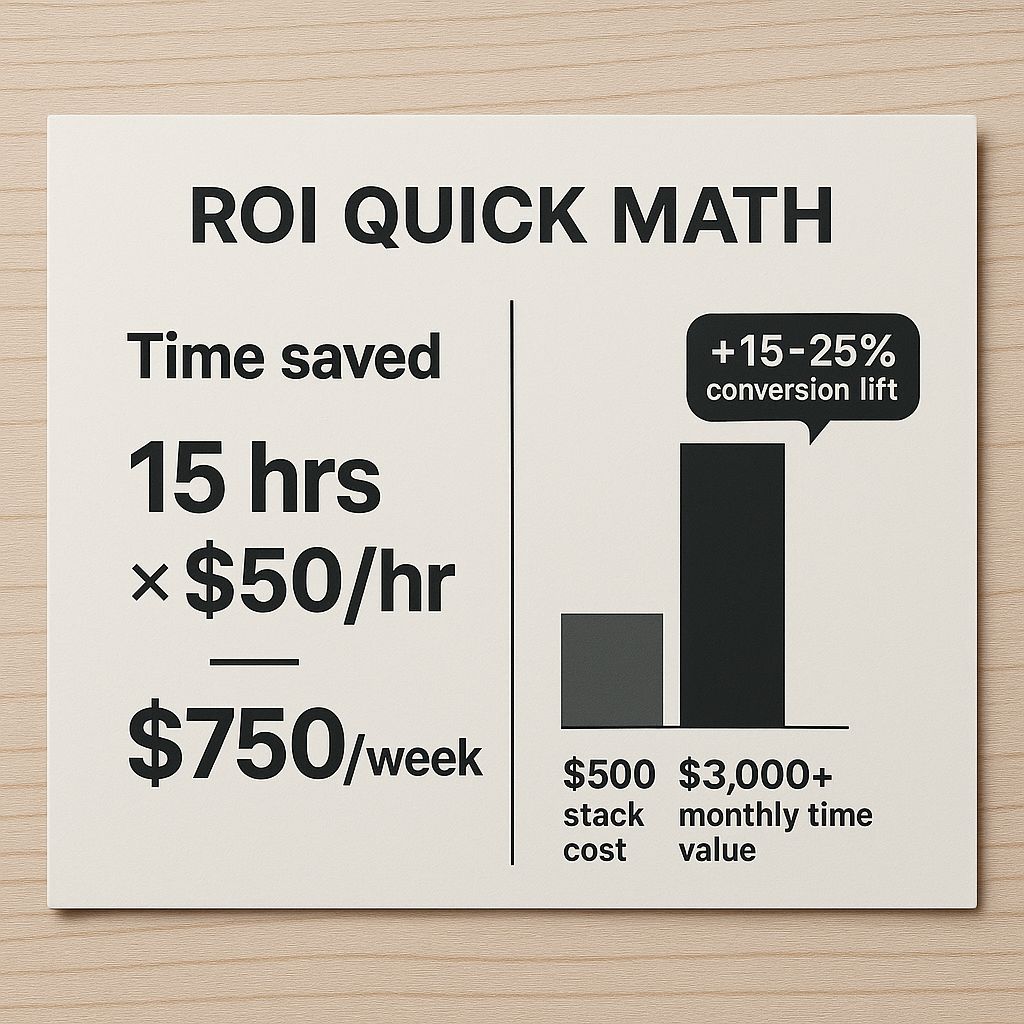
The most compelling reason to adopt AI marketing tools is the return on investment. A strategically selected set of AI tools—what I call the “$500 Marketing Stack”—delivers outsized returns in three key areas: time savings, quality improvements, and data insights.
“Small businesses using AI marketing tools save an average of 15 hours per week on content creation and customer engagement tasks while simultaneously improving content quality and conversion rates.” — 2023 Small Business AI Adoption Report
Let’s break down this ROI: If your effective hourly rate is $50, those 15 hours represent $750 weekly or $3,000 monthly in time value alone. Factor in improved conversion rates (typically 15-25% with properly implemented AI tools), and the return far exceeds the $500 monthly investment.
Content Creation Tools That Do the Heavy Lifting
Content remains king in digital marketing, but creating high-quality material consistently is among the biggest challenges for small businesses. These AI-powered content creation tools help solve this fundamental problem.
1. Jasper ($49/month): Your AI Writing Assistant
Jasper has evolved from a simple text generator to a comprehensive AI writing platform specifically designed for marketing content. Its standout feature is the ability to maintain your brand voice across all content types—from social media posts to long-form articles.
Unlike generic AI writing tools, Jasper integrates with SEO platforms to ensure content ranks well while reading naturally. The platform’s templates for different content formats (emails, ads, blog posts) help even non-writers create professional-grade material quickly. Most SMBs report 60-70% time savings on content production after implementing Jasper.
2. Canva Pro with Magic Studio ($12.99/month): Visual Content Generator
Visual content typically requires specialized design skills or expensive freelancers, but Canva Pro with Magic Studio has changed that equation entirely. The AI-powered Magic Studio features transform basic ideas into professional designs through tools like Background Remover, Magic Resize, and Brand Kit. For more insights into AI tools, check out this list of free AI tools.
The game-changer for SMBs is the Text-to-Image generator that creates custom visuals from simple descriptions. This eliminates the need for stock photos or custom photography for most marketing materials. With over 610,000 templates and AI design suggestions, even businesses without dedicated designers can maintain visual consistency across all channels.
3. Descript ($15/month): Video and Podcast Production Assistant
Video marketing delivers the highest engagement rates across platforms, but production has traditionally been time-consuming and technical. Descript solves this with an innovative approach that treats video editing more like document editing.
The platform’s Overdub feature creates a synthetic version of your voice that can correct mistakes or add content without re-recording. Its automatic transcription and Studio Sound features eliminate the need for professional audio equipment or editing knowledge. Most impressively, the new Storyboard feature automatically generates video templates based on your script, making video production accessible to any small business.
Customer Engagement Tools That Convert
Creating great content is only half the battle. To generate actual revenue, you need tools that engage prospects and convert them into customers. These AI-powered engagement platforms automate personalized interactions at scale.
1. Klaviyo Basic ($45/month): Email Automation With Predictive Analytics
Klaviyo has revolutionized email marketing for small businesses by bringing enterprise-level predictive analytics to an affordable platform. Unlike basic email tools, Klaviyo’s AI analyzes customer behavior to automatically segment your audience and predict future purchasing patterns.
The platform’s most valuable feature for SMBs is its flow-based automation that creates personalized customer journeys without requiring technical expertise. For example, the abandoned cart flows automatically adjust send times and offers based on individual customer data. Users report an average 20% increase in email-driven revenue after switching from standard email platforms.
2. ManyChat Growth ($15/month): AI-Powered Chatbots
Customer service expectations have skyrocketed, with 82% of consumers expecting immediate responses. ManyChat solves this with AI-driven conversational marketing across multiple channels, including your website, Facebook Messenger, Instagram, and WhatsApp. The platform’s strength lies in its ability to qualify leads and answer common questions without human intervention. For businesses looking to enhance customer interactions, enhancing e-commerce experiences with tools like ManyChat can be a game-changer.
3. Birdeye Starter ($79/month): Review Management and Response Generation
Online reviews directly impact purchasing decisions for 93% of consumers, making review management essential for SMBs. Birdeye automates the entire review process, from requesting reviews at the optimal moment to generating personalized AI responses for both positive and negative feedback.
The platform’s Interaction AI can identify sentiment in customer comments and craft appropriate responses that match your brand voice, saving hours of monitoring while ensuring timely engagement. Most businesses see a 23% increase in positive reviews within three months of implementation, directly influencing local search rankings.
Marketing Intelligence Tools That Inform Strategy
Making data-driven decisions separates successful marketing from expensive guesswork. These AI tools provide actionable insights without requiring a data science degree to interpret them.
1. Google Analytics 4 (Free)
Google Analytics 4 represents a complete reimagining of web analytics, with AI at its core. Unlike previous versions that focused primarily on pageviews, GA4 uses machine learning to identify trends, predict future actions, and highlight anomalies without manual analysis.
The predictive metrics feature is particularly valuable for SMBs, calculating churn probability and potential revenue from different customer segments. While free, proper implementation is crucial—take the time to set up conversion events that align with your actual business goals rather than vanity metrics.
2. SurferSEO Basic ($69/month): Content Optimization Intelligence
Content optimization has traditionally been more art than science, but SurferSEO changes that with data-driven content recommendations. The platform analyzes top-ranking pages for your target keywords and provides specific guidance on content structure, length, topics to cover, and even word choice.
What sets Surfer apart is its Content Editor, which provides real-time optimization scores as you write, eliminating the guesswork from SEO content creation. Most SMBs report a 30-40% improvement in content ranking positions within 60 days of implementing Surfer’s recommendations. For those interested in enhancing their e-commerce experiences, Surfer’s tools offer valuable insights and strategies.
3. Semrush Pro ($119.95/month): Comprehensive SEO and Competitor Analysis
Semrush represents the largest investment in this stack but delivers proportional value through its comprehensive marketing intelligence capabilities. Beyond standard SEO features, the platform’s AI-powered Market Explorer identifies your true online competitors (often different from who you think they are) and reveals their strategies. For businesses looking to enhance their e-commerce experiences, Semrush provides invaluable insights that can be leveraged to stay ahead in the market.
The Content Marketplace connects directly with AI-powered writers who understand SEO, while the Position Tracking tool alerts you to ranking changes before they impact revenue. Small businesses typically identify at least three high-value keyword opportunities within the first month that they would have otherwise missed.
Social Media Management Tools That Save Time
Social media demands consistent attention across multiple platforms, a particular challenge for resource-constrained SMBs. These AI tools ensure your presence remains active and strategic without consuming your entire day.
1. Hootsuite Professional ($99/month): Multi-Platform Scheduling With AI Recommendations
Hootsuite has evolved beyond simple scheduling to become an AI-powered social media command center. Its content recommendation engine suggests optimal posting times based on when your specific audience is most engaged, not generic best practices.
For time-strapped business owners, the platform’s most valuable feature is the AI-assisted response suggestions that help maintain customer engagement without crafting each reply from scratch. The analytics dashboard provides actionable insights in plain English rather than overwhelming you with metrics.
2. Lately.ai Starter ($49/month): Content Repurposing and Scheduling
Content repurposing is perhaps the most efficient marketing strategy, and Lately.ai automates this entire process. Upload a long-form piece of content—like a blog post, video, or podcast—and the AI automatically generates dozens of social media posts with appropriate hashtags and formatting for each platform.
What makes Lately truly powerful is its learning capability. The system analyzes which of your posts perform best and adjusts its generation algorithm accordingly, continually improving results. Users typically see engagement rates increase by 25-40% within the first three months.
Build Your Custom AI Marketing Stack
While all these tools deliver value, your specific business needs will determine which combination makes sense. Here’s how to construct your custom AI marketing stack while staying within budget. For more insights, explore our guide on enhancing e-commerce experiences with AI tools.
Essential Tools vs. Nice-to-Have Tools
Start by identifying your biggest marketing bottleneck. For service businesses, customer engagement tools often deliver the quickest ROI. For e-commerce, email automation typically provides the most immediate lift. Product companies with longer sales cycles generally benefit most from content creation tools that nurture prospects through educational content.
At a minimum, every small business should implement a content creation tool, one customer engagement platform, and a free analytics solution like GA4. This foundation allows you to create content efficiently, engage prospects automatically, and measure results accurately.
Mix-and-Match Strategies to Stay Under $500
The full stack described here totals slightly over $500, so most businesses will need to prioritize. Consider these common configurations that match different business types, such as those enhancing e-commerce experiences to optimize their operations effectively.
- Service Business Stack: Jasper ($49) + Canva Pro ($12.99) + ManyChat ($15) + Birdeye ($79) + GA4 (Free) + Semrush ($119.95) = $275.94
- E-commerce Stack: Jasper ($49) + Canva Pro ($12.99) + Klaviyo ($45) + GA4 (Free) + SurferSEO ($69) + Hootsuite ($99) = $274.99
- B2B/Professional Services: Jasper ($49) + Descript ($15) + Klaviyo ($45) + GA4 (Free) + Semrush ($119.95) + Lately.ai ($49) = $277.95
Implementation Timeline: First 30 Days
Successful AI tool implementation requires a methodical approach. For most small businesses, a 30-day rollout works best, starting with one tool per week. Begin with a content creation tool like Jasper, as it delivers immediate time savings. In week two, add your customer engagement platform. Weeks three and four should focus on analytics and intelligence tools that will guide your strategy. This gradual approach prevents overwhelm and allows your team to master each tool before adding complexity. Need a guided 30-day rollout? Get Catalyst Pro’s timeline, prompts, and templates tailored to your niche. Grab the plan.»
Measure Your AI Marketing ROI
The true value of your AI marketing stack becomes clear when you measure both quantitative and qualitative returns. Beyond the obvious metrics like leads generated or sales closed, track time savings, content consistency, and customer satisfaction improvements. Pipedrive’s integrated marketing tools can help you connect these dots by showing the complete customer journey from first touch to closed deal.
Key Performance Indicators to Track
For content creation tools, measure production time (hours saved per piece), content volume (increase in output), and engagement metrics (time on page, shares, comments). The average SMB sees content production time decrease by 65% while maintaining or improving quality. Learn more about enhancing e-commerce experiences with the right tools.
For customer engagement tools, track response time, conversion rates, and customer satisfaction scores. Most businesses see average response times drop from hours to minutes, with corresponding increases in conversion rates of 15-30%.
Time Savings Calculator
To calculate your true ROI, multiply hours saved weekly by your effective hourly rate (or the cost of outsourcing these tasks). For a business owner valuing time at $75/hour who saves 12 hours weekly, that’s $900 in weekly time value alone—or $3,600 monthly against a $500 investment. The math becomes even more favorable when factoring in increased revenue from improved marketing effectiveness.
When to Upgrade Your Tools
Most AI marketing tools offer tiered pricing based on usage volume or advanced features. The right time to upgrade is when you’re consistently bumping against usage limits or when revenue growth clearly justifies additional investment. As a general rule, consider upgrades when you’re seeing at least a 3x return on your current investment or when growth is constrained by tool limitations rather than market factors.
One advantage of this approach is scalability—most tools in this stack can grow with your business from solo entrepreneur to multi-million dollar operation without changing platforms.
Your AI Marketing Action Plan
Begin your AI marketing transformation with these five concrete steps: First, audit your current marketing activities to identify the most time-consuming tasks and biggest revenue opportunities. Second, select your initial three tools based on this audit, prioritizing your most critical needs. Third, block dedicated implementation time on your calendar—specifically 2-3 hours per tool for setup and learning. Fourth, document standard operating procedures as you learn each tool to make delegation easier later. Finally, schedule a 30-day review to measure initial results and adjust your strategy. For those in the ecommerce sector, consider enhancing your ecommerce experiences with AI tools to maximize efficiency and growth.
Remember that AI tools amplify your marketing strategy but don’t replace it. The clearer your target audience, messaging, and objectives, the more effective these tools will be. Pipedrive’s sales and marketing tools can help you define and implement this strategy while the AI handles execution.
Frequently Asked Questions (FAQ)
As you consider implementing AI marketing tools for your small business, you likely have concerns about practicality, learning curves, and overall effectiveness. These questions represent the most common concerns I hear from SMB owners taking their first steps with marketing AI.
Each represents a legitimate concern that deserves a thoughtful answer based on actual implementation experience rather than theoretical possibilities. For instance, when enhancing eCommerce experiences, practical insights can be more valuable than mere theories.
Can AI marketing tools really replace a marketing team?
AI tools don’t replace marketing teams—they replace the repetitive, time-consuming tasks that prevent your team (even if that’s just you) from focusing on strategy. They’re best viewed as force multipliers that allow small teams to produce at the level of much larger operations. These tools excel at content production, data analysis, and routine engagement but still require human oversight for strategy development, brand voice maintenance, and creative direction. Most SMBs find that AI tools allow them to delay hiring additional marketing staff while growing, effectively letting 1-2 people perform like a team of 4-5.
How long does it take to learn these AI marketing tools?
Most modern AI marketing tools prioritize user experience, with learning curves of 2-5 hours for basic proficiency. Mastery typically requires 2-3 weeks of regular use. Tools like Jasper and Canva offer guided tutorials and templates that accelerate the learning process, while platforms like Klaviyo provide step-by-step setup wizards. The most challenging aspect isn’t learning tool functionality but developing effective prompting skills to get optimal results from AI systems. Plan for approximately one hour of focused learning per day during your first week with each new tool.
Which AI marketing tool should I implement first?
The highest-impact first implementation for most businesses is a content creation tool like Jasper or Canva Pro. These tools deliver immediate time savings while increasing your marketing output, creating momentum that drives the adoption of additional tools. Content creation typically represents the largest time investment in marketing, so automating this area provides the quickest relief for resource-constrained businesses.
If your business is already generating leads but struggling with follow-up, start with a customer engagement tool like ManyChat or Klaviyo instead. The right starting point ultimately depends on your specific bottleneck—content creation, customer engagement, or marketing intelligence.
Do I need technical skills to use these AI marketing tools?
The tools in this stack were specifically selected for their accessibility to non-technical users. Most feature drag-and-drop interfaces, templates, and natural language inputs that require no coding knowledge. The technical bar has lowered significantly in recent years, with AI making these platforms increasingly intuitive.
That said, basic digital literacy is necessary—comfort with web applications, understanding of marketing fundamentals, and willingness to follow tutorial guidance. If you can use social media or word processing software, you have sufficient technical skill to implement these tools.
|
AI Marketing Tool |
Technical Difficulty (1-5) |
Learning Time |
|---|---|---|
|
Jasper |
2 |
1-2 hours |
|
Canva Pro |
1 |
30-60 min |
|
Klaviyo |
3 |
3-4 hours |
|
Semrush |
3 |
4-5 hours |
|
Google Analytics 4 |
4 |
3-5 hours |
Most platforms offer extensive help documentation, video tutorials, and customer support to assist with setup and optimization. Many also offer onboarding calls or setup assistance as part of their subscription.
Can I get by with free versions of these tools instead?
Free versions of AI marketing tools typically impose significant limitations that reduce their effectiveness for business applications. While they allow you to test functionality, they rarely provide the throughput or features needed for consistent marketing results. For example, free AI writing tools often limit outputs, lack integration capabilities, or don’t allow commercial usage of generated content. The exception is Google Analytics 4, which provides enterprise-grade analytics at zero cost.
A more effective approach for budget-conscious businesses is to implement fewer paid tools rather than more free ones. Three properly implemented paid tools will typically deliver better results than attempting to cobble together a stack of limited free versions.
For businesses with extremely limited budgets, consider starting with just one paid tool in your highest-priority area while using free options temporarily for less critical functions. As ROI becomes apparent, reinvest in additional paid tools.
The AI marketing revolution has permanently changed what’s possible for small businesses. Tools that once required enterprise budgets are now accessible to companies of any size, creating unprecedented opportunities for SMBs willing to embrace them. Start small, measure carefully, and scale intelligently—the marketing results that follow will transform not just your metrics but your entire business growth trajectory.
Build your $500 AI stack—without the guesswork
Catalyst Pro audits your funnel, assembles the right 3–6 tools under $500, and sets up a 30-day rollout—content, engagement, analytics—plus plug-and-play SOPs and an ROI tracker.
Start your free Stack Plan »

