
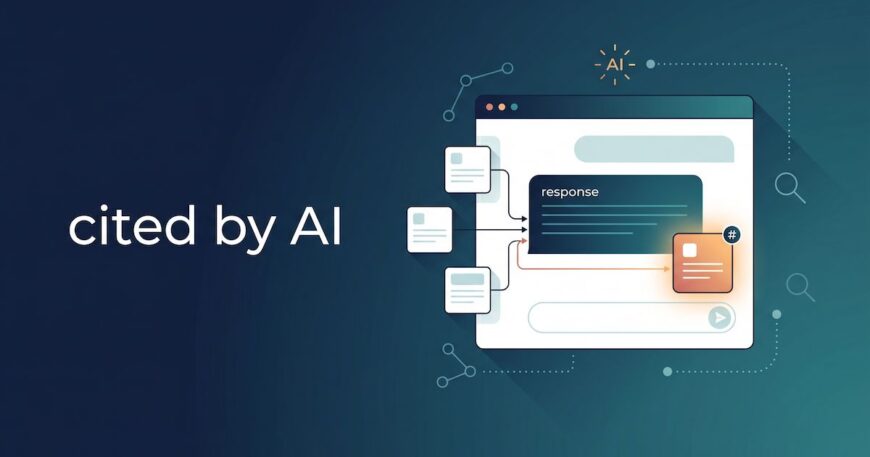
- GEO (Generative Engine Optimization) is the practice of optimizing your content so AI search tools cite your brand in their generated answers — not just rank your page in a list of links.
- Authority and credibility signals — like breadth of web mentions and expert-led content — are the central levers AI systems use when selecting sources to cite.
- Google officially states that optimizing for generative AI search is still SEO at its core, meaning foundational best practices remain your most reliable investment.
- Tactics like creating llms.txt files or “chunking” content specifically for AI are widely circulated but unsupported by how major AI search systems actually work.
- Later in this article, you’ll find a practical GEO checklist directly connected to a broader content distribution strategy that compounds your citation potential over time.
If your brand isn’t showing up when someone asks ChatGPT or Google’s AI Mode a question you should own, you have a GEO problem. Generative Engine Optimization (GEO) is the discipline of structuring your content, authority, and digital footprint so that AI-powered search engines pull from your brand when generating answers — and if you’re not thinking about it yet, check your AI citation presence before your competitors do. Catalyst Pro’s diagnostic tool is built specifically to surface where your brand stands in AI-generated results, giving you a clear starting point rather than guesswork.
What You Need to Know: How GEO Impacts Your Brand’s Visibility in AI
AI search isn’t a future trend anymore — it’s how people are currently finding answers online. Knowing about GEO is what separates brands that are cited as trusted sources from those that are ignored in the conversations your customers are having with AI tools.
Understanding GEO and How It’s Different From SEO
Search is evolving. The aim was to rank on the first page for many years. These days, countless users bypass the results page altogether and simply ask an AI assistant. GEO is a direct response to this change.
Understanding GEO: Being Referenced, Not Simply Ranked
Generative Engine Optimization is about making your brand’s content so trustworthy, user-friendly, and authoritative that AI search systems — such as Google’s AI Overviews, ChatGPT search, and similar tools — will use it as a reference when generating responses. The result isn’t a ranked link. Instead, it’s a reference that’s seamlessly integrated into a conversational answer. This provides a completely different type of visibility, and it necessitates a completely different strategy. For more insights, explore why your business might not be showing up in ChatGPT.
Ever wondered why your business isn’t showing up in ChatGPT? It’s usually because your content isn’t accessible to AI crawlers or your brand doesn’t have enough credible references that AI systems use to validate a source worth citing.
Classic SEO vs. GEO: The Key Distinction
Classic SEO focuses on ranking signals such as backlinks, keyword density, page speed, and click-through rates. GEO, on the other hand, focuses on citation signals like authority, topical breadth, semantic clarity, and the variety of sources that mention your brand. Although both areas have a common foundation, their priorities differ significantly.
- SEO goal: Appear in a ranked list of results a user chooses to click
- GEO goal: Be selected as a trusted source inside an AI-generated answer
- SEO lever: Link authority, technical structure, keyword targeting
- GEO lever: Reference breadth, expert credibility, content clarity
- SEO measurement: Rankings, organic traffic, impressions
- GEO measurement: Citation frequency, mention diversity, AI answer inclusion
The overlap is real and significant. A technically sound, well-linked, high-quality site will perform better in both environments. But a brand that only optimizes for traditional ranking signals — without building the kind of varied, credible digital presence that AI systems reward — will increasingly find itself absent from the answers that matter most.
Why Google Still Considers GEO as SEO
Google has made it clear that optimizing for generative AI search is the same as optimizing for the search experience, which is still SEO. Google’s AI-powered features, such as AI Overviews, are built on the same core ranking and quality systems that have always governed Google Search. The AI pulls content from Google’s existing index using the same quality assessments it has always used. This means that your basic SEO work is not wasted. In fact, it is your most reliable GEO investment.
How AI Assistants Get Their Information
If you want AI to cite your brand, you first need to understand how AI search tools get their answers. It’s not magic, it’s just retrieval, and the process is more straightforward than most brands think.
Understanding Retrieval and Citation in Layman’s Terms
When you ask a question to an AI search tool, it doesn’t just pull an answer out of thin air. Instead, it scours its index, which is usually made up of content from the web that is publicly available, and puts together a response. It often attributes certain claims to certain sources. The brands that get cited are the ones whose content was both searchable and deemed credible enough to reference.
When we talk about credibility here, we don’t just mean having a great website. We mean having a wide presence on the web. Studies on AI visibility have consistently shown that brands with diverse digital footprints — appearing on a variety of domains, formats, and contexts — are more likely to be cited than those with strong, but narrow, authority.
Why Having a Broad Range of Sources is More Important Than Tweaking Your Page
Most advice on GEO overlooks this important point. You could spend hours reshaping your content, adding schema markup, or trying out various formatting techniques, and still see little or no increase in the number of times AI cites your brand. What really makes a difference is having a variety of reliable, independent sources that mention your brand in relevant situations.
Consider it like this: if your website is the only one claiming you’re a specialist in a field, AI has no outside validation to refer to. However, if your insights are shared in industry publications, your founders are quoted in relevant articles, your products are reviewed on various platforms, and your content is referenced by others in your industry — the AI has a trail of evidence to follow. If you are wondering why your business isn’t showing up in AI search results, learn more about why your business isn’t showing up in ChatGPT.
- Brand mentions across diverse domains signal authority to AI systems
- Third-party references carry more weight than self-published claims
- Topical consistency across multiple sources reinforces subject matter credibility
- Varied content formats — articles, interviews, reviews — broaden your citation surface area
This is exactly why the Distribution Stacking Method is so directly connected to GEO success. Distribution isn’t just about reach — it’s about building the kind of multi-source presence that AI systems interpret as genuine authority.
How Crawlability Affects AI’s Ability to Choose Answers
None of these strategies will be effective if AI systems can’t access your content. Google’s generative AI features rely on content that is publicly accessible and crawlable. This means that any page that is blocked by robots.txt, hidden behind a login, or structured in a way that resists indexing is effectively invisible to the AI. While crawlability isn’t a concern specific to GEO, it’s a necessary first step for all other strategies.
How to Get Your Brand Noticed by AI
Three main factors distinguish brands that are recognized by AI from those that are not. Knowing what these factors are can help you understand where to concentrate your efforts.
Source Variety
Source variety refers to the range of different references that mention, link to, or cite your brand on the internet. A research study that looked at brand visibility on AI platforms discovered that mentions on the web, particularly varied mentions on multiple domains, had a stronger correlation with how frequently AI cited a brand than either domain rating or traditional SEO authority metrics on their own. The more sources mention your brand in more contexts, the stronger the signal that AI systems can use.
Website Credibility
Website credibility is still important, but it’s not the only thing that matters. AI systems take into account the credibility of your website when deciding whether to reference it, and a strong, well-established website gives you a basic level of trustworthiness. However, research into how AI systems choose references has shown that signals of brand reputation — the breadth and credibility of references to your brand from across the web — are more important than just website strength when it comes to being included in AI answers.
What this essentially means is that a new brand with extensive third-party coverage can do better than a well-established brand with a high domain rating but limited digital presence. Domain authority is a minimum requirement, not a maximum limit. Build it, keep it, but don’t consider it as your main GEO tool.
Subject and Style Diversity
AI platforms are more inclined to reference resources that show a steady knowledge of a subject — not just a single well-optimized page. If your brand has content that examines a subject from various perspectives, in different formats (long-form articles, short answers, video, interviews, data summaries), you signal subject depth. That depth informs the AI that you’re a dependable expert on the subject, not a one-hit-wonder optimized for a single keyword.
Why Fake Mentions Don’t Work With AI Systems
It’s easy to want to create brand mentions — paid spots with no real editorial context, AI-created content spread across low-quality websites, or fake link schemes disguised as “GEO tactics.” Stay away from all of it. AI systems that learn from large web datasets are getting better and better at telling the difference between natural, editorially earned references and artificially boosted mention networks. Google has clearly marked fake mentions as not working and possibly counterproductive.
The golden rule for good SEO is the same as it always has been: get your mentions by being genuinely useful, quotable, and trustworthy. A single mention in a relevant industry publication is worth more than fifty mentions in low-quality directories. The quality and context of the mention is just as important as the quantity.
A Handy GEO Checklist
This checklist is meant to be used alongside the Distribution Stacking Method — because GEO isn’t a one-off optimization task. It’s a continuous process of establishing, spreading, and confirming your brand’s authority all over the internet. Go through each item carefully, and come back to them often as AI search keeps changing.
1. Make Sure Your Content Can Be Found and Is Open to the Public
First and foremost, make sure that AI search engines can find your content. Check your robots.txt file to make sure you’re not unintentionally blocking major search engines. Make sure your most important pages aren’t hidden behind logins, paywalls, or JavaScript rendering problems that prevent clean indexing. If the AI can’t find your content, nothing else on this list is relevant. For more insights, consider exploring what is the authority ceiling and how it impacts your content’s visibility.
Utilize Google Search Console to examine index coverage and spot any pages that are marked as crawl errors or unintentionally noindexed. If your site is large or updated regularly, make sure to check your sitemap structure to confirm it correctly represents your existing content architecture. Having a site that is easy to crawl is a must before you can start to build any other GEO signals.
2. Create Credible, Expert Content That Offers More Than Basic Information
AI tools prefer content that provides real, useful information — not content that simply repeats what other sites are already saying. This means going beyond simple explanations, including real expertise, citing reliable sources, and offering unique insights that your audience can’t easily find elsewhere. If your content reads like a summary of other summaries, it won’t earn citations from AI tools that are trying to gather the best information available.
3. Use Semantic HTML That is Easy to Understand for Both Humans and AI
Organize your content in a way that is easy for both your audience and AI crawlers to navigate. Use the correct heading hierarchy (H1 through H3), write anchor text that describes what you are linking to, keep your most important answers near the top of the page, and don’t hide crucial information in complicated JavaScript components or design elements that are hard to access. Semantic HTML isn’t a trick, it’s just good publishing that happens to also work well with how AI retrieval systems process content.
4. Enhance Text with High-Quality Images and Video
Adding multimedia elements to your content not only enriches it, but it also increases the chances of your brand appearing in search results. Always opt for original images, write descriptive alt text that accurately represents the image content, and include relevant videos with precise transcripts or captions. These elements not only enhance the user experience, they also increase the chances of your content being found in various search formats. For more insights, consider reading about strategic implementation with Catalyst Pro.
5. Cultivate Authentic External Citations from a Range of Sources
This is the most impactful strategy on this list, and also the one that most brands tend to overlook. Your aim should be to gain mentions, citations, and references from a diverse array of independent, reliable sources within your industry and beyond. This isn’t about conventional link building for the sake of PageRank. Rather, it’s about creating a network of proof that AI systems can use to confirm your brand as a trustworthy expert on certain subjects.
Consider a wide range of sources for these references. While industry publications and trade press are clear choices, don’t limit yourself to them. Think about all the various platforms and formats where credible third-party references can be found:
Here are some ways to get your brand cited:
- Guest articles and contributed pieces in relevant publications
- Expert quotes and interviews featured in news or trade media
- Product or service reviews on independent platforms
- Podcast appearances and video interviews with transcripts
- Academic or research citations where applicable
- Community mentions in forums, industry groups, and professional networks
- Social proof across platforms your audience actually uses
Each of these reference types adds a layer to your brand’s credibility profile. AI systems encountering your brand across multiple independent, contextually relevant sources are far more likely to treat it as a reliable citation than a brand that only references itself. This is the core mechanism behind the Distribution Stacking Method — stacking credible appearances across channels compounds your citation potential in a way that no single-channel strategy can replicate.
6. Avoid the GEO Scams: What Not to Spend Time On
The GEO field has drawn in its fair share of fraud. Since AI search is a new concept and the inner workings aren’t completely transparent, a small industry of “optimization scams” has popped up — many of which have no proven impact on how AI systems truly choose sources. Wasting time on these strategies takes away from the tasks that genuinely make a difference.
Google has explicitly warned against several tactics that are popular online but are not recommended for improving visibility in AI search. These include creating llms.txt files specifically to influence AI behavior, artificially segmenting content to mimic AI training formats (“chunking”), and seeking manufactured or paid brand mentions that lack genuine editorial context. None of these are aligned with how Google’s generative AI features actually work.
Here’s the bottom line: if a GEO strategy wouldn’t enhance your content’s usefulness, credibility, or accessibility to a genuine human reader, it’s highly unlikely to boost your AI citation rate as well. Concentrate on the meat of the matter, not on taking the easy way out.
GEO Reality Check: The tactics most likely to improve your AI visibility — authoritative content, genuine third-party references, clean technical structure, topical depth — are the same tactics that have always driven sustainable SEO performance. The brands that will win in generative search are the ones that built real authority, not the ones that found a new loophole.
How to Measure Your AI Visibility
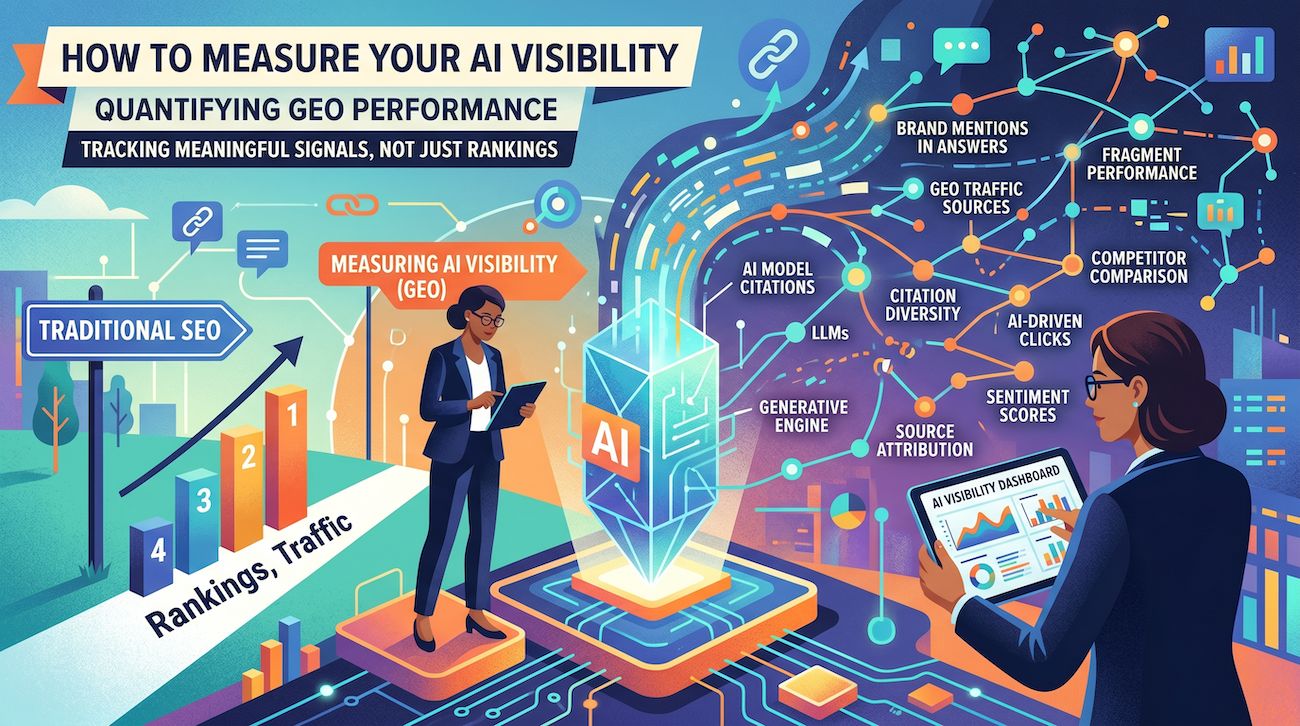
You can’t improve what you can’t see. Measuring GEO performance is genuinely harder than measuring traditional SEO — there’s no universal ranking report for AI citations — but there are meaningful signals you can track to understand whether your strategy is working and where the gaps are.
How AI Visibility Metrics Appear
AI visibility metrics aren’t similar to a keyword ranking report. There isn’t a single dashboard that informs you “your brand ranked #2 in ChatGPT responses today.” Instead, what you’re monitoring is a pattern — the regularity with which your brand is mentioned as a cited source across AI-generated answers pertinent to your industry, and the circumstances in which those citations take place. For more insights on improving your brand’s visibility, consider exploring why your business might not be showing up in ChatGPT.
The most important factor is how often your brand is mentioned when AI tools answer questions that you should be the top result for. Other factors include the quality and relevance of the context in which your brand is mentioned — whether your brand is mentioned as a main source or just in passing, and whether the mention comes up in response to high-intent questions or less relevant ones. Both factors are important, but how often your brand is mentioned in high-intent questions is the factor that you should focus on first.
Brand mention breadth is a related metric that acts as a predictive indicator of future citation performance. AI systems use patterns of references across the web to confirm authority, so by tracking how widely your brand is mentioned across independent sources, you get a predictive view of your GEO trajectory, rather than just a snapshot of where you are now.
- Citation frequency: How often your brand appears in AI-generated answers for relevant queries
- Mention breadth: How many independent domains reference your brand in relevant contexts
- Citation context quality: Whether your brand is cited as a primary authority or a secondary reference
- Query intent alignment: Whether citations appear in response to high-intent, conversion-relevant questions
- Topical coverage: How many of your core subject areas generate brand citations in AI answers
Tracking these metrics manually is time-consuming but possible. Set up regular query testing across major AI platforms using the questions your target audience is most likely to ask. Document which sources get cited, how often your brand appears, and what type of content is being referenced. Over time, this builds a clear picture of where your GEO strategy is gaining traction and where gaps remain.
How to Keep Track of Citation Frequency
Start with manual query testing, which is the easiest method — regularly run your target queries across AI search tools and log the results in a structured format. In addition to manual testing, check your AI citation presence using Catalyst Pro’s diagnostic tool, which is specifically designed to show where your brand stands in AI-generated results and identify the gaps in your citation profile that are costing you visibility. For more insights on optimizing your AI visibility, you can refer to Google’s AI optimization guide. Combining systematic manual testing with a dedicated diagnostic tool gives you both the granular detail and the high-level view you need to make informed GEO decisions.
Understanding Visibility Scoring with GEO-Bench
Developed as an academic evaluation framework, GEO-Bench measures the visibility of content in responses generated by engines. It uses a diverse benchmark of user queries from various domains, paired with relevant web sources, to assess how different strategies for content optimization affect citation rates in AI-generated answers. This framework evaluates visibility by determining whether a given source appears in the AI’s response, and how prominently it contributes to the generated output. While GEO-Bench is a research tool and not a commercial product, its methodology reinforces a key principle: visibility in AI search can be measured, and the strategies that improve it — authoritative content, broad reference networks, semantic clarity — are consistent and repeatable.
What to do next with Catalyst Pro
GEO is not a one-and-done solution. It’s a strategy that builds over time and rewards brands that establish real authority, share their expertise widely, and keep the technical basics that keep their content accessible to AI systems. This article provides a checklist. The Distribution Stacking Method provides the distribution engine to make it work on a large scale. What you need now is an accurate view of where your brand is in AI-generated results, so you know exactly where to focus first.
Check your AI citation presence with Catalyst Pro today and get the diagnostic clarity you need to turn your GEO strategy from theory into measurable results. For more insights on achieving omnipresence, explore The CMO’s Guide to Omnipresence.
Common Questions and Answers
These are responses to the questions most frequently asked by brands when they begin to seriously consider GEO.
What does generative engine optimization (GEO) mean?
Generative engine optimization (GEO) refers to the technique of enhancing your brand’s content, authority signals, and online presence to ensure that AI-based search engines, like Google’s AI Overviews and ChatGPT search, refer to your brand while providing answers to related user questions.
Generative Engine Optimization (GEO) differs from traditional SEO in that it doesn’t just aim to rank your pages in a list of links. Instead, it aims to get your brand selected as a trusted source within an AI’s conversational response. The key factors here are the breadth of your authority, the credibility of your content, the depth of your topic, and crawlability. It’s not just about keyword density or the volume of links.
Is GEO the same as AEO or traditional SEO?
While GEO and AEO (Answer Engine Optimization) are closely related terms with similar objectives — increasing visibility in AI-generated and direct-answer search formats, Google has made it clear that optimizing for generative AI search is still fundamentally SEO, because its AI features are built on the same core ranking and quality systems that power traditional Google Search. In practice, GEO takes SEO a step further by putting additional focus on reference diversity, brand mention breadth, and expert-led content authority — signals that are particularly important for AI citation selection.
What impact can GEO have on my brand’s visibility in AI search?
Studies conducted with the GEO-Bench evaluation tool have demonstrated that using strategic optimization can significantly increase a brand’s visibility in generative engine responses. The extent of the improvement depends on your starting point, how competitive your topic area is, and which optimization strategies you choose to focus on. There are no certain results, but brands that consistently demonstrate genuine authority, maintain a clean technical base, and earn widespread third-party references are consistently better positioned for AI citation than those that don’t.
Is it necessary to have a unique schema markup or an llms.txt file to get a higher ranking in AI search?
Not at all. Google has made it very clear that creating llms.txt files or using unique schema markup to specifically manipulate AI search behavior is not advisable and is not supported by the way their generative AI functions work. Despite these tactics being widely shared online, there is no proven effectiveness in enhancing AI citation rates. For a deeper understanding of AI-driven marketing strategies, check out how Catalyst Pro leads the AI-first marketing revolution.
What does work is foundational: technically clean, publicly crawlable content; authoritative, expert-led writing; and a broad, genuine reference network built through real editorial relationships and distribution. If a tactic doesn’t make your content more useful or credible to a real reader, it’s unlikely to move the needle in AI search either.
What kind of content is most likely to be cited by AI search engines?
The content that is most likely to be cited by AI search engines usually has several common features: it provides more than just a superficial summary, it shows real expertise in the subject matter, it is clearly structured with semantic HTML that AI crawlers can parse effectively, and it is supported by references from independent, trustworthy sources on the internet.
It’s essential to cover a topic thoroughly. A brand that delves into a subject in depth — using a variety of formats, perspectives, and levels of detail — shows that it has consistent authority on that topic. This makes it a better candidate for citation than a brand that has only one well-optimized page. For brands looking to enhance their digital presence, understanding digital PR measurement frameworks is crucial.
Having a variety of formats is important too. If your content comes in many forms — like long articles, short Q&A responses, expert interviews, summaries of data, videos with transcripts — it can show up in more kinds of searches and in more contexts. AI systems find content that matches the format and the purpose of the user’s question, so having lots of different kinds of content gives you more chances to be cited. For more insights, check out this AI optimization guide.
With Catalyst Pro, brands can pinpoint the content gaps and authority signals that are holding back their AI citation presence. This makes it easier to prioritize the tasks that will most improve your GEO performance.
Generative Engine Optimization (GEO) is a new frontier in digital marketing, focusing on how brands can leverage AI-driven search results to enhance their online presence. This innovative approach involves understanding the algorithms that power AI search engines and tailoring content to meet their criteria. By doing so, businesses can increase their visibility and ensure their brand is cited by AI search. For those looking to delve deeper into strategic implementation, check out The CMO’s Guide to Omnipresence.

