



Key Points to Remember
- Classic PR measurements like clip counts and AVE (Advertising Value Equivalents) are not effective in showing actual business results in the current digital environment
- A thorough Digital PR measurement framework should have four main pillars: visibility, engagement, conversion, and sentiment metrics
- It’s important to start with business objectives rather than media goals when creating PR KPIs that are relevant to executives
- The measurement approach of Catalyst Pro assists in converting complicated PR data into actionable insights that are directly linked to revenue growth
- Implementing a 30-day measurement plan can rapidly shift your PR reporting from activity-based to outcome-focused
Measuring the impact of digital PR has developed far beyond counting media clips and calculating advertising equivalencies. In the current data-driven marketing environment, PR professionals require a structured framework that directly links communications efforts to business results. The challenge isn’t collecting metrics – it’s determining which ones are actually important.
For a digital PR measurement framework to be genuinely effective, it must bridge the gap between communications activities and business outcomes. Without this link, PR teams find it hard to justify budgets and show their worth to senior management. This detailed guide will show you how to create a measurement system that demonstrates PR’s contribution to your company’s bottom line.
Why Old School PR Metrics Don’t Work for Modern Digital Marketing
For ages, the PR industry has depended on metrics that sound great but don’t really show business impact. Metrics that focus on volume like clip counts, potential reach, and AVE (Advertising Value Equivalents) miss the mark in three important ways: they don’t consider the quality of the audience, they don’t care if your message actually made an impact, and they don’t connect to revenue or business growth.
The way audiences interact with brands has been completely transformed by digital channels. PR professionals in today’s world must measure across a connected ecosystem that includes earned media, social amplification, website behavior, and conversion actions. Traditional metrics simply weren’t designed for this level of complexity.
“PR teams focusing solely on media placement metrics are missing the bigger picture. Without connecting communications to business outcomes, you’re essentially flying blind.” – Digital PR Strategy Report, Catalyst Pro
The 4 PR Measurement Pillars That Drive Business Results
A comprehensive digital PR measurement framework must incorporate four distinct but interconnected pillars. Each builds upon the next to create a complete view of your PR program’s effectiveness.
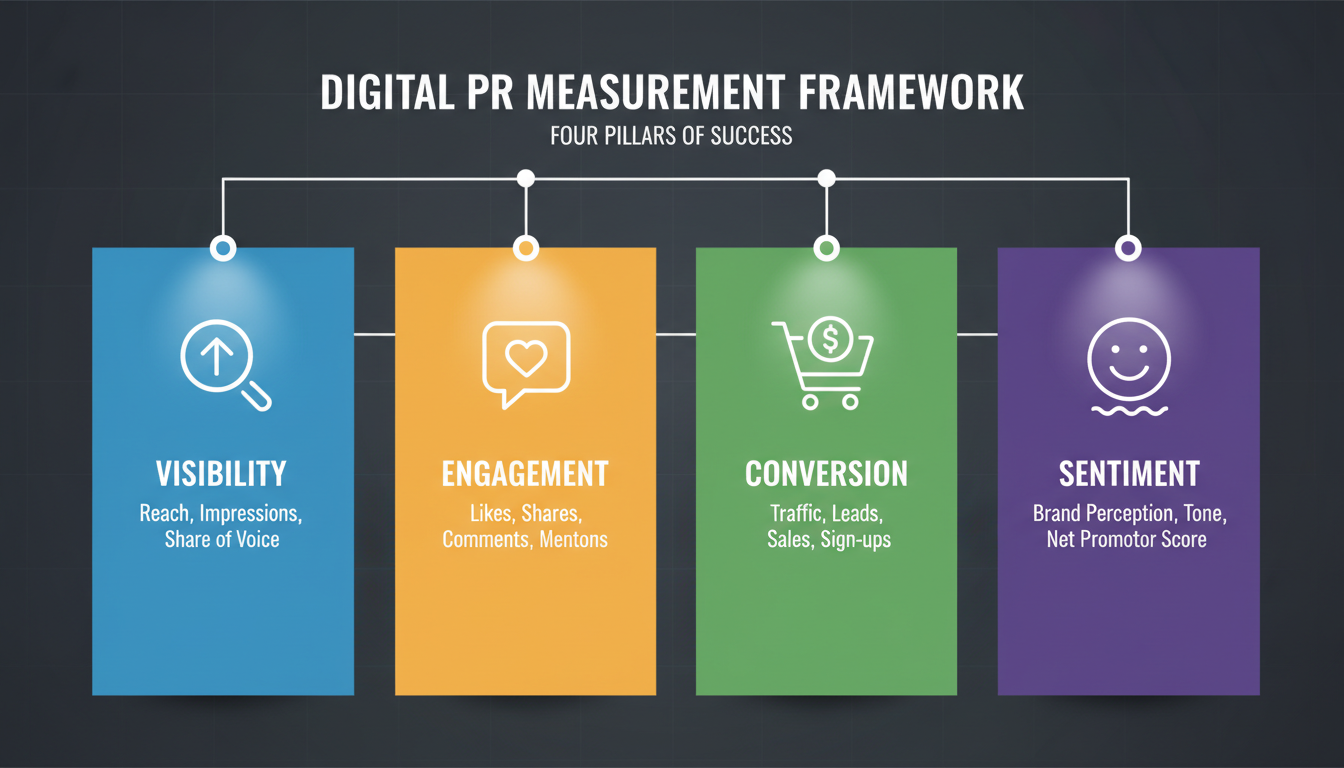
Visibility Metrics: More than Just Impressions
Visibility metrics are used to gauge your brand’s exposure across various digital platforms. While conventional metrics such as impressions and reach are still important, a modern approach to measuring visibility requires a more comprehensive analysis. This involves examining where your coverage is featured, the trustworthiness of those features, and whether they are reaching your target audience segments. For more insights on achieving enterprise marketing results on a startup budget, explore innovative strategies that can enhance your visibility metrics.
Advanced visibility metrics include share of voice compared to competitors, message penetration in industry publications, and executive visibility scores. These measurements help quantify PR’s contribution to brand awareness objectives while providing context that basic impression counts lack.
Engagement Metrics: It’s Not Just About the Numbers
Engagement metrics give us a glimpse into how audiences are interacting with your PR content. This pillar takes us from just being seen to being interacted with. Key measurements include how many times your earned media was shared or commented on, how long people spend with your PR-driven content, and how much engagement there is when your PR content is amplified across your own channels. For more insights, consider exploring Sparktoro insights that can enhance your understanding of audience interaction.
Engagement quality is more important than engagement quantity. A handful of meaningful interactions from industry influencers or potential customers can have a bigger impact on your business than thousands of generic likes. Advanced PR measurement frameworks give more weight to engagement based on the quality and relevance of the audience.
Conversion Metrics: Following the Path to ROI
Conversion metrics link PR efforts to particular audience behaviors that lead to business outcomes. This involves tracking referral traffic from earned media, generating leads through PR content, and directly attributing sales influenced by PR activities. These metrics offer the most straightforward connection between PR initiatives and business results.
Although attribution continues to be a difficult task, the use of modern analytics tools is making it increasingly feasible to monitor the customer journey from the PR touchpoint to conversion. UTM parameters, custom landing pages, and integrated CRM tracking all help to quantify the direct contribution of PR to pipeline and revenue.
Assessing Brand Perception: Sentiment Metrics
The impact of your PR efforts on how your brand is perceived can be gauged qualitatively using sentiment metrics. This involves analyzing the sentiment of media coverage, tracking conversations on social media, and conducting brand perception studies. These measurements enable us to determine the role PR plays in managing reputation and positioning. For insights on leveraging technology in marketing, explore how Catalyst Pro uses machine learning to enhance brand presence.
Advanced sentiment analysis has moved beyond just categorizing messages as positive or negative. It now includes things like message penetration, spokesperson credibility, and competitive positioning. These more nuanced measurements provide important context about how audiences perceive your brand’s story.
3. Quality of Referral Traffic from Earned Media
The quality of referral traffic is a unique metric that directly connects PR coverage to website behavior. This metric looks at more than just visitor counts; it also examines the depth of engagement, session duration, pages per visit, and conversion rates from each media source. High-quality media placements usually result in more engaged visitors who browse multiple pages and take significant actions. By tagging inbound links with UTM parameters and setting up the correct attribution models in Google Analytics, PR teams can determine which publications provide the most valuable traffic, not just the most traffic.
4. Backlink Profile Growth and Domain Authority
SEO value is one of the most important contributions of PR to digital marketing, although it is often underreported. Quality backlinks from authoritative media outlets can directly enhance your domain authority, improving organic search visibility across all keywords. Modern PR measurement should track not just the quantity of links, but also the quality of links, including the domain authority of linking sites, the relevance of anchor text, and the status of follow/nofollow. Tools like Ahrefs or Semrush can help to quantify the SEO impact of each earned media placement, allowing PR teams to demonstrate long-term value that extends far beyond the initial coverage cycle.
5. Social Sharing of PR Content
Assessing how PR content is shared on social media platforms can give us important information about how well our message is received and how engaged our audience is. This measurement should not only count shares but also consider audience growth, engagement rates, and the quality of the discussion that the PR content inspires. The most important aspect of this metric is determining which stories and messages inspire the most significant engagement.
By leveraging the network effect of social amplification, you can significantly increase the reach and impact of your earned media. If you track these metrics correctly, you can see which types of PR coverage generate the most valuable social response from both industry influencers and potential customers.
6. Assigning Leads to PR Activities
Linking PR activities directly to lead generation is the ultimate goal of digital PR measurement. This requires close coordination between PR tracking, marketing automation, and CRM systems to track prospects from the first media touchpoint through the sales pipeline. Advanced attribution models can now determine how earned media influences purchasing decisions, even when it’s not the last touchpoint before conversion. The most advanced PR teams create custom attribution models that accurately credit PR’s role in the customer journey, rather than relying on simplistic last-touch attribution that usually undervalues the contribution of earned media.
7. Metrics for Executive Brand Visibility
Thought leadership for key executives is a significant brand and sales advantage that should be measured systematically. This metric measures the inclusion of spokesperson quotes, placement of bylined articles, opportunities for speaking engagements, and growth of social media authority for company leaders. Executive visibility is directly related to brand trust, especially in B2B environments where personal relationships influence major purchasing decisions. By measuring executive visibility alongside company brand metrics, PR teams can show their contribution to building the human side of the brand – an asset that is not easily replicated by competitors.
Effective Digital PR Measurement: The Tools You Need
Building a strong measurement framework means investing in the correct technology stack. Today’s PR teams need tools that bring together media monitoring, social listening, website analytics, and attribution modeling into a single, cohesive system. The difficulty isn’t just in gathering data, but in connecting different information sources to uncover significant patterns that can guide strategy.
|
Type of Tool |
Main Features |
Compatibility with Other Systems |
|---|---|---|
|
Media Monitoring Tools |
Track media coverage, analyze sentiment, and measure share of voice |
Can be integrated with social media platforms, analytics systems, and CRM |
|
Web Analytics Tools |
Track referrals, measure content engagement, and map conversion paths |
Can be integrated with CRM, marketing automation, and media monitoring tools |
|
SEO Platforms |
Analyze backlinks, measure domain authority, and track keyword visibility |
Can be integrated with content management systems and web analytics tools |
|
Attribution Systems |
Map multi-touch attribution and customer journeys |
Can be integrated with CRM, marketing automation, web analytics, and media monitoring tools |
When choosing tools, focus on your specific measurement goals rather than following industry trends. Many teams spend too much on comprehensive platforms with features they never use and miss out on specialized tools that would better meet their unique needs. The most effective measurement stacks combine the best tools in each category with custom integration points that answer your specific business questions.
Many people forget to consider the ability to export data. The tools you use to measure your results should let you take out and mix data in custom ways as your analysis needs change. Platforms with strong APIs and direct access to databases give you the flexibility you need for complex measurement frameworks.

Media Monitoring Platforms That Are Worth Your Money
Reliable media monitoring that captures not just mentions but the context and quality of coverage is the cornerstone of any PR measurement system. Today’s platforms have come a long way from simple keyword tracking to include AI-powered sentiment analysis, message penetration scoring, and automatic categorization of coverage themes. When choosing media monitoring tools, prioritize accuracy over volume – a system that delivers fewer but more relevant results will save you many hours of manual filtering. Look for platforms that offer customizable Boolean search capabilities, retroactive search adjustments, and the ability to create distinct report segments for different business units or product lines.
Essentials of Analytics Integration
The real power of measuring digital PR comes when you can link media data with the behavior and conversion metrics of a website. To do this, you need to carefully plan and technically implement across various platforms. At the very least, your framework should connect media monitoring, Google Analytics, and your CRM system so you can track the entire customer journey. To integrate these, you usually need to create consistent naming conventions, implement custom UTM parameters for all content that can be tracked, and set up automated data pipelines between systems. The most advanced measurement frameworks also include marketing automation data, social analytics, and sales pipeline metrics to give a full view of the business impact of PR.
Tips for Creating a Custom Dashboard
Raw data only becomes useful when it is presented in a way that highlights significant patterns. PR dashboards that are effective combine metrics from a variety of sources into a single view that tells a coherent story about the impact of your program. When creating dashboards, begin with the business questions that need to be answered rather than the data that is available. Organize metrics in a hierarchical manner to show the relationship between different levels of measurement, from basic visibility metrics to deeper engagement and conversion indicators. The most effective dashboards also include benchmarking against past performance, comparisons with competitors, and progress toward specific KPI targets to provide the necessary context for interpretation.
Reporting to executives is highly dependent on the presentation layer. PR teams may require detailed operational dashboards with granular metrics, but leadership dashboards should concentrate on high-level results and business impact. Many teams establish tiered dashboard systems with varying levels of detail for different audiences. For more insights, explore how to measure public relations KPIs that actually matter.
“Great PR measurement isn’t about collecting the most data – it’s about producing the best insights. The best frameworks turn complex metrics into clear strategic guidance.” – Digital PR Measurement Guide, Catalyst AI
Dashboard design should focus on storytelling rather than data dumping. Good visualizations highlight the “so what” behind the numbers, drawing attention to significant trends and actionable insights instead of just reporting metrics. This storytelling approach helps connect PR activities to business outcomes in a way that makes sense to executives, demonstrating why digital PR is worth it for businesses.
Typical Digital PR Measurement Blunders to Steer Clear of
Even the best planned measurement frameworks can fail when teams make common implementation errors. These mistakes often come from traditional PR measurement practices that don’t work well in the digital world. Spotting these patterns early on can help you improve your approach before incorrect data results in a misguided strategy.
Not only do the worst measurement errors waste resources, but they also actively misguide decision-making by creating false impressions of program performance. This can lead to doubling down on tactics that seem successful, while neglecting strategies that truly impact the business. For businesses questioning the effectiveness of their strategies, it might be worth exploring whether digital PR is worth it for their operations.
Don’t Be Fooled By Impressive But Meaningless Metrics
One common mistake when it comes to measuring is to focus on metrics that may look good on paper but don’t really tell you anything about your business. Metrics like potential reach, advertising equivalency, and raw clip counts may seem impressive, but they don’t actually provide any useful strategic insights. These are often referred to as vanity metrics, and they typically have a few things in common: they prioritize quantity over quality, they can be easily manipulated, and they don’t correlate well with actual business results. This doesn’t mean you should ignore these metrics completely, but rather that you should understand them in context and connect them to more meaningful indicators. For a deeper understanding of how to effectively measure business impact, consider exploring the value of digital PR for your business.
Another tricky form of vanity measurement is when you’re tracking the correct metrics but not at the right scale. This could be measuring sentiment across all coverage instead of just within your target audience segments, or tracking social shares without distinguishing between high and low-value amplifiers. In order to measure effectively, you need both the correct metrics and the correct focus.
The AVE Trap: Why Advertising Value Equivalents Mislead
Despite being widely discredited by PR industry associations, Advertising Value Equivalency (AVE) remains surprisingly common in measurement frameworks. This approach fundamentally misunderstands both PR and advertising by assuming editorial content delivers identical value to paid placements based solely on space/time calculations. Beyond this conceptual flaw, AVE creates practical problems by encouraging teams to chase high-value placements regardless of audience relevance, message penetration, or actual business impact. Modern measurement frameworks should replace AVE with metrics that capture PR’s unique value – credibility generation, third-party validation, and organic audience engagement that paid media simply cannot replicate. For a deeper dive into effective PR strategies, explore Rand Fishkin’s audience-first approach.
Underestimating the Influence of PR due to Attribution Issues
PR’s impact on the customer journey is often underestimated by the default attribution models in most analytics platforms. Last-click attribution credits the final touchpoint with the entire conversion, disregarding PR’s crucial role in the early awareness and consideration phases. Similarly, measuring PR, social, and digital marketing as completely separate channels fails to capture how these elements work together in integrated campaigns. To address this, more sophisticated attribution models need to be implemented that properly credit PR’s influence throughout the funnel, particularly for complex B2B sales cycles where earned media often initiates the customer relationship long before formal lead capture occurs.
Unreliable Measurement Practices
The most harmful measurement error is the inconsistent use of metrics over time. When measurement methods change with each campaign or reporting cycle, it is impossible to analyze trends and strategic learning is severely limited. Consistent measurement applied over long periods is required for sustainable improvement, with new metrics added alongside established ones rather than completely replacing them. This consistency allows for meaningful benchmarking, trend identification, and the ability to link PR tactics to outcome patterns. While measurement frameworks should evolve as capabilities mature, it is critical to maintain core consistency in primary KPIs in order to demonstrate program progress and refine strategy based on accumulated insights.
How Leading Brands Link PR Metrics to Revenue Growth
Top-tier companies have created complex frameworks that connect PR activities to revenue growth and business expansion. These strategies often involve a close connection between PR metrics and sales data, custom attribution models that correctly assess the value of earned media touchpoints, and executive dashboards that convert communications metrics into business terms. The most advanced users have progressed beyond mere correlation to determine causal relationships between specific PR strategies and revenue results through controlled testing and statistical analysis. By examining these innovative strategies, communications teams can modify proven methodologies to meet their own measurement needs.
Attribution Model: A Triumph in the Tech Sector
“We couldn’t defend our PR budget until we adopted multi-touch attribution. This tracked user journeys from initial media coverage to final conversion. We discovered that 28% of our enterprise deals were influenced by earned media touchpoints in the early research phase. This was completely invisible in our previous last-click model.” – SaaS Marketing Director
A top enterprise software company revolutionized its PR measurement by implementing a custom attribution model. This assigned an appropriate value to earned media touchpoints throughout the customer journey. Their framework tracked specific URLs from earned media placements to conversion events, even when those conversions happened months later. This approach revealed that while PR rarely served as the final conversion touchpoint, it initiated more than 30% of enterprise-level sales relationships.
The main breakthrough was incorporating PR measurements straight into their CRM system, which enabled sales teams to identify which potential clients had interacted with particular media coverage. This incorporation brought PR and sales teams into alignment, with media placements now seen as important lead generation resources rather than just brand awareness efforts. The measurement framework allocated a weighted value to various forms of media engagement depending on content type, publication authority, and user engagement depth.
The results were game-changing: After showing that deals influenced by media closed 35% faster and had 27% higher average contract values than deals without PR touchpoints, the PR budget increased by 42%. This direct link to revenue metrics completely shifted executive perception of the communications function.
B2B Framework: Lead Generation Method
A mid-size B2B tech company changed their strategy by using earned media as a direct lead generation channel instead of just for brand-building. They created a framework that included dedicated landing pages for each major media placement, with unique tracking codes that followed visitors through the conversion funnel. This method allowed them to attribute specific leads, opportunities, and closed business to individual PR placements. The system showed that thought leadership content published in industry publications generated the highest-quality leads with 3.2x higher conversion rates than their paid digital channels, which completely changed their marketing investment strategy.
Example of a Consumer Brand: Social Proof Pipeline
A consumer goods brand has created a measurement framework called the “Social Proof Pipeline” that monitors how earned media coverage becomes user-generated content and social validation. Their system keeps an eye on how media placements initiate social discussions, which then sway purchasing decisions via peer suggestions. By embedding unique tracking codes in each media placement, they can trace the entire journey from initial coverage to social amplification to website traffic and final conversion. For brands looking to achieve enterprise marketing results on a startup budget, this approach offers a cost-effective solution.
The framework showed that some kinds of storytelling in earned media led to 5 times more social sharing than others. In addition, these socially amplified stories resulted in 2.8 times higher conversion rates when consumers came across them before visiting the brand’s website. This insight enabled them to concentrate their PR efforts on story angles with the highest “social multiplication factor”. This effectively transformed every dollar spent on earned media into multiple dollars of social reach.
30-Day Plan for Implementing PR Measurement
You don’t need months of planning or a wealth of technical resources to put a thorough PR measurement framework into place. With this 30-day plan, you can quickly and systematically change your measurement practices and lay the groundwork for continuous improvement. The plan is designed to quickly implement key metrics and set the stage for more sophisticated measurement as your skills grow.
Week 1: Review and Goal Setting
Start by conducting a detailed review of your existing measurement methods, identifying any discrepancies between what you’re monitoring and what’s actually important to your business. Take a look at the PR reports from the past three months and objectively evaluate whether they show a clear impact on the business or just list activities. Then, hold discussions with key business leaders to gain insight into their definition of PR success and the metrics that would enable them to better appreciate communications.
Next, you’ll want to determine 3-5 key business goals that your PR program will support. These could include increasing the number of qualified leads, building credibility in the market, or boosting customer loyalty. For each goal, you’ll need to pinpoint specific KPIs that will show how PR is contributing. This process of setting goals ensures that your PR metrics and business results are aligned before you start the technical implementation.
Week 2: Setting Up and Integrating Tools
|
Type of Tool |
Priority for Configuration |
Points of Integration |
|---|---|---|
|
Monitoring Media |
Custom search strings, tracking messages, tiering outlets |
Analytics for the web, CRM |
|
Analytics for the Web |
Tracking referrals, goals for conversion, custom segments |
Monitoring media, CRM |
|
Analytics for Social Media |
Tracking shares, metrics for engagement, identifying influencers |
Monitoring media, analytics for the web |
|
CRM/Automation for Marketing |
Source codes for PR, models for attribution, tracking pipeline |
Monitoring media, analytics for the web |
Now that objectives have been defined, it’s time to configure your tools for measuring in order to capture the data that’s relevant. Start by setting up tracking parameters that are correct in Google Analytics so that traffic from earned media sources can be identified. Create UTM parameters that are custom for links in press releases and materials for the media that can be tracked, and establish landing pages that are dedicated to major campaigns in order to simplify attribution.
Following this, you should set up your media monitoring platform to not only track brand mentions, but also track message penetration, spokesperson quotes, and competitor coverage. You should also create separate searches for different business units, products, or campaigns to allow for more specific analysis. The important thing is to move beyond basic monitoring to meaningful categorization that connects coverage to specific business objectives.
Work with your sales operations team to create fields in your CRM system that capture the influence of PR in the customer journey. This could involve adding “PR” as a lead source option, creating custom fields to track opportunities influenced by the media, or setting up tags for prospects who engage with earned media content.
Lastly, you’ll want to develop basic data integration methods to link these systems. This could begin with manual exports and imports while you advocate for more advanced integration. The second week’s goal isn’t to be flawless, but to create the basic connections between PR activities and business results.
Week 3: Begin Gathering Data and Setting Benchmarks
Once you have your tracking systems set up, it’s time to start collecting some initial data to set your performance benchmarks. Try to gather at least three months of historical data if you can (more if possible) so that you can identify any patterns or seasonal changes in your metrics. Having this historical data is crucial for being able to interpret your future results in a meaningful way.
- Media measurements: Volume of coverage, penetration of message, voice share, sentiment tendencies
- Digital measurements: Traffic referrals, engagement percentages, conversion tracks, social amplification
- Business measurements: Attribution of leads, sales influence, customer engagement, brand perception
Use these metrics to create realistic performance benchmarks for each crucial measurement. What is your usual voice share compared to competitors? What percentage of coverage successfully communicates key messages? What is the average conversion rate from media traffic referrals? These benchmarks give necessary context for future measurements and setting goals.
Take some time this week to record your measurement methods, such as search parameters, calculation formulas, and reporting procedures. This recordkeeping will ensure consistency over time and make your process clear to stakeholders. Make sure to include definitions for each metric, data sources, calculation methods, and how often you will report.
Week 4: Initial Reporting and Refinement
Generate your first all-inclusive assessment report using the novel framework. Concentrate on narrating a cohesive story that links PR activities to business outcomes rather than merely reporting metrics. Begin with high-level business impacts before delving into specific PR metrics, and explicitly connect the dots between communications efforts and business results. For insights on how to achieve this, explore AI-first marketing strategies that can enhance your reporting framework.
Present this preliminary report to key stakeholders, asking for feedback on the format, metrics, and insights. Use this chance to teach internal clients how to understand the new metrics and why they are more important than traditional vanity measurements. This stakeholder engagement is critical for building organizational support for your new measurement approach.
In conclusion, you need to establish a plan for the continuous improvement of your measurement framework. Find the areas in your current strategy that are lacking and prioritize improvements based on how it will affect your business. This could mean using more complex attribution models, incorporating more data sources, or creating custom metrics for certain business goals. The focus should be on constant progress rather than trying to get everything perfect on the first try.
Turning PR Data into Insights for Executives
The last hurdle in PR measurement isn’t gathering data or computing metrics – it’s turning that data into strategic insights that shape business decisions. Executives don’t need more data; they need clear direction on what the data means for business strategy. Good PR measurement frameworks include interpretation layers that turn raw metrics into recommendations that can be acted upon.
The most effective PR teams build reporting systems with varying degrees of detail for different audiences. Executive dashboards concentrate on the broad business impacts and strategic implications, while operational reports provide the tactical details necessary for program management. This method ensures that each stakeholder receives insights that are relevant to their decision-making needs, enhancing the perceived value of PR measurement throughout the organization. When PR data directly correlates with business results, communications transition from a tactical function to a strategic driver of organizational success. For a deeper understanding of PR measurement, explore PR KPIs that actually matter.
Commonly Asked Questions
While implementing your digital PR measurement framework, you may come across common questions from team members and stakeholders. These answers tackle the most common issues and offer advice for dealing with typical obstacles.
How often should we revise our PR measurement framework?
You should review your measurement framework every quarter to ensure it aligns with changing business goals, with more thorough evaluations carried out yearly. While the main KPIs should stay the same to allow for trend analysis, the specific metrics and reporting formats may change as your measurement capabilities develop. The best method combines consistency for benchmarking with ongoing improvement based on stakeholder feedback and shifting business priorities. Avoid the urge to completely revamp your framework with each reporting cycle, as this compromises your ability to spot significant performance trends over time.
How can you measure the influence of PR on a brand’s reputation?
When it comes to measuring the impact on reputation, it’s necessary to combine data from several sources rather than depending on a single metric. Effective measurement of reputation typically includes sentiment analysis of media coverage, monitoring of conversations on social media, regular surveys of brand perception, and benchmarking of competitors. The most advanced methods correlate these reputation indicators with business metrics such as customer retention, price sensitivity, and recruitment efficiency to show the tangible value of reputation assets. What’s most important is to establish consistent measurement over time, not just periodic snapshots, so you can track trends in reputation and correlate them with specific PR initiatives.
How does digital PR measurement assist in crisis management?
- Real-time monitoring and sentiment tracking provide early warning capabilities
- Effectiveness of crisis response can be evaluated through message penetration analysis
- Audience segmentation identifies the stakeholders most affected
- Benchmark recovery timeline through comparative analysis against similar crises
Effective measurement offers both preventive and responsive benefits in the face of reputation challenges. Robust monitoring, on the preventive side, can spot emerging issues before they escalate into full crises. It does this by identifying unusual conversation patterns or sentiment shifts. This early warning function enables communications teams to address potential problems proactively rather than reactively, similar to how Catalyst Pro uses machine learning to ensure omnipresence in digital marketing strategies.
Measurement frameworks are especially useful in times of crisis, providing essential support for decision-making by monitoring message reach, identifying key stakeholders, and assessing the effectiveness of responses in real-time. The most beneficial feature is the capacity to break down the analysis by audience, enabling teams to prioritize their response efforts based on which stakeholders are most impacted or influential.
After a crisis, measurement systems allow for an unbiased evaluation of reputation recovery by monitoring key indicators back to pre-crisis levels. This recovery tracking assists in setting attainable goals with leadership regarding the timeline for reputation restoration and shows the worth of crisis response investments.
How can I persuade my higher-ups to put money into better PR measurement tools?
The best way to do this is by showing the business cost of not having the right measurements in place, rather than focusing on the features of the tool. Calculate how much your company is investing in PR activities that are not being properly measured, and then present the tool investments as a way to protect that existing spend. Make a business case that highlights specific decisions that could be made better with the right data, the potential efficiency gains from automated reporting, and the competitive disadvantages of maintaining outdated measurement approaches. If possible, implement a pilot program using free or low-cost tools to generate initial insights that demonstrate the potential value of more comprehensive solutions. Executives respond to demonstrated results over theoretical benefits.
What is the least PR measurement setup for small businesses?
Despite having limited resources, small businesses can put in place an effective measurement by focusing on a few high-impact metrics rather than trying to track everything. At least, set up Google Analytics to track referral traffic from earned media sources, put in place basic social listening for brand mentions, and create simple ways to ask new customers how they heard about your business. These basic measures can be put in place with free or low-cost tools while providing meaningful insights about the business impact of PR.
As your program evolves, you can slowly incorporate more complex metrics like message penetration, competitive share of voice, and basic sentiment tracking. The important thing is to start with metrics that are directly related to business outcomes rather than PR activities, even if your initial approach isn’t as comprehensive as enterprise measurement frameworks.
For companies looking for a more organized method without a substantial investment, Catalyst Pro provides measurement frameworks that are specifically designed for teams with limited resources but a high responsibility for outcomes. Discover how enterprise marketing results on a startup budget can be achieved with this innovative tool.
Perhaps you’re wondering, “How can I build a PR measurement system that actually proves business impact?”
You don’t have to figure it out alone. If you’re ready to implement a framework that ties visibility, engagement, backlinks, and conversions directly to revenue—and finally show executives the value PR delivers—start your journey with a platform built for results. Visit www.trycatalyst.ai to transform your digital PR measurement into a true growth engine.

