

Article-at-a-Glance
- User-generated content increases trust, with 93% of consumers finding UGC more authentic than brand-created content, driving higher conversion rates
- UGC campaigns reduce marketing costs by up to 86% compared to professional content production, while often generating superior engagement metrics
- The six most effective UGC formats include customer reviews, social media mentions, user-submitted visuals, Q&As, guest content, and contest submissions
- Properly implemented UGC strategies require creating shareable moments in your customer journey and developing branded hashtags that resonate with your audience
- JoinBrands offers a streamlined platform for connecting with content creators and managing your UGC campaigns efficiently at scale
Traditional marketing isn’t cutting it anymore. Your audience has become immune to polished, picture-perfect advertising that screams “we’re trying to sell you something.” In today’s digital landscape, consumers crave authenticity and genuine connections with brands. That’s where user-generated content (UGC) enters as your secret marketing weapon—the authentic voice that cuts through the noise.
UGC encompasses any content—reviews, photos, videos, social posts—created by real people about your brand or products. Unlike traditional marketing, which tells consumers what to think, UGC shows them what others are actually experiencing. This distinction makes all the difference in a world where trust in institutions continues to decline while peer influence reaches all-time highs.
The Truth About Traditional Marketing That No One Tells You
The glossy magazine ads and perfectly scripted commercials that dominated marketing for decades are losing their effectiveness at an alarming rate. Ad blockers are now used by over 40% of internet users globally, and traditional advertising ROI continues to plummet across industries. The uncomfortable truth? Consumers don’t want to be marketed to—they want to be engaged with.
Traditional marketing also suffers from a significant credibility gap. When your brand says your product is amazing, consumers naturally take that claim with a grain of salt. There’s an inherent skepticism toward any company tooting its own horn. This skepticism has only deepened in our era of information overload and widespread misinformation.
Perhaps most damaging is that traditional marketing creates a one-way conversation. Your brand speaks, and consumers listen—or more likely, they don’t. This model fails to leverage the most powerful marketing force available: your existing customer base. Every satisfied customer represents a potential marketing channel that traditional approaches leave untapped, especially when it comes to enhancing e-commerce experiences.
Why UGC Outperforms Professional Content Every Time
The statistics around UGC performance are nothing short of staggering. Content created by actual users consistently outperforms professionally produced content across virtually every meaningful metric. From engagement rates to conversion percentages, UGC delivers results that traditional marketing simply can’t match in today’s consumer environment.
What makes UGC so effective is that it perfectly aligns with how modern consumers make purchasing decisions. Before buying, people naturally seek validation from others who’ve already taken the plunge. UGC provides that validation in the most authentic way possible—through the unfiltered experiences of real customers who have nothing to gain by sharing their honest opinions.

93% of Consumers Trust UGC Over Brand Content
Trust is the new currency in marketing, and UGC is the trust jackpot. An overwhelming 93% of consumers find content created by actual customers more credible than content created by brands. This statistic alone explains why UGC-based campaigns frequently outperform traditional marketing initiatives by orders of magnitude. When JoinBrands helps companies implement UGC strategies, they typically see trust metrics improve almost immediately, creating a foundation for sustainable growth that paid advertising simply cannot replicate.
Cost-Efficiency: UGC Costs 86% Less Than Brand-Created Content
Beyond its effectiveness, UGC delivers another compelling advantage: dramatic cost reduction. Professional content creation—with its photographers, videographers, models, sets, and post-production—can cost thousands of dollars for just a handful of assets. In contrast, UGC can be sourced at a fraction of the cost, often delivering an 86% reduction in content production expenses.
This cost efficiency doesn’t just benefit your marketing budget—it transforms how quickly you can scale content production. Instead of waiting weeks or months for professional shoots and editing, UGC can be generated continuously by your customer base. This allows for rapid testing and iteration, keeping your content calendar full while maintaining flexibility to respond to trends and opportunities.
The Authenticity Factor That Brands Can’t Manufacture
The most powerful aspect of UGC might be the one thing money literally cannot buy: genuine authenticity. When real customers share their experiences with your products, they bring a level of credibility that professional marketing simply cannot replicate. They speak in natural language, show products in real-world settings, and address the actual concerns potential customers have. For businesses looking to enhance e-commerce experiences, leveraging UGC can be a game-changer in building trust and engagement.
This authenticity manifests in myriad ways. A mother showing how your baby product fits into her hectic morning routine. A fitness enthusiast demonstrating your protein powder’s mixability after a tough workout. A traveler showcasing your luggage surviving an adventure through three continents. These authentic moments resonate with prospects in ways that staged photoshoots never could.
Authenticity also creates emotional connections that drive brand loyalty. When consumers see others like themselves using and enjoying your products, they can envision themselves having similar positive experiences. This emotional resonance is incredibly difficult to manufacture through traditional marketing channels but happens naturally through well-curated UGC.
“User-generated content is like having your most satisfied customers sell for you 24/7, in their own words, with their own creativity, and with a level of authenticity that no marketing department could ever produce.” — Marketing strategist and UGC advocate
The most successful brands today aren’t just incorporating UGC into their marketing—they’re building entire strategies around it. They understand that in a world where consumers are bombarded with thousands of marketing messages daily, authentic voices cut through the noise like nothing else. By amplifying the voices of real users, these brands build communities rather than just customer bases. For instance, enhancing e-commerce experiences through user-generated content can significantly increase engagement and loyalty.
6 Types of User-Generated Content That Convert Like Crazy
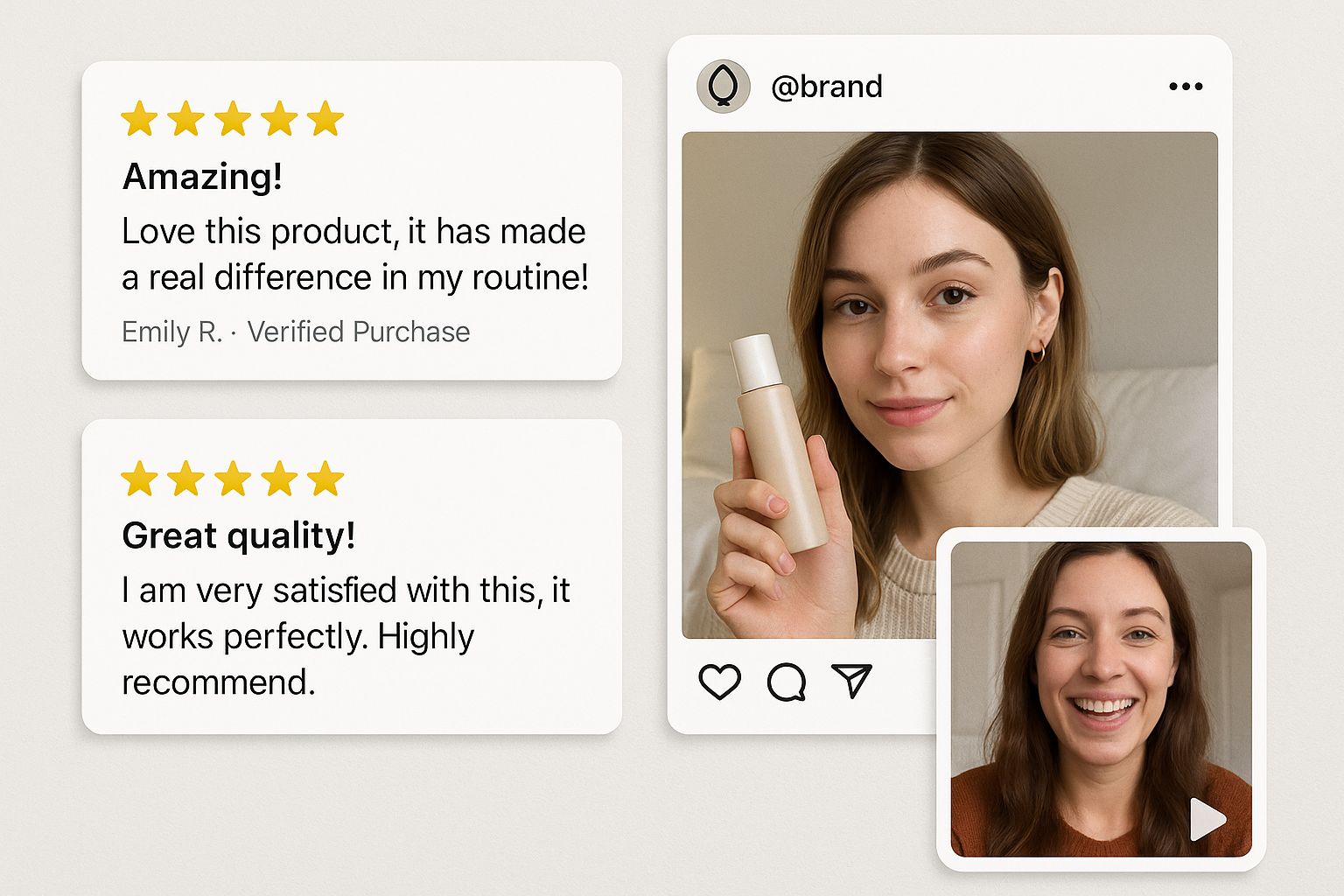
Not all user-generated content is created equal when it comes to driving conversions. The most effective UGC strategies leverage specific content types that naturally align with consumer decision-making processes. Understanding these high-converting formats allows you to focus your efforts where they’ll deliver the greatest impact for your brand.
Customer Reviews and Testimonials: Your 24/7 Sales Team
Customer reviews and testimonials remain the cornerstone of effective UGC strategies, functioning as your always-on sales team. A staggering 97% of consumers consult product reviews before making purchase decisions, and products with more than 50 reviews can increase conversion rates by up to 4.6%. But quantity isn’t enough—the quality and specificity of reviews matter immensely.
The most powerful testimonials address specific pain points your product solves. Encourage reviewers to share detailed accounts of how your product or service impacted their lives rather than simple star ratings. Video testimonials, in particular, create an emotional connection that text alone cannot achieve, with conversion rates often 80% higher than text-only reviews.
Strategic placement of reviews throughout your customer journey is equally important. Don’t limit testimonials to product pages—incorporate them into email campaigns, social media content, and even paid advertising. By showcasing authentic experiences at every touchpoint, you reinforce trust precisely when purchase decisions are being formed. For more insights on using user-generated content effectively, check out this article on modern marketing strategies.
Social Media Mentions and Tags
When customers voluntarily mention or tag your brand on social platforms, they’re providing gold-standard UGC that influences their entire network. These organic shout-outs represent powerful endorsements that reach audiences who may never see your branded content. Each tag extends your reach into new social circles that already have a built-in trust factor with the person posting, enhancing e-commerce experiences through authentic engagement.
The real power of social mentions lies in their contextual relevance. Unlike static reviews, social media posts typically show your products in action, in real-world scenarios that potential customers can relate to. This practical demonstration of your product’s value in everyday settings can address unspoken objections and visualize benefits in ways your marketing team might never conceive.
User-Submitted Photos and Videos
Visual UGC delivers conversion power that text simply cannot match. Products featuring customer photos see conversion rate increases of up to 90% compared to those without. These authentic visuals show your products in real-world settings, demonstrating actual use cases and providing social proof simultaneously.
User-submitted videos are particularly potent conversion tools, with 84% of consumers reporting that they’ve been convinced to make a purchase after watching a video. These don’t need to be professionally produced—in fact, raw, authentic footage often performs better because it feels genuine rather than staged. When customers see someone like them using and enjoying your product, they can more easily visualize themselves having the same positive experience.
Customer Q&As and Forums
Community-driven Q&A sections and forums represent a unique form of UGC that addresses specific consumer concerns directly. These platforms allow potential customers to see real questions being answered by actual users, creating an authentic information resource that builds confidence in purchasing decisions. Questions often reveal concerns your marketing may not have addressed, while answers provide peer validation that carries more weight than official responses.
The interactive nature of these forums creates a dynamic knowledge base that evolves with your customer base. As new questions arise, your community naturally generates fresh content that speaks directly to emerging concerns or use cases. This self-sustaining content ecosystem provides tremendous value while requiring minimal resource investment from your team.
Guest Blog Posts and Articles
User-written content that goes beyond quick reviews into detailed experiences represents high-value UGC that can significantly impact conversion rates. Guest posts written by actual customers bring authenticity while delivering the depth of information that considered purchase decisions often require. These extended formats allow for nuanced discussion of benefits, creative use cases, and personal connections to your brand that shorter UGC formats cannot accommodate.
The SEO benefits of user-created long-form content shouldn’t be overlooked either. These detailed accounts often naturally incorporate the exact language and questions your target audience uses when searching for solutions. By hosting this content on your own platforms, you capture search traffic with highly credible content that seamlessly guides prospects toward conversion.
Contest Submissions and Challenges
Structured UGC campaigns like contests and challenges generate high-quality content while actively engaging your community. These initiatives typically produce content that showcases your products in creative, attention-grabbing ways that your marketing team might never have conceived. The competitive element motivates participants to produce their best work, resulting in standout content that can be repurposed across multiple marketing channels.
The promotional aspect of contests creates a natural amplification effect as participants share their submissions with their own networks to gather support. This organic sharing extends your reach far beyond your existing audience while simultaneously generating valuable content. When designed thoughtfully, these campaigns create a virtuous cycle of engagement, content creation, and brand awareness.
How to Build a UGC Strategy That Actually Works
Having a strategic framework is essential for UGC success—random collection of user content rarely delivers meaningful results. Effective UGC initiatives require intentional design, clear objectives, and systematic implementation. The most successful brands approach UGC as a core marketing function rather than a supplementary tactic, integrating it throughout their customer experience.
Create Shareable Moments in Your Customer Journey
The foundation of successful UGC strategies lies in deliberately engineering moments that naturally inspire sharing. This means identifying emotional high points in your customer journey and enhancing them to become inherently shareable. The unboxing experience, first successful use, or achievement of desired results all represent potential sharing triggers that can be amplified with thoughtful design. To delve deeper into these strategies, explore this insightful article on user-generated content.
Physical products can incorporate shareable elements through distinctive packaging, unexpected delight factors, or Instagram-worthy visual design. Service businesses can create shareable moments by celebrating customer milestones, providing physical tokens of achievement, or creating distinctive environmental elements that beg to be photographed. The key is identifying when your customers feel most connected to your brand and enhancing that moment to encourage natural documentation and sharing.
Develop a Branded Hashtag That People Want to Use
An effective branded hashtag serves as both a collection mechanism for UGC and a community identifier that customers actually want to associate with. The most successful branded hashtags are concise, memorable, and aligned with how customers already think about themselves—not just your brand. Adobe’s #CreateYourStory, REI’s #OptOutside, and GoPro’s #GoPro all succeed because they celebrate the customer’s identity and achievements rather than merely promoting the brand.
The best hashtags also contain an implicit invitation to action and create a sense of belonging to something larger than a mere transaction. When designing your branded hashtag, focus on the aspirational identity your customers embrace when using your products, rather than the products themselves. This shift from product-centric to identity-centric thinking dramatically increases voluntary hashtag adoption and creates a self-sustaining UGC ecosystem.
The Right Way to Ask for Customer Content
- Be specific about what you’re looking for—vague requests yield minimal results
- Time your requests to coincide with positive emotional experiences
- Personalize outreach based on customer preferences and past behavior
- Make content creation and submission as frictionless as possible
- Always explain how content will be used and obtain proper permissions
Timing is everything when requesting UGC. The optimal moment to ask comes immediately after a positive experience—the excitement of unboxing, the satisfaction of solving a problem, or the achievement of a desired outcome. These emotional high points create natural motivation to share that makes your request feel like an opportunity rather than an imposition. For example, enhancing these e-commerce experiences can significantly boost user-generated content.
The language you use when requesting content dramatically impacts response rates. Framing requests as invitations to be featured, rather than asking for favors, positions content creation as a benefit to the customer. Messages like “Show us how you’re using your new camera—we might feature you on our Instagram!” transform the request into an opportunity for recognition that appeals to the natural desire for social validation.
Reducing friction in the submission process is equally crucial. Each additional step or complication in your submission process will dramatically reduce participation rates. Ideally, customers should be able to submit content in a single step from the platforms they already use. Tools that require separate accounts, complicated upload processes, or excessive information gathering will significantly diminish your results. For instance, enhancing e-commerce experiences can help streamline the submission process.
Incentives That Work (Without Breaking the Bank)
Effective incentives for UGC don’t necessarily require large financial investments—recognition often proves more motivating than monetary rewards. The opportunity to be featured on your brand’s social channels, website, or packaging provides powerful social validation that many customers value more highly than small financial incentives. This recognition-based approach not only reduces costs but also attracts content creators motivated by genuine enthusiasm rather than purely transactional considerations.
UGC Legal Guidelines You Can’t Ignore
As powerful as user-generated content can be, it comes with legal responsibilities that brands must navigate carefully. Mishandling these legalities can transform your UGC campaign from a marketing triumph to a costly legal nightmare. Understanding the legal framework that governs UGC is essential before launching any initiative. For those looking to enhance their digital presence, enhancing e-commerce experiences can be a crucial part of your strategy.
The fundamental principle to remember is that users typically retain copyright of content they create, even when it features your products. This means you need explicit permission to repurpose that content across your marketing channels. Assumptions or implied consent rarely hold up when legal challenges arise, putting your brand at unnecessary risk.
Getting Proper Permission to Use Customer Content
Obtaining proper permission involves more than casual social media interactions. While comments like “Can we share this?” might seem sufficient, they rarely constitute legally binding permission. Instead, implement a systematic approach to rights management that clearly documents consent and usage terms for all UGC.
The most effective permission systems combine automation with clear documentation. When users submit content through your branded platforms, include clear terms explaining how content may be used, with checkboxes for specific permissions such as website use, social media, advertising, and physical marketing materials. For content discovered on social platforms, use dedicated permission-request templates that clearly outline intended uses and request explicit confirmation.
Remember that permission from one platform doesn’t automatically transfer to others. If a customer approves usage on Instagram, that doesn’t grant permission for use in paid advertising or packaging. Be specific in your requests and maintain detailed records of exactly what permissions have been granted for each piece of content, especially when enhancing e-commerce experiences.
Copyright Considerations for Different Platforms
Each social platform has distinct terms governing content rights that directly impact your UGC strategy. Instagram’s terms, for example, grant the platform broad usage rights but don’t transfer those rights to brands featured in content. Twitter similarly distinguishes between platform rights and third-party usage rights. Understanding these platform-specific nuances prevents assuming permissions you don’t actually have.
Platform policies also evolve regularly, requiring ongoing vigilance to maintain compliance. What was permissible under last year’s terms may violate current policies, exposing your brand to unexpected liability. Establish a regular review process for terms of service updates across all platforms where you source UGC to ensure continued compliance. For example, enhancing eCommerce experiences can be significantly affected by these policy changes.
Sample Terms and Conditions for UGC Campaigns
“By submitting content using #YourBrandHashtag or tagging @YourBrand, you grant [Company Name] a non-exclusive, royalty-free, worldwide license to use, reproduce, modify, publish, and distribute such content across marketing channels including but not limited to social media, websites, email marketing, advertisements, and physical marketing materials. You confirm you own or have permission to share this content and that it doesn’t violate any third-party rights.”
While this sample provides a starting point, consult with legal counsel to develop terms specific to your business needs and jurisdictional requirements. Different regions have varying requirements for valid consent, particularly when minors are involved. Ensure your terms address how you’ll handle personal information contained within submissions, especially if your audience includes customers from regions with strict data privacy regulations like GDPR or CCPA.
Real-World UGC Success Stories That Will Inspire You
Theory is valuable, but nothing illustrates the transformative power of UGC quite like examining brands that have mastered it. These success stories demonstrate not just the potential reach of effective UGC campaigns but also the strategic thinking that makes them successful. Each of these brands approached UGC with clear objectives and thoughtful execution that aligned perfectly with their audience’s natural behaviors.
How GoPro Built an Empire on Customer Videos
GoPro represents perhaps the most impressive UGC success story in recent marketing history, building a billion-dollar brand largely through content created by its customers. Rather than telling consumers their cameras could capture amazing moments, they let users show what was possible, creating an aspirational cycle that drove both content creation and product sales.
The genius of GoPro’s approach lies in how they positioned their product as an enabler of amazing content rather than just a technical device. By featuring spectacular user videos across their marketing channels and creating the GoPro Awards program with significant cash prizes, they incentivized a constant stream of increasingly impressive content. This strategy created a virtuous cycle where amazing content drove camera sales, which produced more content, continuously reinforcing the brand’s position as the tool for adventure documentation.
The numbers tell a compelling story: GoPro’s YouTube channel has amassed over 10 million subscribers and billions of views—with the vast majority featuring user-created content. Their hashtag #GoPro appears in millions of Instagram posts, creating a massive repository of authentic marketing content that continuously reinforces the brand’s core value proposition without requiring traditional advertising investments.
Starbucks’ White Cup Contest: 4,000+ Entries in Just 3 Weeks
Starbucks masterfully demonstrated how simple UGC concepts can generate extraordinary engagement with their White Cup Contest. They invited customers to decorate their iconic white cups and submit photos as design entries, with the winning design to be produced as a limited edition reusable cup. This brilliantly simple premise generated over 4,000 entries in just three weeks, creating a treasure trove of artistic content that celebrated both customer creativity and the brand’s ubiquitous cup.
The campaign succeeded by tapping into behaviors customers were already exhibiting—personalizing and photographing their Starbucks cups—and adding just enough structure and incentive to amplify participation. By promising to produce the winning design, Starbucks created a meaningful reward beyond mere recognition, while simultaneously gathering valuable insights into how customers personalized their brand experience.
Airbnb’s Community-Driven Content Strategy
Airbnb revolutionized travel accommodation by building their entire visual identity around user-generated content. Instead of professional photography that feels staged and commercial, Airbnb primarily features authentic photos taken by hosts and guests. This strategy not only reduced content production costs but also provided prospective travelers with realistic expectations of the spaces they were booking.
The company extended this UGC approach beyond just property listings with their “Live There” campaign, which encouraged travelers to share authentic local experiences through the #AirbnbExperience hashtag. These user stories created a content ecosystem that shifted perceptions of Airbnb from simply offering accommodations to enabling authentic travel experiences. The authentic, non-commercial aesthetic of this content resonated perfectly with their target audience’s desire to “travel like a local” rather than a tourist.
How to Measure UGC Impact on Your Bottom Line
The real value of UGC lies not just in its authenticity but in its measurable business impact. Establishing clear metrics and measurement frameworks is essential to optimize your UGC strategy and demonstrate its value to stakeholders. While UGC feels intuitively valuable, concrete data allows you to refine your approach and secure continued investment in this powerful marketing approach.
Begin with a comprehensive measurement framework that tracks both leading and lagging indicators. Leading indicators like engagement rates, sentiment analysis, and sharing behavior provide early signals about campaign performance, while lagging indicators such as conversion rates, average order value, and customer lifetime value demonstrate bottom-line impact. This dual approach provides both immediate feedback and long-term validation.
Conversion Tracking for UGC Campaigns
Conversion attribution for UGC requires more sophisticated tracking than traditional campaigns due to its distributed nature. Implement unique tracking parameters for different UGC sources to identify which types and channels deliver the highest conversion rates. This granular tracking allows you to identify whether reviews, social posts, videos, or other UGC formats drive the most valuable customer actions for your specific business.
A/B testing provides particularly valuable insights when optimizing UGC. Test product pages with and without customer photos, email campaigns featuring testimonials versus traditional marketing copy, and ads incorporating UGC against professionally produced alternatives. These direct comparisons often reveal dramatic performance differences that guide resource allocation and campaign design.
- Use UTM parameters to track traffic and conversions from specific UGC sources
- Implement pixel tracking to measure how UGC influences the customer journey
- Create segment-specific conversion funnels to analyze how different audience groups respond to various UGC types
- Track conversion lift when UGC elements are added to existing marketing assets
- Measure the impact on the average order value when UGC is incorporated into product pages
Remember that UGC often influences conversions that happen through other channels. A customer might discover your product through user content on Instagram, but later purchase directly through your website without any trackable link. Post-purchase surveys asking “How did you first hear about us?” can help capture this attribution data that analytics tools might miss.
The most sophisticated UGC measurement approaches also incorporate customer lifetime value analysis. UGC frequently attracts customers with higher retention rates and greater long-term value than those acquired through paid advertising. Tracking cohort performance based on acquisition source often reveals that UGC-acquired customers demonstrate significantly higher lifetime value, justifying greater investment in UGC initiatives.
Engagement Metrics That Actually Matter
Not all engagement metrics carry equal weight when evaluating UGC effectiveness. While vanity metrics like likes and follower counts provide some indication of reach, deeper engagement actions more accurately predict business impact. Comments, shares, saved posts, and time spent with content typically correlate more strongly with purchase intent than passive engagement metrics.
Sentiment analysis provides another critical dimension for UGC evaluation. Beyond quantitative engagement, the emotional tone of user interactions reveals valuable insights about how your brand and products resonate with customers. Modern AI-powered tools can analyze comment sentiment at scale, flagging both potential issues and particularly positive associations that can inform broader marketing strategy.
Calculating ROI From User Content
Comprehensive ROI calculation for UGC must account for both direct costs and opportunity costs against alternative marketing approaches. The direct cost framework should include content acquisition costs (incentives, technology platforms, rights management), content curation and management expenses, and distribution costs across paid and owned channels. Compare these investments against measurable outcomes like attributed revenue, earned media value, and content production savings.
The most overlooked ROI component is typically the content production value UGC provides. Calculate what it would cost to professionally produce an equivalent volume of content through traditional means, including photography, videography, editing, and talent costs. This replacement cost analysis often reveals that UGC delivers extraordinary value even before considering its superior authenticity and performance metrics.
Your 30-Day Plan to Launch a UGC Campaign
Transforming UGC theory into practice requires systematic implementation. This 30-day roadmap provides a structured approach to launching your first comprehensive UGC initiative or revitalizing existing efforts. The plan breaks the process into manageable phases that build upon each other, allowing you to establish the necessary foundation before scaling your efforts.
Begin by auditing your existing UGC landscape during the first week, including analysis of what content customers are already creating, which platforms they prefer, and what sharing behaviors occur naturally. Simultaneously, define clear objectives for your UGC initiative that align with broader business goals—whether increasing conversion rates, reducing content production costs, or building community engagement. This foundation ensures your subsequent efforts address real business needs rather than simply chasing engagement.
Frequently Asked Questions
As you implement your UGC strategy, specific challenges will inevitably arise. These frequently asked questions address the most common obstacles brands encounter when enhancing e-commerce experiences with user-generated content.
How do I encourage customers to create content if I have a small following?
Building UGC momentum with a limited audience requires focusing on your most engaged existing customers rather than total audience size. Identify your “super-users” through purchase history and engagement patterns, then reach out personally to request specific types of content. These direct invitations typically yield much higher participation rates than broadcast requests. As you collect initial content, feature it prominently across all customer touchpoints to normalize sharing behavior and demonstrate that real customers are actively engaging with your brand. For more insights, check out how user-generated content is a secret weapon in modern marketing.
For small businesses, local connections often provide the most fertile ground for initial UGC. Partner with complementary local businesses or community organizations to expand your reach while maintaining relevance. These partnerships can include cross-promotion of UGC, shared hashtags, or collaborative events that naturally generate shareable moments. The key is creating a critical mass of initial content that makes participation feel natural for subsequent customers.
Can UGC work for B2B companies or just B2C brands?
B2B companies can leverage UGC just as effectively as B2C brands, though the formats and approaches may differ. Case studies, implementation stories, and user testimonials represent powerful B2B UGC formats that directly address the longer, more complex B2B buying process. For technology products, user-created tutorials and problem-solving content often perform exceptionally well, while professional services firms can showcase client success stories and results-focused content.
What should I do about negative user-generated content?
Negative UGC requires strategic response rather than automatic suppression. When customers share negative experiences, respond promptly with empathy and concrete solutions that demonstrate your commitment to customer satisfaction. This transparent approach not only addresses the immediate concern but shows prospective customers that you stand behind your products and take feedback seriously. Research consistently shows that brands that effectively address negative feedback often create stronger customer loyalty than those that never faced criticism at all. For more insights, consider enhancing e-commerce experiences to better handle customer feedback.
Is it better to focus on quantity or quality with UGC?
Quality consistently outperforms quantity in UGC effectiveness. A single authentic, emotionally resonant piece of user content typically delivers more marketing value than dozens of generic submissions. Focus your strategy on eliciting meaningful content that showcases real benefits and experiences rather than accumulating high volumes of basic content. The most effective approach targets specific content types that address key customer questions or objections while maintaining the authentic voice that makes UGC powerful. For more insights on improving customer interactions, consider enhancing e-commerce experiences.
How often should I refresh my UGC strategy?
UGC strategies should undergo quarterly review and annual comprehensive overhaul to maintain effectiveness. Quarterly reviews should examine performance metrics, platform changes, and emerging content trends that might require tactical adjustments. Annual strategic reviews should more deeply assess whether your UGC approaches still align with evolving business objectives, customer behaviors, and competitive landscape. This dual review cadence allows for continuous optimization while ensuring the fundamental strategy remains aligned with business goals.
The true power of user-generated content lies in its ability to create authentic connections that traditional marketing simply cannot replicate. When implemented strategically, UGC transforms your customers from passive buyers into active brand advocates who willingly share their experiences and influence their networks. The resulting content ecosystem not only drives immediate marketing performance but also builds a sustainable competitive advantage through community engagement and social proof.
Ready to transform your marketing with the power of authentic customer voices? JoinBrands connects you with real customers eager to create content that showcases your products in authentic, engaging ways.
Turn authentic customer posts into predictable revenue. Capture every tag and review in a unified inbox, auto-request permissions, trigger follow-ups, and convert UGC attention into sales with Catalyst’s free Business Operating System. Get started at em2bos.com.

