
Key Takeaways
- Online communities generate an extraordinary 4,530% ROI, yielding $45.30 for every dollar invested, according to the State of Community Management report.
- Successful community engagement requires five essential elements: clear purpose, consistent content, active moderation, member recognition, and seamless onboarding.
- The platform choice significantly impacts engagement levels, with owned platforms providing more control and mobile apps driving up to 3X higher participation rates.
- Communities That Convert offers specialized strategies to transform passive audiences into active, revenue-generating community members.
- Strategic content frameworks like problem-solution models drive higher conversion rates and create multiple conversion touchpoints throughout the member journey.
The digital landscape has evolved beyond simple content consumption to active participation. Online communities have emerged as powerful conversion engines that drive business growth while creating exceptional value for members.
According to the 2022 State of Community Management report, online communities generate an astounding 4,530% ROI. That’s $45.30 returned for every dollar invested. Communities That Convert has been helping marketers harness this potential by transforming passive audiences into engaged community members who not only participate but convert into loyal customers and brand advocates.
Online Communities Are Conversion Engines (Here’s Why)
Online communities have transcended their reputation as mere social gathering spaces to become sophisticated conversion engines. They create environments where authentic relationships develop naturally, establishing trust that traditional marketing channels simply cannot replicate. When members receive consistent value, their buying resistance naturally decreases, and conversion becomes the logical next step in their relationship with your brand.
These communities serve as living, breathing ecosystems where prospects and customers interact with your brand organically. Rather than being subjected to intrusive advertising, community members actively seek solutions, share experiences, and build connections that naturally lead to purchasing decisions. This shift from push marketing to pull engagement represents the future of digital marketing strategy.
The 4,530% ROI of Community-Based Marketing
The jaw-dropping 4,530% ROI from community investment isn’t accidental—it’s a natural outcome of effective community engagement strategies. This astronomical figure stems from the compounding value communities create: they simultaneously reduce customer acquisition costs, increase retention rates, and drive upsells through trust-based relationships. Traditional marketing channels typically focus on just one of these areas, while communities impact all three simultaneously.
When calculating community ROI, most businesses underestimate the full spectrum of benefits. Beyond direct conversions, communities generate valuable user content, reduce support costs, accelerate product development through feedback, and create powerful social proof. These indirect benefits often exceed the direct revenue generated through community sales and subscriptions.
How Communities Drive Customer Retention and Lifetime Value
The most significant impact of community-building comes not from initial conversions but from dramatic increases in customer lifetime value. Community members demonstrate significantly higher retention rates—often 30-50% above non-community customers. This retention effect stems from multiple factors: deeper product knowledge, stronger emotional connection to the brand, and the social switching costs that develop when meaningful relationships form within the community.
Communities transform the traditional customer journey from a linear process into a circular engagement model where customers become advocates who attract new prospects. This self-reinforcing cycle creates a compounding effect on customer lifetime value. As members become more invested in the community, they naturally expand their relationship with your products and services, increasing average order values and purchase frequency without requiring additional acquisition costs. To learn more about enhancing customer experiences, consider exploring strategies for enhancing e-commerce experiences.
5 Essential Elements of High-Converting Communities
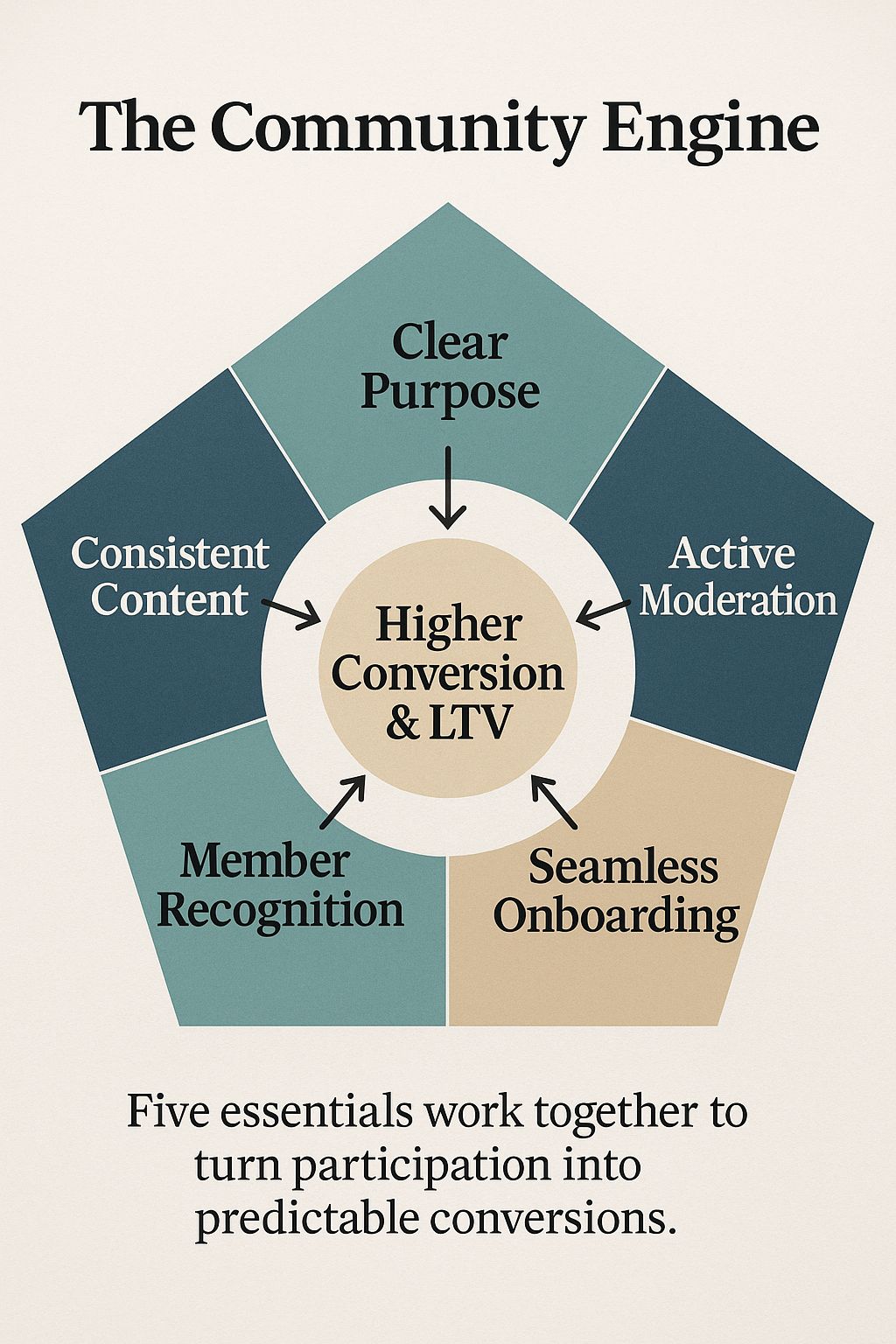
Building a community that consistently drives conversions requires intentional design around five critical elements. These foundational components determine whether your community becomes a thriving conversion engine or just another abandoned digital space. Each element serves both engagement and conversion goals, creating an environment where transactions become a natural extension of the community experience.
Clear Purpose and Value Proposition
High-converting communities begin with crystal-clear purpose statements that align business objectives with genuine member needs. This purpose acts as the community’s compass, guiding content, moderation, and growth strategies. The most effective value propositions emphasize transformation rather than features—clearly articulating how the community will help members achieve specific outcomes that matter to them.
Your community’s purpose must answer two essential questions: “Why should I join?” and “Why should I stay?” The answers should be compelling enough that members would willingly pay for access, even if you offer free membership. Communities with vague purposes like “networking” or “sharing ideas” typically struggle with both engagement and conversions, while those focused on specific transformations (like “becoming a confident public speaker” or “mastering Facebook ads”) create clear paths to monetization.
Consistent Content Cadence
The lifeblood of any thriving online community is its content rhythm—the predictable cadence of valuable posts, events, and interactions that members come to expect and anticipate. This consistency trains members to return regularly, increasing the opportunities for meaningful engagement. The most successful communities maintain a balance of content types: educational resources that build skills, discussion prompts that foster connection, and celebration posts that reinforce progress.
Content calendars should be designed with conversion pathways in mind, strategically introducing offers when they represent the logical next step in the member’s journey. This approach transforms selling from an interruption into a service, providing exactly what members need at the moment they need it most. When community managers maintain this balanced content cadence, engagement metrics consistently correlate with conversion metrics.
Active Moderation and Leadership
Thriving communities require active moderation that goes beyond enforcing rules to actively cultivating the desired culture. Effective moderators serve as both guardrails and guides—removing disruptive elements while nurturing valuable contributions. The most successful communities maintain a moderator-to-member ratio of approximately 1:100 for active participants, ensuring timely responses and consistent engagement.
Leadership visibility directly impacts conversion rates, with communities where founders or team members actively participate showing conversion rates 2-3 times higher than those with absent leadership. This leadership presence establishes authority and trust while demonstrating genuine investment in member success. When leaders share their expertise, behind-the-scenes insights, and authentic challenges, they transform from distant authority figures into trusted advisors whose recommendations naturally carry more weight.
Member Recognition Systems
Strategic recognition systems transform casual participants into committed community advocates. Effective recognition extends beyond automated badges to include personalized acknowledgment of contributions, progress, and milestones. These recognition moments create powerful psychological rewards that drive continued engagement while showcasing the community’s values in action. For more insights on enhancing user experiences, explore our guide on enhancing e-commerce experiences.
The most sophisticated communities develop multi-tiered recognition systems that create clear advancement paths for members. These systems might include spotlight features, leadership opportunities, exclusive access, and even financial incentives for top contributors. By publicly celebrating member achievements, communities simultaneously motivate the recognized individual while demonstrating the potential value to newer members—establishing clear “success models” that others naturally want to emulate.
Seamless Onboarding Experience
The first 72 hours of membership determine whether someone becomes a valuable community contributor or another inactive account. Effective onboarding sequences guide new members through three critical experiences: making their first contribution, connecting with established members, and experiencing early wins that validate their decision to join. Communities with structured onboarding processes show 60% higher 30-day retention rates than those allowing members to figure things out independently.
Conversion-focused communities design onboarding pathways that naturally lead toward initial offers. This doesn’t mean immediately pitching products, but rather establishing patterns of engagement that align with the customer journey. For example, asking new members to share their biggest challenges creates opportunities for solution-based recommendations later, while prompting them to establish goals creates natural checkpoints for relevant offers.
Platform Selection: Where Your Community Lives Matters
The platform hosting your community dramatically impacts both engagement patterns and conversion potential. Platform selection represents one of the most consequential decisions you’ll make, affecting everything from data ownership to monetization options. The optimal platform balances accessibility with the specific engagement features your community strategy requires.
Platform decisions should be guided by your specific conversion goals and member behaviors. While free social platforms offer broad accessibility, they severely limit control over the member experience and data insights critical for optimization. Conversion-focused communities increasingly migrate from social platforms to dedicated community software or custom solutions that provide enhanced analytics, integration capabilities, and direct monetization options.
Prefer owned, mobile-first control? Catalyst Pro delivers branded community spaces with push notifications, roles/permissions, and native offer modules—so you keep the data and the conversions.
Owned vs. Rented Community Spaces
The fundamental platform decision comes down to owned versus rented community spaces—each offering distinct advantages and limitations for conversion optimization. Rented spaces on platforms like Facebook Groups or LinkedIn provide immediate audience access and familiar interfaces but restrict your ability to customize the experience, capture member data, or control how your offers appear. Communities on rented platforms typically convert at 1.5-3% compared to 5-10% on owned platforms.
Owned platforms—whether custom-built solutions or specialized community software—provide complete control over the member experience, branding, data collection, and conversion pathways. While requiring more significant initial investment, these owned spaces enable sophisticated engagement tracking, direct integration with your sales systems, and freedom from algorithm changes or platform policy shifts. The conversion advantages of owned platforms compound over time as you gather proprietary engagement data unavailable on rented platforms.
Mobile App Advantage: 3X Higher Engagement Rates
Communities with dedicated mobile applications consistently demonstrate engagement rates three times higher than browser-only experiences. This dramatic difference stems from both convenience and the psychological impact of having your community icon visible on members’ home screens. Mobile apps also enable push notifications that drive immediate action—delivering 5-8 times higher response rates than email notifications for time-sensitive opportunities.
The engagement advantage of mobile access translates directly to conversion improvements. Communities with mobile apps report 40% faster conversion cycles and 25% higher average order values than browser-only equivalents. This effect is particularly pronounced for recurring revenue models, where the frictionless access of mobile platforms reduces cancellation rates by making consistent engagement effortless rather than requiring deliberate action.
Content That Sparks Conversation and Conversion
Strategic content serves as the catalyst that transforms passive community members into active participants and customers. High-converting communities develop content strategies that simultaneously nurture engagement and create natural pathways to offers. The most effective approach balances structured content from community leaders with facilitated member contributions that demonstrate social proof and diverse perspectives.
Content calendars for conversion-focused communities typically operate on multiple timescales: daily engagement prompts, weekly featured discussions, monthly themes aligned with business objectives, and quarterly campaigns tied to major offers. This layered approach maintains consistent engagement while creating natural rhythms that guide members toward conversion opportunities without appearing manipulative or overly promotional.
Problem-Solution Framework
The problem-solution framework represents the most reliable content structure for driving both engagement and conversions. This approach begins with highlighting specific pain points shared by community members, fostering discussion around challenges and implications before transitioning to solution exploration. By allowing members to fully express their frustrations and experiences, you create emotional investment in finding solutions while gathering invaluable insight into their specific needs and language.
When executed effectively, problem-solution sequences position your offerings as natural answers to clearly articulated needs rather than interruptions or sales pitches. This framework works most powerfully when structured over multiple days: beginning with problem identification posts, followed by exploration of attempted solutions, culminating in comprehensive approaches that might include your products or services as components. Communities using this structured approach report conversion rates 2-3 times higher than those using direct promotional content.
User-Generated Content Strategies
User-generated content forms the backbone of self-sustaining community engagement while simultaneously creating powerful social proof for conversion opportunities. The most effective UGC strategies balance spontaneous member contributions with structured prompts designed to elicit specific types of content. Weekly success stories, case study spotlights, and implementation challenges consistently rank among the highest-converting UGC formats across industries.
To maximize both engagement and conversion impact, develop clear contribution guidelines that help members share experiences in formats most valuable to the broader community. These guidelines might include templates for case studies, specific questions for testimonials, or frameworks for sharing implementation results. When members see their contributions highlighted and valued, they become increasingly invested in community success, creating a virtuous cycle of deeper engagement and higher conversion receptivity.
Question Formats That Drive Participation
The specific wording and structure of community questions dramatically impact both response rates and conversion potential. High-performing question formats include experience-based prompts (“What’s your biggest challenge with…?”), specific implementation requests (“How did you handle…?”), and future-focused scenarios (“What would you do if…?”). These formats consistently generate 3-5 times more responses than general discussion topics or simplistic polls.
Questions designed with conversion pathways in mind create natural opportunities to introduce solutions without appearing promotional. For example, asking members to share their biggest challenges with Facebook ads naturally creates openings to discuss your Facebook ads course or service. The key conversion principle is ensuring questions highlight specific pain points your offerings directly address, creating natural segmentation opportunities for targeted follow-up.
The Community Member Journey Map
High-converting communities strategically design member experiences as intentional journeys rather than random interactions. These journey maps track progression from initial discovery through various engagement stages to eventual conversion and advocacy. By mapping specific touchpoints and interactions at each stage, you can identify both engagement bottlenecks and conversion opportunities that might otherwise remain invisible.
Effective journey mapping requires tracking both behavioral metrics (post frequency, response patterns, content consumption) and psychological transitions as members develop deeper community connections. The most sophisticated communities develop scoring systems that quantify member progression, triggering specific interventions or offers when members reach key thresholds. This systematic approach transforms community management from reactive moderation to proactive journey orchestration.
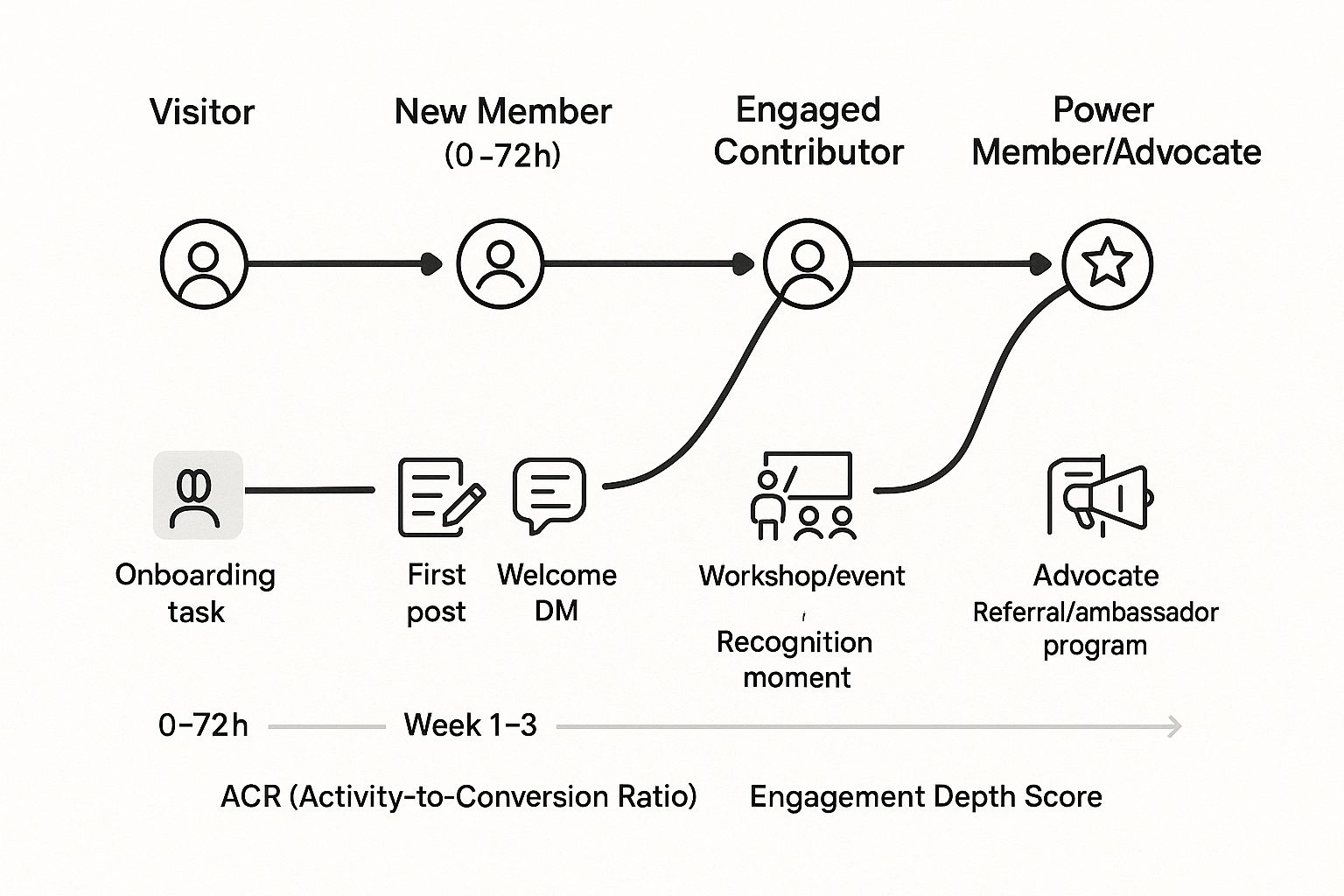
From Lurker to Regular Contributor
The critical transition from passive consumption (lurking) to active contribution represents the most significant engagement threshold in community development. Research indicates that while 60-90% of community members begin as lurkers, well-designed activation sequences can convert 30-40% into regular contributors within their first month. These activation sequences typically combine personal outreach, low-friction participation opportunities, and visible recognition for initial contributions.
Conversion data consistently shows that members who make this lurker-to-contributor transition convert at rates 4-6 times higher than those who remain in passive consumption modes. The psychological principle driving this correlation is commitment consistency—once members publicly engage with community content, they become significantly more receptive to deepening their relationship through purchases. Strategic community designs create clear “engagement ladders” with progressively deeper participation opportunities leading naturally toward conversion touchpoints.
Creating Your Community Leadership Pipeline
Sustainable, high-converting communities develop internal leadership pipelines that identify and nurture potential moderators, ambassadors, and program leaders from within the membership. These leadership pathways serve dual purposes—creating deeper engagement opportunities for your most active members while establishing visible success models that motivate broader community participation. Communities with established leadership programs report 40% higher retention rates and 35% higher conversion rates than those relying solely on founder or staff leadership.
Implementing a structured leadership development process begins with creating clear role definitions and advancement criteria that members can aspire to. Effective programs typically include training components, trial responsibility periods, and meaningful recognition for leadership contributions. The conversion advantage comes from the trust these member-leaders establish—their recommendations carry substantially more influence than direct marketing messages, with ambassador-driven promotions often converting at 3-5 times the rate of identical offers from brand channels.
Identifying and Nurturing Potential Advocates
The most valuable community members aren’t necessarily the most vocal—they’re the ones who systematically influence others toward meaningful engagement and conversion. Identifying these potential advocates requires looking beyond simple activity metrics to track influence patterns: whose content consistently generates responses, whose recommendations others follow, and whose participation correlates with broader engagement spikes. Advanced communities implement formal advocate identification systems that flag members demonstrating these high-influence behaviors.
Once identified, potential advocates should enter structured nurturing sequences designed to deepen their community investment while providing tools that amplify their natural influence. These sequences might include exclusive access opportunities, advanced training, direct founder interaction, and formal recognition programs. From a conversion perspective, these advocates function as internal salespeople who generate 5-7 times more qualified leads than traditional marketing channels—making advocate development one of the highest-ROI activities for conversion-focused communities.
Conversion Touchpoints Throughout the Community
Strategic community design incorporates multiple conversion touchpoints that appear as natural extensions of the member experience rather than disruptive sales attempts. These touchpoints should correspond with moments of peak engagement or specific member needs, creating situations where your offers represent the logical next step in the member’s journey rather than an interruption to it.
The most effective conversion architecture distributes touchpoints across multiple channels and formats: from subtle solution mentions in discussion responses to dedicated promotional events and direct outreach to qualified prospects. This diversified approach ensures members encounter relevant offers regardless of their specific engagement patterns, while maintaining appropriate frequency that builds awareness without creating promotion fatigue.
Direct vs. Indirect Conversion Opportunities
Conversion-focused communities balance direct promotional opportunities (explicit offers, sales events, promotional announcements) with indirect pathways that guide members toward purchasing decisions through educational content, success stories, and facilitated discovery. While direct approaches generate immediate response, indirect methods typically produce higher-value conversions with stronger retention rates. The optimal balance appears to be approximately 20% direct promotion to 80% indirect nurturing, though this ratio varies based on community maturity and offering complexity.
Indirect conversion pathways might include educational content series that demonstrate expertise, member success spotlights that showcase results, implementation workshops that reveal solution complexity, or diagnostic tools that help members self-identify needs. These approaches build conversion readiness without explicit selling, creating informed prospects who enter sales conversations with established trust and clear problem awareness. Communities that master these indirect pathways typically report customer acquisition costs 40-60% lower than traditional marketing channels.
When and How to Make Offers
Timing significantly impacts community offer performance, with conversion rates varying by as much as 300% based on when and how offers are presented. The highest-converting opportunities typically align with four key moments: immediately following problem acknowledgment, after engagement with related content, during structured promotional events, and at membership milestone moments. Strategic community calendars coordinate content themes and engagement activities to create natural bridges to these high-converting moments.
Beyond timing, offer framing dramatically affects conversion success. Community-centric offers positioned as membership enhancements or collective opportunities consistently outperform traditional marketing approaches. Specific techniques include early-access privileges for members, community-exclusive pricing, collaborative cohort experiences, and progress-acceleration frameworks. These approaches transform purchasing from an individual consumption decision into a community participation choice—leveraging social dynamics that significantly increase conversion probability.
Measuring Community Success Beyond Vanity Metrics
Conversion-focused communities require measurement frameworks that go beyond traditional engagement metrics to directly connect community activities with business outcomes. While metrics like member count, post volume, and general engagement provide operational insights, they often fail to capture the true business impact of community investments. Sophisticated measurement approaches track specific behaviors that correlate with conversion readiness, creating predictive models that guide both community management and offer timing.
The most effective measurement systems integrate community data with broader marketing and sales analytics, creating unified customer views that track multi-touch attribution across community touchpoints. These integrated systems enable precise ROI calculations while identifying specific community activities and content types that most effectively drive conversion progress. Communities with these advanced measurement capabilities typically achieve 30-50% higher conversion rates through continual optimization based on behavioral insights.
Activity-to-Conversion Ratio
The Activity-to-Conversion Ratio (ACR) measures how efficiently community engagement translates to business results by tracking conversions relative to specific member activities. Rather than measuring general engagement, ACR focuses on identifying which particular actions—content consumption, discussion participation, event attendance, or tool usage—most strongly correlate with eventual purchasing decisions. Communities with mature ACR systems typically identify 3-5 “power activities” that demonstrate 5-10X stronger conversion correlation than general participation.
Implementing ACR measurement begins with tagging different community activities and tracking their relationship to conversion events over time. The resulting data reveals both the activities most worth promoting and the optimal sequencing for maximum conversion probability. For example, a software community might discover that members who attend a live demonstration, then participate in implementation discussions, and finally download a specific resource convert at rates 400% higher than the general membership—creating a clear engagement pathway worth promoting and optimizing.
Engagement Depth Scoring
Engagement Depth Scoring quantifies member involvement beyond surface-level activity metrics by assessing the quality and impact of participation rather than mere frequency. Sophisticated scoring systems weight different activities based on their correlation with community commitment and conversion likelihood: creating original content might earn more points than simply reacting to posts, while meaningful comments receive higher scores than brief responses. These nuanced measurements provide significantly more predictive power than traditional engagement metrics.
From a conversion perspective, engagement depth scores enable precisely targeted offers based on demonstrated community investment rather than generic activity thresholds. Communities implementing these scoring systems typically segment members into distinct engagement tiers, with customized conversion pathways for each level. This segmentation enables appropriately timed offers that match member readiness, substantially increasing conversion rates while reducing the negative perception risks associated with premature or misaligned promotions.
Customer Lifetime Value Comparison
The ultimate community success metric compares the lifetime value of customers acquired through community pathways against those from other marketing channels. This comparison typically reveals community-sourced customers demonstrate 3-5X higher lifetime values through increased retention rates, larger average purchase values, and greater brand advocacy. These dramatic differences justify community investment strategies focused on long-term relationship development rather than immediate conversion optimization. For more insights, explore how enhancing e-commerce experiences can contribute to increased customer lifetime value.
Implementing meaningful lifetime value comparisons requires integrating community participation data with customer purchase histories and retention metrics. The resulting analysis typically reveals specific community engagement patterns that correlate with maximum lifetime value, enabling targeted nurturing strategies for high-potential members. For subscription businesses, community participation data often provides early warning indicators of churn risk, enabling proactive intervention strategies that substantially improve retention metrics.
3 Case Studies of Community Conversion Transformation
Examining successful community conversion models provides valuable implementation blueprints while demonstrating the real-world impact of strategic community engagement. The following case studies showcase diverse approaches across different business models and industries, highlighting both tactical execution details and measurable business outcomes.
Passion.io: From Facebook Group to $2M App Community
Passion.io transformed a free Facebook group for course creators into a thriving $2M community by implementing a structured migration strategy to their owned platform. The migration began with introducing exclusive content and experiences only available on their proprietary platform while maintaining the Facebook group as an entry point. By creating clear value differentiation between the free and premium experiences, they achieved a remarkable 22% conversion rate from group members to paid community participants within the first six months.
HubSpot: Building a Multi-Channel Community Ecosystem
HubSpot’s community strategy demonstrates the power of creating specialized engagement channels for different member segments and journey stages. Rather than building a single community destination, HubSpot developed an ecosystem of interconnected spaces: their knowledge base for self-service learning, user forums for peer support, academy for structured education, and partner communities for implementation specialists.
This segmented approach enabled HubSpot to develop highly relevant conversion pathways for each community segment: certification offers for academy members, client referral opportunities for partners, and product upgrades for forum participants. The multi-channel strategy has contributed significantly to HubSpot’s impressive 33% annual recurring revenue growth while maintaining customer acquisition costs well below industry averages.
The ecosystem model allows HubSpot to match community experiences precisely to member needs while creating natural upgrade pathways between different community spaces. New users typically begin in knowledge base or forum environments, then progress to academy resources as their implementation sophistication grows, with some eventually entering partner programs as their expertise develops.
“Our community isn’t just a support channel—it’s a growth engine that touches every part of our flywheel. When we integrated community metrics with our customer success data, we discovered community participants upgrade 3X more frequently and churn 62% less than non-participants.” — HubSpot Community Team
The success of HubSpot’s approach highlights the importance of intentional community architecture that creates clear pathways between different engagement environments rather than trying to serve all member needs within a single community structure. This segmented design enables precisely targeted conversion opportunities that feel like natural progression rather than promotional interruptions.
Articulate Marketing: Relationship-Based Community Conversions
Articulate Marketing’s community strategy demonstrates the effectiveness of relationship-focused conversion pathways for high-value B2B services. Rather than emphasizing scale, their community model focuses on facilitating meaningful connections between senior marketing leaders through carefully curated experiences. Their invitation-only approach maintains exceptional engagement quality while creating an environment where peer recommendations drive conversion decisions.
By implementing structured relationship development protocols that guide members from initial introduction through collaborative experiences to mutual support, Articulate has achieved a 40% client acquisition rate from community participation while dramatically shortening their typical sales cycle from months to weeks. Their approach emphasizes facilitating valuable peer relationships rather than direct promotion, with conversion opportunities emerging naturally from the trust established through these curated interactions. For more insights into enhancing customer experiences, you can explore how e-commerce experiences are enhanced with innovative strategies.
Your 30-Day Community Conversion Blueprint
Implementing effective community conversion strategies requires systematic execution rather than scattered tactical experiments. The following 30-day blueprint provides a structured implementation approach that balances immediate engagement improvements with long-term conversion architecture. Each weekly focus builds upon previous foundations while delivering measurable progress indicators that maintain implementation momentum. For more insights, you can explore online community launch strategies that complement this blueprint.
This phased approach prevents the common implementation pitfall of trying to optimize too many elements simultaneously, which typically results in execution inconsistency and inconclusive results. By focusing on specific system components each week while maintaining clear measurement protocols, you’ll develop both the operational capabilities and data insights needed for continuous community optimization.
Week 1: Foundation and Framework
The first implementation week focuses on establishing your community’s fundamental conversion architecture through four critical activities: purpose clarification, journey mapping, measurement setup, and content framework development. Begin by refining your community purpose statement to explicitly connect member benefits with business objectives, ensuring all subsequent activities align with both engagement and conversion goals. Next, develop initial journey maps that outline how members should progress from discovery through various engagement stages to eventual conversion points.
With strategic foundations established, implement basic measurement systems that track both engagement metrics and conversion indicators, creating dashboards that make these connections visible to all team members. Finally, develop a preliminary content framework that balances engagement-focused value delivery with strategic conversion touchpoints, establishing a sustainable rhythm that serves both member needs and business objectives. This foundation week should conclude with a clear operational plan for the subsequent implementation phases. For more insights, explore how enhancing e-commerce experiences can align with these strategies.
Week 2: Content Strategy Implementation
The second week focuses on executing your content strategy through developing and scheduling core content assets, training team members on effective facilitation techniques, and establishing consistent production workflows. Begin by creating 2-3 weeks of foundational content that demonstrates your community’s value while establishing expected interaction patterns. This content should include a balanced mix of discussion prompts, educational resources, and structured engagement opportunities that align with your identified conversion pathways.
Week 3: Engagement Acceleration
Week three shifts focus to systematically increasing meaningful member participation through personalized outreach, strategic recognition initiatives, and targeted activation campaigns for specific member segments. Implement structured intervention protocols for different member types: activation sequences for new joiners, re-engagement campaigns for inactive members, and deepening opportunities for active participants. These systematic approaches transform sporadic engagement into consistent participation patterns that create reliable conversion opportunities.
Week 4: Conversion Path Optimization
The final implementation week focuses on refining specific conversion pathways based on engagement data gathered during previous phases. Begin by analyzing member behavior patterns to identify natural conversion opportunities, then develop appropriate offers and presentation approaches for each major segment. Test different conversion touchpoints—direct promotions, educational bridges, member spotlights, and collaborative opportunities—tracking response rates to determine optimal approaches for your specific community context. For more insights on enhancing user experiences, explore enhancing e-commerce experiences.
Conclude this implementation phase by establishing ongoing optimization protocols that continuously refine both engagement strategies and conversion pathways based on member response data. These protocols should include regular review cycles, testing frameworks for new approaches, and integration processes that connect community insights with broader marketing and product development initiatives.
Frequently Asked Questions
Throughout our work with conversion-focused communities across various industries, certain questions consistently arise regarding implementation challenges, resource requirements, and performance expectations. For example, when it comes to enhancing eCommerce experiences, there are specific considerations that must be addressed. The following responses address these common concerns based on aggregated experience across hundreds of community implementations.
Common Community Engagement Challenges and Solutions
- Low Initial Participation: Implement structured onboarding sequences with clear first actions
- Engagement Plateaus: Introduce new interaction formats and recognition systems
- Conversation Dominators: Develop private leadership channels for highly active members
- Content Fatigue: Implement member spotlight programs and user-generated content systems
- Conversion Resistance: Create value-demonstration pathways before introducing offers
These implementation challenges represent normal development stages rather than fundamental strategy flaws. Communities typically progress through predictable maturity phases, each requiring specific interventions and optimization approaches. Understanding these natural progression patterns helps prevent premature strategy abandonment during inevitable development plateaus. For example, enhancing eCommerce experiences can be a key intervention for communities facing conversion resistance.
The following specific questions address the most common implementation concerns we encounter when helping organizations develop conversion-focused communities:
How long does it typically take to see conversions from a new community?
Initial conversion indicators typically emerge within 60-90 days of implementing structured community engagement strategies, though significant revenue impact usually requires 4-6 months of consistent execution. This timeline varies based on several factors: your offering complexity, typical customer decision cycles, community size, and engagement frequency. Communities supporting high-consideration purchases with lengthy sales cycles naturally require longer development periods than those focused on impulse or low-threshold conversion opportunities. For more insights, you can explore HubSpot’s guide on launching online communities.
The most reliable early indicator isn’t direct revenue but rather the development of conversion-correlated behaviors: increasing question specificity, implementation discussions, and peer recommendation activities. Communities that track these behavioral precursors can typically predict revenue impact 30-60 days before it materializes in sales data. This behavioral insight enables proactive optimization of conversion pathways before sales results fully materialize.
Should I start with a free or paid community model?
Most successful community strategies begin with free access models that optimize for membership growth and engagement development before introducing premium components. This approach enables rapid learning and model refinement without the additional pressure of delivering against paid expectations. Once engagement patterns stabilize and clear value metrics emerge, introducing premium tiers or paid offerings becomes substantially less risky and more likely to succeed.
How many moderators do I need per 100 active members?
Effective moderation ratios vary significantly based on community type, discussion sensitivity, and engagement frequency. General discussion communities typically require one dedicated moderator per 250-300 active members, while support-focused or high-sensitivity communities may require ratios closer to 1:100. The key operational metric isn’t members-per-moderator but rather response time to member contributions—maintaining average response times under two hours during active periods typically requires adjusting moderator coverage based on participation patterns rather than raw member counts.
Beyond professional moderators, many successful communities implement layered moderation systems that incorporate member-leaders as first-tier responders. These volunteer moderators—when properly trained and recognized—can effectively extend moderation coverage while creating deeper engagement opportunities for your most active participants. Communities with well-developed member-moderator programs typically achieve effective coverage with one professional moderator per 500-1,000 active members, supplemented by 1-2 volunteer moderators per 100 active participants. For more insights on enhancing community experiences, explore our article on enhancing e-commerce experiences.
Moderation resource planning should also account for community maturity stages, with new communities typically requiring 2-3 times more moderation support than established ones with clear behavioral norms. This higher initial investment accelerates culture development while preventing early problem behaviors from becoming entrenched patterns. As the community matures, moderation resources can gradually shift from rule enforcement toward proactive engagement facilitation.
|
Community Type |
Recommended Professional Moderator Ratio |
Response Time Target |
Additional Considerations |
|---|---|---|---|
|
General Discussion |
1:250-300 active members |
<4 hours |
Consider member-moderator programs |
|
Support-Focused |
1:100-150 active members |
<2 hours |
Technical expertise requirements |
|
High-Sensitivity Topics |
1:75-100 active members |
<1 hour |
May require specialized training |
|
New Communities |
1:100 active members |
<1 hour |
Higher initial investment to establish culture |
What’s the ideal posting frequency for community managers?
Optimal posting frequency balances consistent presence with sufficient space for member contributions, typically ranging from 1-3 daily touchpoints in active communities. Rather than focusing solely on quantity, successful community managers develop consistent content rhythms that members come to expect and anticipate: perhaps a morning discussion prompt, midday resource share, and evening wrap-up question. This predictable cadence trains members when to check in, increasing the visibility and impact of each contribution while establishing reliable engagement patterns.
How do I prevent community engagement from dropping after initial launch?
Post-launch engagement declines typically stem from four common causes: inconsistent leadership presence, lack of clear participation pathways, insufficient recognition systems, or misalignment between community content and genuine member needs. Preventing these declines requires implementing structured sustainability systems during initial community design rather than attempting reactive fixes after engagement begins dropping.
The most effective prevention strategy combines consistent content calendars with systematic new member activation sequences and progressive engagement pathways that offer increasingly deeper participation opportunities. These structural elements should be supplemented with regular community health assessments that track leading indicators like first-week participation rates, conversation depth metrics, and member-initiated discussion percentages.
When engagement plateaus occur despite these preventative measures, successful revitalization typically involves introducing new interaction formats, restructuring recognition systems, and directly engaging key members through personalized outreach. These interventions should be guided by specific engagement data rather than general assumptions about member preferences, focusing resources on the activities and segments demonstrating highest conversion correlation.
Building thriving communities that consistently drive conversions requires strategic intention, systematic execution, and continuous optimization based on member behavior data. By implementing the frameworks and strategies outlined in this guide, you’ll develop community assets that simultaneously deliver exceptional member value while driving measurable business outcomes.
For additional resources on advanced community engagement strategies and personalized implementation guidance, visit Communities That Convert where we help marketers transform passive audiences into active, revenue-generating communities. For those interested in enhancing their online retail presence, explore our insights on enhancing e-commerce experiences to further boost community engagement.
Ready to turn your audience into a high-ROI community you own? Launch a branded, mobile-first space with seamless onboarding, recognition tiers, shoppable moments, and CRM-grade automation—all powered by the Business Growth Engine. Build it once, scale it forever. Get your custom community stack at mysbge.com.

