
Key Takeaways
- Small businesses are uniquely vulnerable to social media crises due to limited resources, less brand recognition, and high dependency on local reputation.
- The first 60 minutes of crisis response are critical – assess the situation, pause scheduled posts, and acknowledge the issue publicly.
- An effective crisis management plan includes designated team roles, pre-approved message templates, and clear decision-making authority.
- Following the 3-part apology formula (acknowledge, apologize, action plan) can significantly reduce damage during a social media crisis.
- When handled properly, a social media crisis can become an opportunity to demonstrate transparency and strengthen customer loyalty.
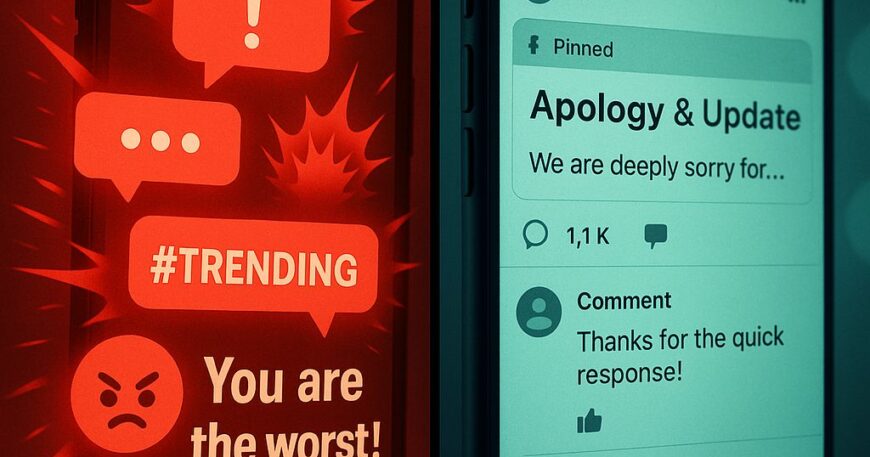
One negative comment can spiral into a full-blown crisis for your small business in minutes. I’ve seen it happen countless times: a customer complaint goes viral, an employee posts something inappropriate, or a well-intended message gets misinterpreted. Suddenly, you’re facing a tsunami of negative attention that threatens everything you’ve built.
For small businesses without dedicated PR teams, social media crises can be particularly devastating. According to CB Insights, 82% of businesses that experience severe reputation damage face significant revenue decline within a year. The good news? With the right approach and preparation, you can transform potential disasters into opportunities that actually strengthen your brand’s relationship with customers.
Crisis management isn’t just for large corporations with dedicated teams. Sprout Social, a leader in social media management solutions, found that small businesses that respond effectively to crises often experience higher post-crisis customer loyalty than businesses that never faced public challenges. The key lies in preparation, speed, and authenticity in your response.
When Social Media Turns Against Your Small Business
Social media moves at lightning speed. What starts as a single customer complaint can transform into a trending hashtag within hours. For small businesses, this speed presents unique challenges since you likely don’t have a dedicated social media team monitoring mentions 24/7. The democratized nature of social platforms means anyone can broadcast their grievances to the world, regardless of their follower count.
I’ve worked with dozens of small businesses that were blindsided by unexpected social media crises. The bakery, whose seasonal promotion was misinterpreted as culturally insensitive. The local hardware store that faced backlash after an employee’s personal political views were associated with the business. The family restaurant that received a one-star review from an influencer that went viral. For those looking to navigate such situations, here’s a guide on social media crisis management.
Why Small Businesses Are More Vulnerable to Social Media Crises
While larger corporations can weather social media storms with dedicated response teams and substantial brand equity, small businesses face unique vulnerabilities that make crisis management both more critical and more challenging.
Limited Resources and Staffing
Most small businesses operate with lean teams where each person already wears multiple hats. When a crisis hits, there’s rarely a dedicated communications professional ready to take charge. Instead, the owner or a staff member must drop everything to address the situation, often without specialized training in crisis communications. This resource constraint can lead to delayed responses or ineffective messaging that unintentionally escalates the situation.
In many cases, the person managing your social accounts may be a part-time employee or someone handling these responsibilities alongside other crucial operational duties. During a crisis, this divided attention can prove disastrous when every minute counts.
Less Brand Recognition Buffer
Established brands benefit from what crisis management professionals call “reputation capital” – the goodwill and familiarity they’ve built over years that provides some protection during controversies. Small businesses typically have less of this buffer. Your local coffee shop might have dedicated customers, but without widespread brand recognition, a single negative incident can disproportionately define your business to potential new customers.
This vulnerability is amplified by the fact that for many potential customers, a crisis might be their first exposure to your brand. Research from Edelman shows that 59% of consumers form an opinion about a brand after seeing how they respond to criticism online – making first impressions during a crisis particularly consequential for smaller businesses.
Local Reputation Dependency
Small businesses typically draw customers from a limited geographic area, making local reputation absolutely critical to survival. When a crisis erupts on social media, it quickly reaches your exact customer base rather than being diluted across a national audience. Your neighbors, community leaders, and local influencers are all witnessing how you handle the situation in real-time.
The interconnected nature of local communities means negative sentiment spreads quickly through word-of-mouth channels beyond social media itself. This geographical concentration of impact means small businesses must be particularly attentive to managing local perception during crises.
5 Common Social Media Crisis Scenarios for Small Businesses
Understanding the types of crises you might face is the first step in preparing for them. While each situation is unique, most social media crises fall into recognizable patterns that smart business owners can prepare for in advance.
- Customer service failures that escalate publicly
- Employee behavior that reflects poorly on your business
- Misinterpretation of marketing content or promotions
- Quality control issues amplified through customer sharing
- Being caught in broader social or political controversies
1. Customer Complaints Gone Viral
The most common crisis scenario begins with a legitimate customer complaint that, instead of being resolved through traditional channels, gets shared publicly and resonates with other users. What makes these situations particularly dangerous is that they often stem from real operational issues that need addressing. Consider the case of a local restaurant that failed to accommodate a customer with food allergies, leading to a detailed Facebook post that was shared over 10,000 times in their community.
These crises tend to gain traction because they tap into common consumer frustrations. Other customers who’ve had similar experiences (even minor ones) suddenly feel empowered to add their voices, creating a snowball effect. What might have been a single unhappy customer becomes a public referendum on your business practices.
The opportunity hidden within these crises is the chance to demonstrate your commitment to customer satisfaction. Businesses that respond with genuine concern, take visible corrective action, and follow up consistently often emerge stronger than before.
2. Employee Misconduct Shared Online
When an employee’s behavior reflects poorly on your business, the situation can quickly escalate into a full-blown crisis. This might involve an employee making inappropriate comments on their personal social media that gets linked to your business, or worse, captured on video behaving inappropriately while in uniform or at your business location.
These situations are particularly challenging because they involve navigating employment laws while also managing public perception. You need to balance responding decisively without violating an employee’s privacy or legal rights. Small businesses often struggle here because they lack dedicated HR and legal departments to guide their response.
The best protection comes from clear social media policies communicated during onboarding and reinforced regularly. Employees should understand how their personal online presence can impact the business and what the consequences might be.
3. Accidental Offensive Content
Even well-intentioned social media posts can spark outrage if they accidentally touch on cultural sensitivities or appear tone-deaf. I’ve seen small businesses face massive backlash after publishing humorous content that unintentionally offended certain groups, or jumping on trending topics without understanding their full context.
The challenge here is that what seems innocent to one person can be deeply offensive to another. Cultural blind spots are particularly dangerous because they often aren’t visible until after the damage is done. Without diverse perspectives reviewing content before posting, small businesses are especially vulnerable to these missteps.
4. Product/Service Failures Publicized
Quality control issues happen to every business, but when evidence of those failures gets shared on social media, the impact multiplies exponentially. Think about a bakery delivering a disastrous wedding cake, a contractor’s shoddy workmanship, or a salon’s haircut gone wrong – when these are documented and shared visually, they can devastate a small business’s reputation.
These crises are particularly challenging because the evidence is visual and compelling. Photos and videos of product failures tend to get shared far more widely than text-based complaints. For local businesses dependent on quality reputation, these visual failures can undermine years of positive word-of-mouth.
5. Being Caught in Broader Social Issues
Sometimes the crisis isn’t about anything you did but about broader social or political tensions that somehow involve your business. A local coffee shop might find itself labeled as “anti-police” after asking an officer to move her vehicle, or a restaurant might be accused of political bias based on which community groups it serves.
These situations are especially tricky because they often involve polarized perspectives where any response risks alienating some portion of your customer base. Small businesses that serve diverse communities particularly struggle with these scenarios, as taking a clear stance might seem necessary but comes with inherent risks.
The Real Cost of Mishandling a Social Media Crisis
The financial impact of a social media crisis extends far beyond temporary embarrassment. According to research by the University of Maryland, small businesses lose an average of 30% of their revenue during the month following a significant reputation crisis. The costs accumulate in both obvious and hidden ways, creating long-lasting damage that can take years to overcome.
Beyond immediate revenue losses, businesses face increased marketing costs to rebuild their reputation, potential legal expenses, and the operational costs of implementing remedial measures. For businesses already operating on thin margins, these additional expenses can be existentially threatening.
Immediate Revenue Impact
When a social media crisis erupts, the first place you’ll feel it is in your daily sales figures. Customers immediately distance themselves from businesses experiencing public relations problems, creating a sudden drop in revenue. For seasonal businesses or those with tight cash flow, even a 20% drop in sales for a few weeks can create serious financial strain.
What makes this impact particularly devastating is its timing – crises don’t wait for your slow season or when you have cash reserves. They often hit during otherwise normal operations when you’re unprepared for sudden revenue fluctuations.
Long-term Trust Erosion
While immediate revenue drops are painful, the more insidious damage comes from long-term erosion of customer trust. The digital footprint of your crisis remains searchable long after the immediate situation has passed. New potential customers researching your business months or even years later will encounter these negative stories, creating an ongoing barrier to growth. For more insights, you can explore navigating a social media meltdown.
Trust, once broken, requires significantly more investment to rebuild than it did to establish initially. This “trust tax” means you’ll need to invest more in marketing, provide deeper discounts, and demonstrate value more explicitly than competitors who haven’t faced similar crises.
Competitive Disadvantage in Local Markets
In competitive local markets, a social media crisis gives your competitors a significant opportunity. While you’re focused inward on damage control, they’re capitalizing on your weakened position. Many savvy competitors will increase their marketing spend specifically to capture customers during your vulnerable period.
The damage is most acute in industries where customers have many equivalent options and switching costs are low. Restaurants, retail stores, and service businesses are particularly vulnerable to this competitive disadvantage effect.
Build Your Crisis Management Plan Before You Need It
The worst time to develop a crisis management strategy is during a crisis. According to a Clutch survey, 59% of small businesses have no formal crisis management plan, yet those with established plans resolve crises 30% faster. Creating your strategy during calm times allows for thoughtful consideration rather than panic-driven reactions. Remember that crisis management isn’t just about damage control – it’s about protecting the business you’ve worked so hard to build.
Crisis Response Team Roles
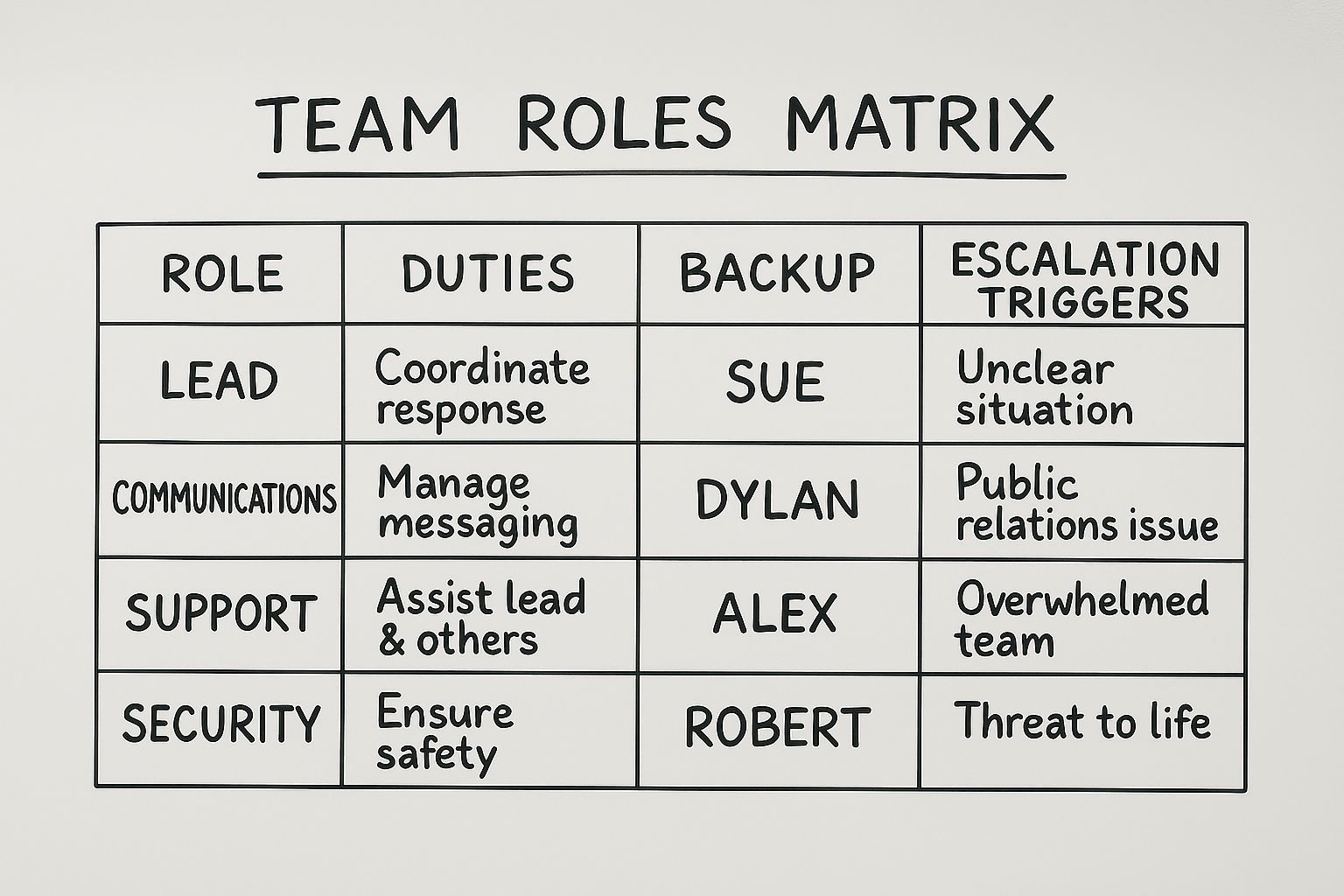
Even in the smallest organization, clearly defined roles prevent confusion when a crisis hits. At minimum, designate a primary decision-maker, a communications lead who will craft and deliver messages, and a customer response coordinator to handle direct inquiries. For solo entrepreneurs, consider which trusted advisors (your attorney, business mentor, or even family member) you’ll consult during different types of crises.
Document these roles formally, including backup persons for each position and specific situations when they should be contacted. Include all relevant contact information and preferred communication methods so team members can be quickly assembled when minutes matter.
Pre-approved Message Templates
When a crisis erupts, crafting thoughtful communications under pressure becomes nearly impossible. Develop templates for different scenario types that can be quickly customized with specific details. Include initial acknowledgment statements, follow-up messages, and resolution announcements that align with your brand voice while demonstrating appropriate concern.
These templates should include placeholders for specific details but provide the overall structure and tone for crisis communications. Having legal and leadership pre-approval on these templates eliminates dangerous delays when you need to respond quickly.
Social Listening Setup
You can’t manage a crisis you don’t know exists. Implement basic social listening tools to alert you to unusual spikes in mentions or negative sentiment. Free options like Google Alerts, TweetDeck search columns, and Facebook notifications provide basic coverage, while affordable tools like Mention and Hootsuite offer more comprehensive monitoring.
Configure alerts for your business name, key products, leadership names, and industry-specific terms that might indicate emerging issues. The earlier you detect potential problems, the more effectively you can prevent them from escalating into full-blown crises.
Clear Decision-making Authority
Crisis response requires quick decisions without the luxury of extended discussion. Establish clear authority guidelines that specify who can make what level of decisions during different crisis scenarios. This prevents dangerous delays while team members seek approvals or debate response options.
“The single biggest failure in crisis management is hesitation. When a small business owner tells me they waited to ‘see how things develop’ before responding, I already know they’ve made their situation significantly worse.” — Social Media Crisis Management Expert
Consider creating a decision matrix that outlines different crisis levels and the corresponding authority levels required. For example, minor customer complaints might be handled by any team member using approved language, while major reputation threats require owner involvement before any public statement.
Document exactly when escalation should occur and through what channels. This clarity eliminates the dangerous “wait and see” approach that allows small problems to become major crises.
Identify Your Risk Areas
Every business has unique vulnerability points where crises are most likely to emerge. Conduct a thorough risk assessment to identify your specific danger zones. Restaurant businesses might face food safety concerns, service businesses might have employee conduct risks, and product companies might face quality control issues.
Act Fast: The First 60 Minutes of Your Crisis Response
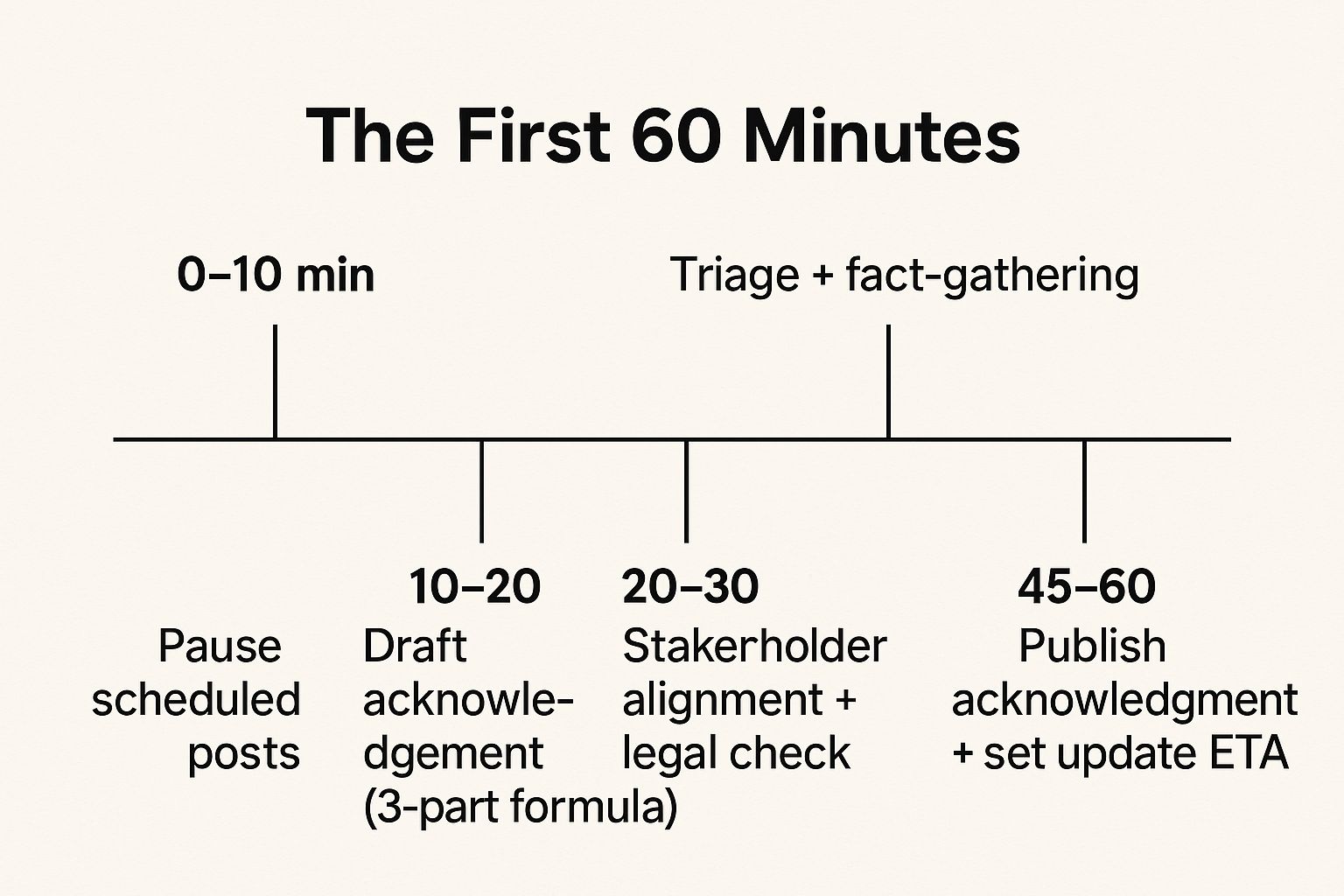
The initial hour after discovering a potential crisis largely determines its ultimate impact on your business. Research from Twitter shows that 60% of users expect brands to respond within an hour of a complaint, and this expectation intensifies during escalating situations. How you handle these critical first minutes sets the tone for everything that follows. Decisive early action can contain a situation before it spirals, while hesitation or missteps can transform a manageable problem into a full-blown crisis.
Follow-up Communications
After the immediate crisis response, strategic follow-up communications maintain transparency and demonstrate your ongoing commitment to resolution. These messages should provide updates on your progress, acknowledge any new information discovered, and reinforce the actions you’re taking. The timing is crucial—too frequent and you keep the issue alive unnecessarily, too sparse and stakeholders feel forgotten.
Most successful crisis recoveries include at least three follow-up communications: an initial update within 24-48 hours of your first response, a substantial progress report at the one-week mark, and a final resolution announcement. Each communication should be slightly more positive in tone as you move from acknowledgment toward resolution and rebuilding.
Want this 60-minute flow pre-built with templates and alerts? Try Catalyst Pro to automate the first hour and keep your team in lockstep.
Making Good on Promises
The promises you make during a crisis become your credibility test afterward. When you commit to specific actions—whether implementing new training, changing policies, or offering compensation—these commitments must be fulfilled completely and visibly. For instance, transforming workflows in healthcare can serve as a model for how to effectively implement changes.
“The difference between a temporary setback and permanent damage lies in what happens after the apology. Words matter, but actions prove them true.” — Crisis Communication Specialist
Document every promise made during your crisis response, assign clear ownership for each commitment, and establish concrete deadlines. Create a tracking system to ensure nothing falls through the cracks as the immediate pressure subsides. When delays are unavoidable, proactively communicate the reason and provide a revised timeline rather than hoping no one notices.
Consider creating tangible evidence of your follow-through that can be shared with stakeholders. This might include before-and-after photos of facility improvements, screenshots of updated policies, or testimonials from staff who completed new training programs.
Transparent Changes Based on Feedback
The most effective crisis recovery strategies incorporate meaningful changes based directly on the feedback received during the crisis. This demonstrates that you’re not just managing public relations but genuinely improving your business. When implementing these changes, explicitly connect them to the concerns raised, showing stakeholders that their voices directly influenced your actions. For example, enhancing ecommerce experiences can be a direct response to feedback about online shopping challenges.
Change Implementation Tracking
Feedback Received
Change Implemented
Completion Date
How We Communicated It
Customer complaints about response time
Added live chat support option
March 15, 2023
Email to all customers, social announcement
Concerns about staff training
New quarterly diversity training program
April 1, 2023
Blog post with photos, employee spotlights
Product quality inconsistency
Implemented new QA process
March 30, 2023
Behind-the-scenes video, updated packaging
The most powerful demonstrations of change come when you invite the original complainants to participate in developing solutions. The customer whose complaint sparked a crisis can become your most powerful advocate when they see their feedback creating positive change. Document these transformations through case studies, testimonials, or before-and-after comparisons that visualize the improvements.
Remember that transparency doesn’t require perfection—it’s about honest communication of both successes and continued challenges. Acknowledging where you’re still working to improve shows authenticity that resonates with customers far more than polished corporate messaging.
Case Study: How The Get Baked Bakery Turned “Illegal Sprinkles” Into a Brand Win
In October 2021, a small bakery in Leeds, UK called Get Baked faced an unusual crisis when they were reported to Trading Standards for using American sprinkles containing a food coloring (E127) that’s banned in the UK. Owner Rich Myers initially posted about the “sprinklegate” situation on Facebook with frustration and humor, explaining they’d have to pull their best-selling products because “British sprinkles are shit” compared to the American version.
Instead of responding defensively or quietly complying, Myers leaned into the absurdity of the situation with authenticity and humor. He provided transparent updates about the investigation, created limited-edition “illegal sprinkle” merchandise, and engaged with both supportive and critical comments with genuine personality. The crisis generated international media coverage, quadrupled the bakery’s social media following, and ultimately increased their business significantly. By transforming a potential compliance nightmare into a charming David-vs-Goliath narrative about bureaucracy and sprinkles, Get Baked demonstrated how small businesses can leverage their authenticity during crises to create stronger connections with customers than they had before.
Crisis Management Tools for Budget-Conscious Small Businesses
Effective crisis management doesn’t require enterprise-level tools with enterprise-level prices. Today’s small businesses can access powerful, affordable solutions that provide much of the functionality previously available only to corporate PR departments. The key is identifying which capabilities matter most for your specific business and investing strategically in those areas, such as enhancing ecommerce experiences.
Start with a core set of basic tools that cover monitoring, response management, and analysis. Many platforms offer free tiers or significant small business discounts that provide adequate functionality until you scale. The investment in even basic tools often pays for itself during a single well-managed crisis by reducing response time and improving message consistency.
Remember that the most powerful crisis management tool is preparation, which costs nothing but time. Documentation templates, response workflows, and scenario planning can be developed with basic word processing and spreadsheet programs you already use. These foundational elements often prove more valuable than sophisticated software during actual crises.
Free Social Listening Options
Social listening—monitoring mentions of your brand across platforms—provides early warning of potential issues before they escalate. Google Alerts remains the most accessible entry point, allowing you to monitor mentions of your business name, key products, and competitors across the web. Platform-specific tools like TweetDeck (for Twitter) and Facebook’s built-in notification settings provide free basic monitoring of your primary social channels.
For slightly more comprehensive coverage without cost, consider Mention’s free tier (which covers up to 1,000 mentions), Social Mention’s real-time search aggregator, and Hootsuite’s limited free plan. These tools won’t capture everything, but they’ll alert you to significant spikes in activity or especially visible mentions that might indicate emerging problems. The key to making free tools effective is precise configuration—focus on exact business name variations and highly specific product terms rather than broad industry keywords that generate too much noise.
Template Resources
Crisis response templates save critical time when minutes matter. Sites like Canva, HubSpot, and Buffer offer free crisis communication templates that can be customized to your brand voice. These include initial acknowledgment statements, apology frameworks, progress updates, and resolution announcements that provide professional structure while allowing personalization for specific situations.
When to Call in Professional Help
Recognize when a crisis exceeds your internal capabilities. Consider professional assistance when: the situation involves legal liability, threatens significant revenue loss, garners mainstream media attention, or involves sensitive issues beyond your expertise. Many PR professionals now offer crisis-specific services with project-based pricing rather than requiring retainers, making expert help more accessible to small businesses during critical moments.
Turning Crisis Into Opportunity: The Small Business Advantage
While crises create obvious challenges, they also present unique opportunities for small businesses to demonstrate values that strengthen customer loyalty. Your size becomes an advantage—you can respond with authenticity, make decisions quickly, implement changes rapidly, and demonstrate personal accountability in ways that larger corporations cannot. Research consistently shows that businesses that handle crises well often emerge with stronger customer relationships than those that never face public challenges. By approaching crisis management not just as damage control but as a chance to visibly demonstrate your values, you transform temporary setbacks into powerful brand-building moments that leave your business more resilient than before.
Frequently Asked Questions (FAQ)
The following questions address the most common concerns small business owners have about managing social media crises. These practical answers provide quick guidance for specific situations you may encounter during a reputation challenge. For more detailed strategies, you can explore social media crisis management guides. Remember that while these general principles apply broadly, each crisis has unique elements that may require customized approaches.
For ongoing support with social media crisis management, consider joining industry-specific business groups where you can learn from others’ experiences before facing similar challenges yourself. Many small business owners find that peer networks provide some of the most valuable practical advice for navigating complex reputation issues.
How quickly should I respond to a negative viral post about my business?
Aim to acknowledge the situation publicly within 60 minutes of discovery. This initial response doesn’t need to address every detail—it simply needs to demonstrate awareness and concern. A timely response prevents the narrative that you’re ignoring the issue and buys you time to develop a more comprehensive statement.
- For high-visibility issues: Respond within 30-60 minutes with at least an acknowledgment
- For moderate concerns: Respond within 2-3 hours with a more detailed statement
- For slow-building issues: Respond within 24 hours with a complete response
The speed required correlates directly with the visibility and spread of the negative content. A complaint with hundreds of shares needs immediate attention, while isolated criticism can receive a more measured response timeline. If you need more time to gather facts, your initial statement should acknowledge this explicitly: “We’re aware of concerns about [issue]. We take this seriously and are gathering complete information to address it properly. We’ll provide a full update by [specific time].”
Remember that response speed impacts both the original complainant and the much larger audience of observers forming judgments about your business based on how you handle the situation. Research shows 40% of consumers expect responses within an hour on social media, and this expectation intensifies during potential crisis situations.
Should I delete negative comments on my social media pages?
Generally, no—deleting legitimate criticism typically backfires by fueling accusations of censorship and dishonesty. Screenshots of deleted comments often circulate with greater visibility than the originals would have received. Instead, respond transparently to criticism, addressing concerns directly and demonstrating your commitment to resolution. This approach transforms negative comments into opportunities to showcase your customer service values.
There are limited exceptions where removal is appropriate: comments containing hate speech, harassment, threats, competitors posing as customers, or completely unrelated spam content. When removing content for these legitimate reasons, consider briefly documenting why in a general comment: “We welcome all feedback but have removed several comments that violated our community guidelines regarding enhancing eCommerce experiences. We’re continuing to address all legitimate concerns about [topic].”
What’s the difference between a social media crisis and just a few complaints?
A true crisis differs from routine negative feedback in scope, spread, and potential impact. Individual complaints typically focus on specific experiences, receive limited engagement, and can be resolved through standard customer service processes. A crisis involves wider criticism of your fundamental business practices or values, generates significant sharing and media interest, threatens your reputation beyond individual transactions, and requires leadership involvement in the response. The key indicators of crisis status include: unusual patterns of sharing or engagement, mainstream media interest, hashtag development around the issue, comments from people who aren’t customers, or coordinated criticism from multiple sources.
Do I need to respond to trolls during a social media crisis?
Distinguish between trolls (who seek attention through provocation without legitimate grievances) and angry stakeholders with genuine concerns. True trolls typically make outrageous claims, use inflammatory language, lack specific details about their experience with your business, and show a pattern of similar behavior toward multiple organizations.
For confirmed trolls, the best approach is usually a single professional response for the benefit of observers, then disengagement. This prevents feeding their desire for attention while demonstrating to other readers that you respond professionally to all comments. If their comments are particularly harmful, document examples before hiding or removing them according to your platform policies.
However, be careful not to dismiss legitimate criticism as trolling simply because it’s harshly worded. Many genuine customers express frustration in ways that might initially seem like trolling but stem from real negative experiences. When in doubt, provide a measured professional response that addresses any potentially legitimate concerns while avoiding escalation. For more insights, consider exploring how enhancing ecommerce experiences can improve customer satisfaction.
- True trolls: Respond once professionally, then disengage
- Angry customers: Address specific concerns and offer resolution paths
- Unclear situations: Respond professionally with benefit of doubt
- Coordinated attacks: Document patterns and consider platform support
How do I train my employees to prevent social media crises?
Effective employee training focuses on prevention, early detection, and appropriate response protocols. Start with a clear social media policy that distinguishes between personal and professional online presence, outlines prohibited content categories, and explains potential business impacts of inappropriate posts. Ensure this policy is included in onboarding materials and reviewed annually.
Role-playing exercises are particularly effective for crisis prevention training. Create realistic scenarios based on your industry’s common challenges and have employees practice identifying risk signals and implementing appropriate responses. This hands-on approach develops judgment skills that generic social media guidelines alone cannot provide.
Establish clear escalation protocols so employees know exactly when and how to alert leadership about potential issues. The most effective prevention systems include near-miss reporting, where employees can confidentially report situations that almost caused problems so the organization can learn without actual crises occurring. This creates a continuous improvement culture around crisis prevention rather than a blame-oriented environment that discourages transparency.
With a solid social media crisis management plan in place, your small business can confidently navigate even the most challenging online situations. Remember that preparation, swift response, and authentic communication are your most powerful tools for protecting and even strengthening your reputation. Sprout Social offers additional resources and tools to help small businesses develop comprehensive social media management strategies that turn potential crises into opportunities for growth.
Turn a crisis into a credibility win. Stabilize your reputation, replace negative chatter with trust-building stories, and regain qualified traffic in as little as 30 days with Catalyst’s tailored, done-for-you digital PR. Start your recovery at trycatalyst.ai.

