

Key Takeaways
- Pinterest has evolved beyond DIY and recipe boards to become a powerful B2B lead generation platform with 465 million monthly active users actively researching business solutions.
- B2B companies can leverage Pinterest’s visual discovery engine to showcase thought leadership content, infographics, and case studies that capture leads at the research stage of the buying journey.
- Strategic board organization and SEO-optimized pin descriptions are crucial for increasing visibility and driving targeted traffic to lead capture pages.
- Unlike saturated platforms like LinkedIn, Pinterest offers B2B marketers less competition and higher engagement rates, with pins having an average lifespan of 3-6 months versus hours on other platforms.
- LeadGenium’s comprehensive Pinterest marketing services can transform your B2B lead generation strategy with proven techniques that convert visual browsers into qualified prospects.
When thinking about B2B marketing, platforms like LinkedIn and Twitter typically dominate the conversation. Meanwhile, Pinterest quietly powers decision-making journeys for millions of professionals looking for business solutions, ideas, and inspiration. This overlooked platform represents an untapped goldmine for B2B marketers willing to venture beyond conventional lead generation channels.
The numbers tell a compelling story: Pinterest boasts over 465 million monthly active users, with business content gaining significant traction over recent years. What makes Pinterest particularly valuable for B2B is its role as a visual search engine where users actively seek information and solutions—precisely the mindset you want potential leads to have when encountering your brand. LeadGenium has identified Pinterest as one of the most underutilized yet powerful platforms for generating quality B2B leads that actually convert.
Why Pinterest is a B2B Lead Generation Goldmine
Pinterest functions fundamentally differently from other social platforms—it’s a discovery engine where users actively search for ideas and solutions rather than passively consuming content. This search-oriented behavior makes Pinterest users more receptive to business offerings than scrollers on traditional social media. For B2B marketers, this means connecting with potential leads who are already in a research and planning mindset, significantly shortening the path to conversion.
The platform’s visual nature offers a compelling advantage for complex B2B offerings. Concepts that might require lengthy explanations in text form can be communicated instantly through well-designed infographics, charts, and visual case studies. This visual-first approach helps technical or complicated B2B solutions become immediately accessible and engaging. Additionally, Pinterest content has remarkable longevity, with pins continuing to circulate and generate leads for months or even years—unlike the fleeting shelf-life of content on platforms like Twitter or LinkedIn.
Perhaps most significantly, Pinterest remains relatively uncrowded in the B2B space. While your competitors battle for attention on oversaturated platforms, Pinterest offers an opportunity to establish thought leadership and capture high-quality leads with substantially less competition. Early adopters in the B2B Pinterest space consistently report higher engagement rates and lower customer acquisition costs compared to traditional B2B channels.
Setting Up Your B2B Pinterest Profile for Lead Generation
Creating a Business Account That Converts
The foundation of effective Pinterest lead generation begins with a properly configured business account. Unlike personal accounts, business profiles on Pinterest provide access to crucial analytics, advertising capabilities, and rich pins—all essential tools for lead generation. The conversion process from a personal to a business account takes minutes but unlocks significantly expanded functionality. When setting up your profile, select your business type carefully as this influences how Pinterest categorizes and presents your content to potential leads.
Your profile image deserves strategic consideration—for B2B companies, using your logo creates brand recognition, while service-based businesses might benefit from featuring the face of key team members to build personal connection. Ensure your image is properly sized (165×165 pixels) and clearly visible even as a thumbnail, as this small visual cue significantly impacts click-through rates to your profile.
Strategic Board Creation for B2B Audiences
Boards are the organizational backbone of your Pinterest strategy, functioning essentially as topic-specific landing pages for different segments of your audience. Rather than creating generic boards, develop a strategic architecture that maps directly to your buyers’ journey and pain points. For example, a marketing automation company might create separate boards for “Lead Generation Strategies,” “Email Marketing Templates,” and “Marketing Automation Case Studies” to address different aspects of their solution and different stages of the buying process.

The order of your boards matters significantly for lead generation. Pinterest allows you to arrange boards strategically, so place your highest-converting content and lead magnets in the top row where they receive maximum visibility. Reserve at least one board specifically for direct lead generation content—pins that link directly to gated assets, webinar registrations, or consultation bookings. This “conversion board” should be prominently positioned and frequently updated to maintain its effectiveness as a lead capture mechanism.
Optimizing Your Profile Bio and Description
Your Pinterest bio might be limited to 160 characters, but it plays an outsized role in converting profile visitors into leads. Rather than generic company descriptions, craft a bio that speaks directly to your target audience’s challenges and positions your company as the solution provider. Include a clear value proposition and, whenever possible, incorporate relevant keywords that your ideal B2B customers might be searching for on the platform. For more insights, explore marketing on Pinterest to grow your email list.
Adding Website Verification and Rich Pins
Website verification is a critical step that many B2B marketers overlook when setting up their Pinterest presence. This simple process establishes your domain ownership, boosting your content’s credibility and visibility in Pinterest’s algorithm. More importantly, verification enables access to Pinterest Analytics for your website content, allowing you to track which pages generate the most engagement when shared on the platform. For businesses looking to further enhance their online presence, consider enhancing e-commerce experiences to maximize engagement.
Rich Pins represent another powerful lead generation tool exclusive to business accounts. These enhanced pins automatically pull metadata from your website, keeping information consistently updated and providing additional context for potential leads. For B2B marketers, Article Rich Pins are particularly valuable as they display your headline, author, and description directly on the pin, significantly increasing click-through rates for thought leadership content. Data shows that Rich Pins receive up to 70% more engagement than standard pins, making them essential for serious lead generation efforts.
High-Converting B2B Content Types on Pinterest
Success on Pinterest begins with understanding which content formats drive the highest engagement and conversion for B2B audiences. Unlike other platforms where promotional content often underperforms, Pinterest users actively save and engage with business content that provides clear value. The key is creating visually striking pins that blend professional insights with the platform’s aesthetic expectations.
Strategic content planning for Pinterest should focus on evergreen assets that continue generating leads long after publication. While trending topics may create short-term spikes in traffic, the real ROI comes from creating a foundation of durable content that addresses perennial business challenges. By balancing timely industry insights with evergreen resources, your Pinterest profile becomes a consistent lead generation engine requiring minimal maintenance.
Data-Driven Infographics That Get Saved
Infographics consistently outperform other content types for B2B lead generation on Pinterest, generating 3x more engagement than standard text-based pins. The platform’s vertical layout naturally accommodates long-form infographics that deliver substantial value while remaining visually compelling. When creating infographics for Pinterest, focus on proprietary data and insights that position your company as an industry authority while providing immediate value to viewers. For more strategies, explore marketing on Pinterest to grow your reach.
Industry Research and White Paper Promotion
Original research performs exceptionally well as Pinterest lead magnets, especially when key findings are transformed into visually striking pins. Rather than pinning PDF covers or generic graphics, extract the most compelling statistics or findings from your research and create standalone visual assets. These teaser pins should provide genuine value while creating curiosity gaps that motivate viewers to download the complete research through a lead capture form.
Case Study Highlight Pins
Case studies represent powerful social proof for B2B decision-makers, and Pinterest offers a unique format for showcasing client success stories. Create dedicated pins that highlight specific results achieved for clients, using bold typography to emphasize quantifiable outcomes like “42% Increase in Lead Conversion” or “68% Reduction in Customer Acquisition Costs.” These result-focused pins generate significantly higher click-through rates than generic brand content, especially when designed with clean, professional aesthetics that align with Pinterest’s visual environment. For more insights on enhancing online experiences, consider exploring enhancing e-commerce experiences.
Product Feature and Tutorial Pins
Tutorial and how-to content consistently ranks among Pinterest’s most saved content types across all categories. For B2B companies, process visualizations and step-by-step guides create both immediate value and lead generation opportunities. When creating tutorial pins, focus on addressing specific pain points in your customers’ workflows while subtly demonstrating how your solution addresses these challenges.
Thought Leadership Quote Graphics
Quote pins featuring insights from company leaders or industry experts perform exceptionally well for B2B brands on Pinterest. These simple yet effective pins build authority while requiring minimal production resources. The key to conversion-focused quote pins lies in selecting insights that challenge conventional wisdom or provide fresh perspectives on industry challenges. Each quote pin should link to expanded content like blog posts or lead magnets that develop the concept further, creating a natural pathway to lead capture.
Pinterest SEO Strategies for B2B Lead Generation
Keyword Research for B2B Pinterest Search
Pinterest functions primarily as a visual search engine, making keyword optimization essential for lead generation success. Unlike traditional SEO, Pinterest keyword research begins on the platform itself. The guided search feature reveals commonly searched terms as you type, providing valuable insights into how your target audience frames their business challenges. Competitive keyword analysis on Pinterest differs from Google SEO—examine which terms industry leaders rank for by analyzing their best-performing pins through tools like Tailwind.
B2B keyword selection on Pinterest should balance industry terminology with conversational phrases that reflect how decision-makers actually search when seeking solutions. While technical terms may accurately describe your offering, broader problem-based keywords often capture prospects earlier in their decision journey. For example, instead of targeting only “enterprise data integration solutions,” include pins optimized for “connecting business data systems” or “solving data silos problems.”
Pin Description Optimization Techniques
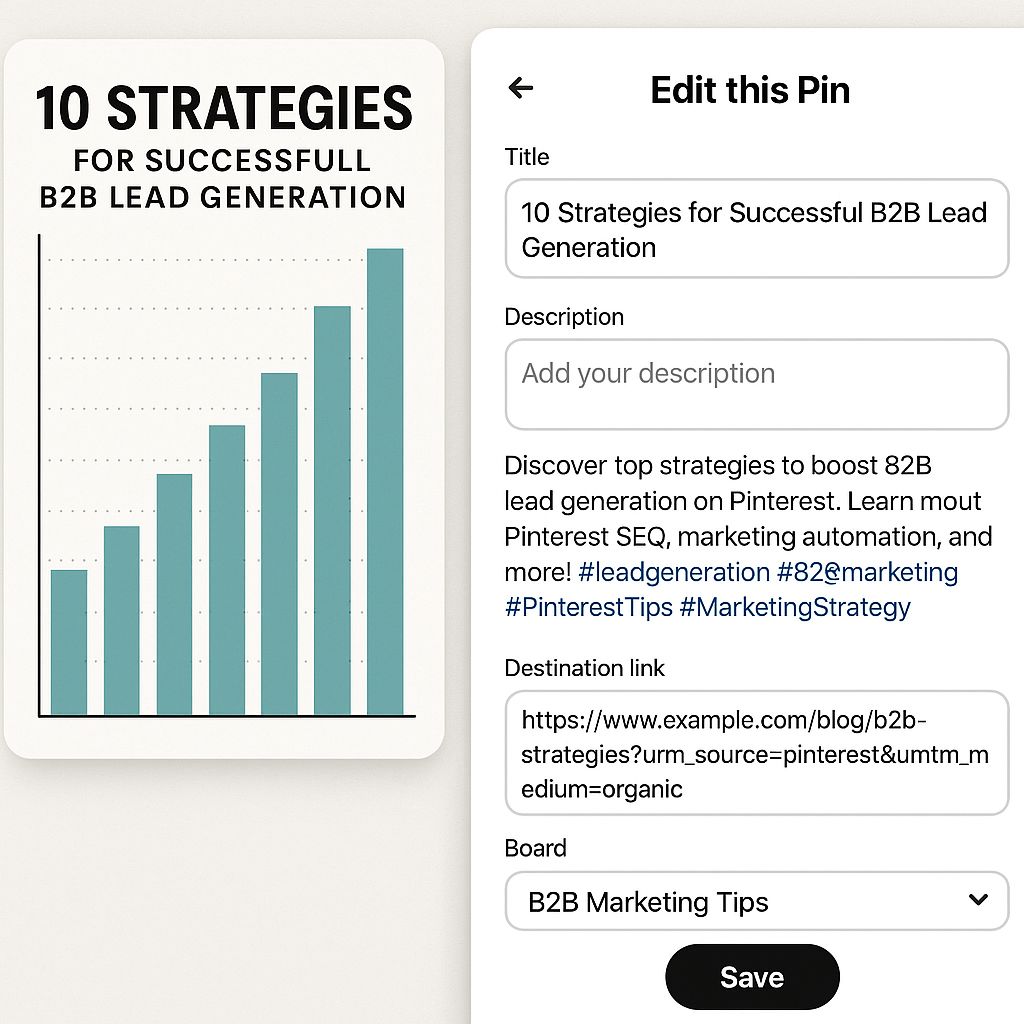
Pin descriptions serve as your primary SEO opportunity, with Pinterest allowing up to 500 characters to signal relevance to both the algorithm and potential leads. Front-load descriptions with primary keywords while maintaining natural, benefit-focused language that addresses specific business challenges. A strategic description follows a clear formula: lead with a compelling hook, integrate primary and secondary keywords naturally, and conclude with a specific call-to-action that creates urgency or curiosity.
Strategic hashtag usage amplifies your pin’s discoverability beyond keyword searches. Unlike Instagram’s approach to hashtags, Pinterest benefits from a restrained strategy focusing on 3-5 highly relevant tags per pin. Industry-specific hashtags perform particularly well for B2B content, helping your pins appear in niche searches conducted by qualified prospects. Regularly audit hashtag performance through Pinterest Analytics to refine your approach based on which tags generate the highest-quality traffic to your lead generation assets.
Board Organization for Maximum Visibility
Board structure significantly impacts your content’s discoverability and conversion potential. Each board should target specific keyword clusters relevant to different segments of your audience or stages of the buyer journey. Board titles and descriptions function as powerful SEO opportunities, with the platform giving significant weight to these elements when determining search relevance. Optimize both fields with primary keywords while ensuring they clearly communicate the value visitors will receive from the content collection. For more insights, explore this guide on marketing on Pinterest.
Strategic content organization within boards creates natural conversion pathways for potential leads. Arrange pins in a logical sequence that guides visitors from awareness content toward decision-stage assets that facilitate lead capture. This intentional content hierarchy helps prospects self-qualify and move naturally toward conversion without aggressive selling. For maximum lead generation effectiveness, periodically reorganize boards to feature high-converting pins in prominent positions while archiving underperforming content.
Real-World B2B Pinterest Success Stories
Nothing validates a strategy quite like real-world results. While many B2B marketers remain skeptical about Pinterest’s value for lead generation, several forward-thinking companies have already cracked the code and are quietly building robust lead pipelines through the platform. For those interested in learning more about how Pinterest can be leveraged for marketing success, check out this guide on marketing on Pinterest.
How MailChimp Uses Pinterest to Generate Leads
MailChimp has revolutionized their B2B lead generation approach by transforming their extensive knowledge base into Pinterest-friendly visual assets. Rather than simply promoting their email marketing platform directly, they’ve created dedicated boards covering topics like “Email Marketing Best Practices,” “Small Business Tips,” and “Design Inspiration” that attract their ideal customers during the research phase.
Their most brilliant strategy involves creating pin-worthy templates and examples that subtly showcase their platform’s capabilities. Each template pin links to a landing page offering the downloadable resource in exchange for contact information. This approach has generated thousands of qualified leads specifically interested in email marketing solutions while positioning MailChimp as a helpful resource rather than just another vendor.
The company reports that Pinterest-generated leads convert to paid accounts at a 34% higher rate than their average digital lead sources, attributing this success to the self-qualifying nature of Pinterest’s search functionality. By meeting prospects exactly where they’re actively seeking solutions, MailChimp captures leads with genuine interest and purchase intent.
HubSpot’s Pinterest Strategy Breakdown
HubSpot’s strategic approach to Pinterest centers on transforming their extensive blog content into highly visual pin formats that serve as entry points to their lead generation funnel. Their boards are meticulously organized around specific buyer personas and challenges, with titles like “Marketing Data & Analytics” and “Sales Strategy Resources” that appeal directly to their target audience’s professional interests. By repurposing existing content into Pinterest-optimized formats, HubSpot maximizes their content investment while creating new touchpoints for potential leads.
Adobe’s Creative Approach to B2B Pinterest Marketing
Adobe brilliantly leverages Pinterest’s visual nature to showcase how their B2B solutions enable creative outcomes. Instead of focusing on product features, they curate inspiration boards that demonstrate what’s possible with their software. Their “Adobe Creative Cloud for Enterprise” board features case studies and examples from major brands, attracting creative directors and marketing leaders from enterprise organizations. This inspiration-first approach generates high-quality leads by appealing to decision-makers’ aspirational goals rather than immediate functional needs—a strategy particularly effective for complex B2B sales with multiple stakeholders.
Integrating Pinterest into Your Broader B2B Marketing Strategy
Pinterest-to-CRM Pipeline Framework
1. Visual Discovery (Pinterest) → Optimized pins drive traffic to targeted landing pages
2. Lead Capture (Website) → Visitors exchange information for high-value content
3. CRM Integration → Leads tagged with Pinterest source for attribution
4. Automated Nurturing → Pinterest-specific sequences based on content interests
5. Sales Handoff → Qualified leads transferred to sales with Pinterest engagement history
Pinterest shouldn’t exist in isolation from your other marketing channels. The platform’s true power emerges when it’s strategically integrated into your broader marketing ecosystem. This integration begins with content planning—developing a unified strategy where content themes and campaigns span across platforms while being optimized for each channel’s specific formats and audience behaviors.
For maximum lead generation efficiency, establish clear pathways from Pinterest engagement to your CRM system. Every pin should connect to a specific stage in your marketing funnel, whether driving awareness, nurturing consideration, or facilitating decision-making. This intentional mapping ensures that Pinterest traffic doesn’t simply generate vanity metrics but contributes meaningful progress toward conversion goals.
Analytics integration plays a crucial role in measuring Pinterest’s contribution to your lead generation efforts. Implement UTM parameters on all Pinterest links to track traffic sources accurately, and configure conversion events to attribute leads properly. This data-driven approach allows for continuous optimization based on which content types and topics generate not just traffic, but qualified leads that progress through your pipeline.
Consider Pinterest’s unique position in the buyer’s journey when integrating it with other channels. While LinkedIn might excel at direct prospect engagement and Twitter at real-time conversation, Pinterest specializes in inspiration and discovery—often capturing prospects earlier in their decision process. This earlier touchpoint creates opportunities for longer nurturing sequences and more comprehensive lead development before sales engagement.
Make every pin attributable. Pipe Pinterest UTM traffic into Catalyst Pro and auto-nurture by topic interest. → trycatalyst.com
Content Repurposing Framework
Developing a systematic approach to content repurposing significantly enhances your Pinterest ROI. Start by auditing existing content assets like webinars, white papers, case studies, and blog posts to identify high-performing material worth transforming into Pinterest formats. For each piece of cornerstone content, create multiple pin variations that highlight different aspects, statistics, or applications to maximize search visibility and appeal to different segments of your audience.
The most successful B2B Pinterest marketers develop templated processes for transforming various content types into platform-optimized formats. For instance, webinars can be segmented into concept graphics and quote pins, while research reports can generate multiple data visualization pins linking to the full download. This systematic approach ensures consistent visual branding while dramatically increasing your content’s reach and lead generation potential without requiring entirely new content creation. Learn more about enhancing e-commerce experiences with effective visual strategies.
Cross-Platform Promotion Techniques
Strategic cross-promotion amplifies your Pinterest presence across channels where your B2B audience already engages. Incorporate Pinterest-specific calls-to-action in relevant blog posts, encouraging readers to save content for later reference—a natural behavior that aligns with how B2B researchers compile resources during decision processes. Email newsletters represent another effective channel for Pinterest promotion, particularly by highlighting themed boards relevant to subscriber segments or featuring your most valuable pins as visual content within the email itself.
LinkedIn and Pinterest can function as complementary channels when strategically aligned. Share your most successful Pinterest boards with relevant LinkedIn groups or in industry discussions, positioning them as curated resource collections rather than promotional content. This approach provides immediate value to your LinkedIn connections while building your Pinterest following among qualified industry professionals who might not otherwise discover your presence on the platform. For more insights on utilizing Pinterest for professional growth, consider exploring strategies for marketing on Pinterest.
CRM Integration for Lead Nurturing
Sophisticated B2B marketers develop Pinterest-specific nurturing sequences based on the boards and pins that generate initial engagement. A prospect who discovers your brand through a technical how-to guide requires different follow-up content than someone who engaged with thought leadership content. By tagging leads with their specific Pinterest entry points, you can deliver precisely targeted nurturing content that builds on their established interests rather than generic messaging.
Sales enablement represents another critical integration point for your Pinterest strategy. Equip sales teams with insights about prospects’ Pinterest engagement patterns, including which topics, solutions, or case studies generated interest. This intelligence allows for more relevant initial conversations and demonstrates a deeper understanding of the prospect’s specific challenges. Some advanced B2B teams even create private Pinterest boards for specific enterprise prospects, curating relevant resources throughout the sales process to maintain engagement between formal touchpoints.
Your Action Plan for Pinterest B2B Lead Generation
Begin your Pinterest B2B journey with a 90-day implementation roadmap: Days 1-7 focus on account setup and competitive analysis; Days 8-30 concentrate on creating cornerstone content and optimized boards; Days 31-60 implement active pinning schedules and initial promotion; and Days 61-90 analyze performance, refine strategies, and scale successful approaches. Throughout this process, maintain a testing mindset—Pinterest success comes from continuous refinement based on performance data. Start with a focused approach targeting a specific segment of your audience with highly relevant content rather than attempting to address your entire market immediately. This focused execution allows for meaningful data collection and strategy optimization before expanding to broader audience segments. Remember that consistency matters more than volume—a strategic presence maintained over time will generate significantly better results than sporadic bursts of activity followed by silence.
Frequently Asked Questions
As Pinterest continues to gain traction as a B2B marketing channel, marketers naturally have questions about implementation and effectiveness. These answers address the most common concerns based on data and proven results from companies successfully leveraging the platform.
Is Pinterest really effective for B2B marketing compared to LinkedIn?
Pinterest and LinkedIn serve fundamentally different functions in the B2B marketing ecosystem. LinkedIn excels at direct professional networking and targeted advertising to specific job titles, while Pinterest functions as a visual discovery platform where professionals research ideas and solutions. The effectiveness comparison depends on your specific objectives and audience behavior. For example, if you are interested in enhancing e-commerce experiences, Pinterest might offer unique advantages.
What makes Pinterest uniquely valuable for B2B is its position earlier in the buyer’s journey. While LinkedIn typically engages prospects already aware of their needs, Pinterest captures potential leads during their initial research and inspiration phase. This earlier touchpoint can be incredibly valuable for complex B2B sales with long consideration cycles, particularly in industries like healthcare, where decision-making can be intricate and lengthy.
- Pinterest content has a significantly longer lifespan (3-6 months) than LinkedIn posts (24-48 hours)
- Pinterest users demonstrate higher intent and focused research behavior
- The platform experiences less saturation in B2B categories, offering lower competition
- Visual content on Pinterest can communicate complex B2B concepts more effectively than text-heavy LinkedIn posts
Rather than viewing them as competing channels, strategic B2B marketers integrate both platforms—using Pinterest for content discovery and initial lead generation, then leveraging LinkedIn for relationship development and direct engagement throughout the sales process.
The data supports this complementary approach: companies using both platforms report 27% higher lead quality and 41% better content engagement than those relying on LinkedIn alone. The visual discovery aspect of Pinterest often captures prospects with problems they haven’t yet fully articulated—a valuable opportunity to shape their buying criteria from the earliest stages.
How long does it take to see lead generation results from Pinterest?
Pinterest typically delivers a longer runway to results compared to paid advertising channels, but with substantially better long-term ROI. Most B2B companies begin seeing meaningful traffic within 30-45 days of implementing a strategic Pinterest presence, with lead generation following as that traffic encounters optimized conversion pathways. The platform’s algorithm favors consistent activity over time, meaning results compound as your profile history and engagement metrics build.
Companies that approach Pinterest with a minimum six-month commitment consistently report reaching positive ROI between months three and four. This timeline reflects the platform’s search engine characteristics—pins require indexing and performance history before gaining significant visibility. For fastest results, focus initial efforts on 2-3 high-value conversion assets supported by 12-15 pins each, rather than attempting to build out a comprehensive profile immediately. This concentrated approach accelerates algorithm recognition for your most valuable content while establishing performance metrics that inform subsequent strategy development.
What’s the ideal posting frequency for B2B content on Pinterest?
Consistency matters more than volume when establishing a B2B presence on Pinterest. Analysis of high-performing B2B accounts shows that publishing 3-5 strategically optimized pins per week generates better results than daily posting of lower-quality content. This moderate frequency allows for proper keyword research, design quality, and strategic alignment while maintaining the consistent activity signals that Pinterest’s algorithm rewards.
Beyond raw posting frequency, strategic scheduling significantly impacts performance. Pinterest traffic patterns differ from other social platforms, with peak B2B engagement occurring during weekday lunch hours and early evenings when professionals are researching solutions outside formal meetings. Advanced Pinterest marketers leverage these patterns by scheduling pins during high-engagement windows while maintaining consistent overall activity. Rather than focusing exclusively on new pin creation, allocate time for engagement activities like board reorganization, pin optimization updates, and strategic repinning of high-performing content to maximize visibility without requiring constant content production.
Do I need a large budget to generate B2B leads on Pinterest?
Pinterest offers one of the most cost-effective entry points for B2B lead generation compared to other digital channels. The platform’s relative underutilization in B2B categories means lower competition for visibility and engagement, allowing even modest investments to generate meaningful results. For companies already producing content for other channels, Pinterest requires primarily an investment in optimization and repurposing rather than net-new content development.
A minimal viable Pinterest lead generation program can be established with just three key investments: professional design templates for consistent visual branding (one-time cost of $200-500), scheduling and analytics tools like Tailwind ($15-30 monthly), and time allocation for strategy and optimization (typically 2-4 hours weekly). This lean approach can generate positive ROI within 90 days for most B2B companies by focusing efforts on highest-value content and conversion paths.
- Design resources: Use tools like Canva Pro ($12.99/month) with professionally designed templates
- Content optimization: Focus on repurposing existing assets rather than creating entirely new content
- Strategic promotion: Start with organic strategies before testing small-scale promoted pins
- Analytics: Leverage free built-in Pinterest analytics before investing in premium tools
- Time investment: Begin with 3-5 hours weekly, focusing on high-impact activities
For companies ready to accelerate results, Pinterest’s advertising platform offers remarkably cost-effective lead generation compared to LinkedIn or Google. Promoted pin campaigns targeting business decision-makers typically see CPCs 40-60% lower than comparable LinkedIn campaigns while maintaining similar or better lead quality. This efficiency makes Pinterest particularly valuable for businesses with limited digital advertising budgets looking to maximize lead generation potential.
The platform’s organic reach also remains significantly stronger than most social networks, allowing companies to build substantial visibility without paid promotion. This organic foundation creates a multiplier effect when selective paid promotion is added to the strategy, reducing overall customer acquisition costs compared to channels requiring continuous ad spend to maintain visibility. For companies looking to further enhance their digital presence, exploring ecommerce experiences can provide additional insights and strategies.
What types of B2B businesses perform best on Pinterest?
While conventional wisdom suggests Pinterest works primarily for visually-oriented B2B offerings, performance data reveals success across diverse B2B categories. The defining factor isn’t industry but rather the ability to translate business challenges and solutions into visual formats that resonate with the platform’s aesthetic and user behavior patterns.
Companies offering services or solutions that address visual aspects of business naturally find traction more quickly—marketing agencies, design services, presentation solutions, and workplace environment providers show consistently strong performance. However, even traditionally “non-visual” B2B categories like enterprise software, financial services, and industrial solutions have developed successful Pinterest strategies by focusing on the visual representation of outcomes, processes, or data rather than the products themselves.
SaaS companies particularly excel by creating visual representations of the workflows, integrations, and results their solutions enable rather than focusing on interface screenshots. Professional services firms find success by visualizing methodologies, frameworks, and case study results instead of abstract service descriptions. Manufacturing and industrial businesses generate engagement through process visualization, application examples, and innovative uses of their products in context.
The consistent factor among successful B2B Pinterest marketers isn’t industry categorization but rather a commitment to translating complex offerings into visually compelling content that addresses specific professional challenges. By focusing on the visual representation of problems solved rather than products offered, virtually any B2B company can develop an effective Pinterest lead generation strategy. For example, enhancing eCommerce experiences can be visually communicated to attract potential leads.
Turn Pinterest Saves into Qualified Pipeline
Catalyst Pro connects your Pinterest traffic to lead capture, scoring, and CRM—so your best-performing boards and pins become repeatable revenue plays. To start your Catalyst Pro trial, visit trycatalyst.com

