
Key Takeaways
- AI marketing automation can help SMBs achieve personalization at scale, reducing manual work by up to 30% while increasing engagement rates by 40-60%
- Small businesses implementing AI marketing tools see an average ROI of 42% within the first six months compared to traditional marketing methods
- Modern AI platforms now offer affordable entry points starting at $50-200/month, making enterprise-level capabilities accessible to businesses of all sizes
- Without AI automation, SMBs risk falling behind competitors, with 76% of consumers expecting personalized experiences that are nearly impossible to deliver manually
- The most effective implementation approach starts with identifying high-impact use cases like lead scoring and content generation before expanding to more complex applications
The marketing automation landscape has transformed dramatically for small and medium-sized businesses. What once required enterprise-level budgets and dedicated technical teams is now accessible to companies of all sizes through AI-powered solutions that are both affordable and user-friendly. Salesforce research shows that 56% of SMBs using AI marketing automation save approximately 30% of their time on day-to-day operations – critical for small teams juggling multiple priorities.
AI Marketing Automation in 2025: What Small & Medium Sized Businesses Need to Know Right Now
AI marketing automation has evolved from simple email scheduling tools to comprehensive platforms that analyze customer behavior, predict outcomes, and execute personalized campaigns across multiple channels simultaneously. The technology now incorporates machine learning algorithms that continuously improve performance based on real-world results, moving beyond rule-based automation into truly intelligent systems that can make autonomous decisions to optimize marketing performance.
Marketing Automation Technology Has Changed Dramatically
The marketing technology stack available to small businesses in 2025 bears little resemblance to tools from just a few years ago. Today’s AI marketing platforms offer sophisticated capabilities once reserved for enterprise companies with seven-figure budgets. Natural language processing has advanced to create compelling marketing copy that rivals human writers. Computer vision can analyze and optimize visual content for maximum engagement. Predictive analytics can now forecast customer behavior with uncanny accuracy, allowing even the smallest businesses to anticipate needs rather than simply react to them.
What Happens If You Don’t Adopt AI Marketing Tools
SMBs that hesitate to implement AI marketing automation face significant competitive disadvantages in today’s marketplace. Without these tools, businesses struggle to meet the personalization expectations that 76% of consumers now demand as standard. Manual marketing processes simply cannot scale to deliver individualized experiences across multiple channels. The opportunity cost manifests in higher customer acquisition costs, lower retention rates, and marketing teams stuck in tactical execution rather than strategic planning. As competitors leverage AI to deliver more relevant content faster and at lower costs, the performance gap widens exponentially over time.
The Real ROI Numbers for Small Businesses
The financial case for AI marketing automation is compelling for SMBs. According to recent industry benchmarks, businesses implementing these systems see an average 42% return on investment within the first six months. This typically breaks down into three components: cost reduction through automation of manual tasks (15-20% savings), revenue increases from improved conversion rates (10-25% lift), and efficiency gains allowing reallocation of marketing resources to high-value activities (20-30% productivity improvement). For a typical small business, this can translate to thousands in monthly savings while simultaneously driving growth.
Modern AI marketing platforms offer tiered pricing models that make sophisticated capabilities accessible even to businesses with modest budgets. Entry-level packages from leading providers now start between $50-200 per month, with scalable options that grow with your business. The democratization of these technologies means small businesses can now access capabilities that would have cost tens of thousands of dollars just a few years ago.
5 Ways AI Marketing Automation Solves Your Biggest SMB Challenges
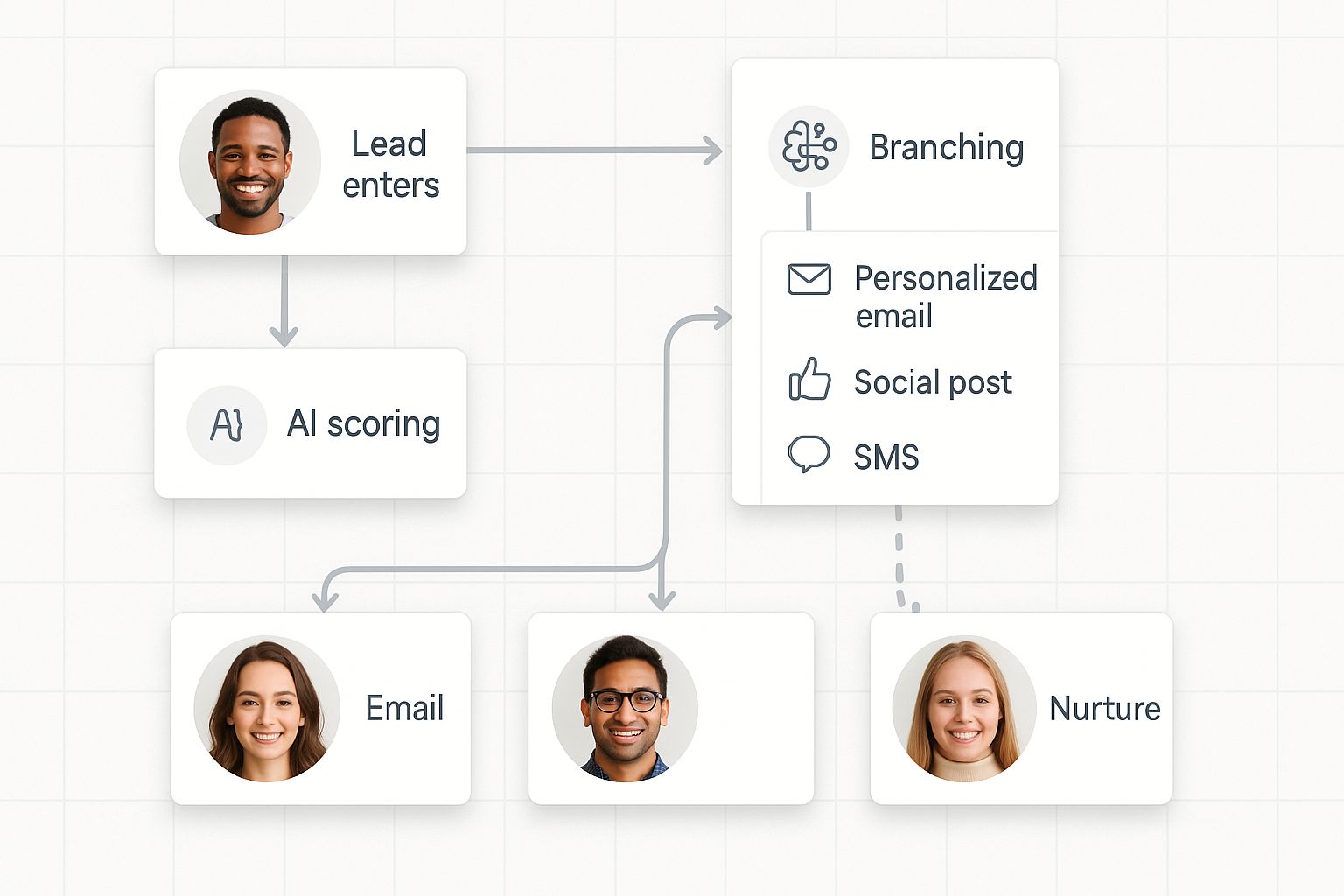
A clean, photo-realistic UI mock of an automation canvas: lead enters → AI scoring → branching to personalized email/social/SMS → conversion → nurture. Include human faces in small profile cards to emphasize real customers.Small businesses face unique marketing challenges – limited resources, small teams handling multiple responsibilities, and the need to compete with larger organizations. AI marketing automation specifically addresses these pain points by multiplying the effectiveness of existing resources. Rather than requiring more staff or larger budgets, these tools allow SMBs to work smarter with what they already have, often producing results that rival much larger competitors.
“The biggest game-changer for our business wasn’t adding more marketers – it was implementing AI tools that made our small team perform like a department three times its size. We’re now running sophisticated multi-channel campaigns that would have been impossible manually.” – Sarah Chen, Founder of GrowthWave Solutions
1. Personalization at Scale Without Hiring More Staff
AI marketing platforms enable SMBs to deliver individualized customer experiences without expanding headcount. These systems can analyze thousands of data points across customer interactions, identifying patterns and preferences invisible to human observation. The technology then automatically tailors content, offers, and timing to match individual customer journeys. A single marketer using AI can now manage personalized communications for thousands of prospects simultaneously, achieving engagement rates 40-60% higher than generic messaging. This capability is particularly valuable for small businesses where each team member already wears multiple hats.
2. Customer Journey Optimization That Actually Works
AI engines excel at mapping and optimizing the entire customer journey from awareness to advocacy. Unlike traditional marketing approaches that struggle to connect touchpoints across different channels, AI systems can track, analyze, and respond to customer behavior in real-time across your website, email, social media, and even offline interactions. The technology identifies friction points and missed opportunities invisible to manual analysis. For SMBs, this means dramatically improved conversion rates at each stage of the funnel without the extensive A/B testing and analytics expertise previously required.
3. Content Creation in Minutes Instead of Days
Content creation has traditionally been a major bottleneck for small marketing teams. AI content generation tools now produce high-quality marketing copy, social media posts, email sequences, and even basic design elements in minutes rather than days. These systems can maintain consistent brand voice while adapting messaging for different channels and audience segments. The most advanced platforms integrate with customer data to generate personalized content variations automatically. SMBs using these tools report 70-80% time savings on content production while simultaneously increasing output volume by 3-5x.
Most importantly, modern AI doesn’t replace human creativity but amplifies it. Marketers can focus on strategic direction and refinement while the AI handles production-level work. This partnership between human strategy and AI execution represents the optimal approach for resource-constrained small businesses.
4. Budget Optimization Through Predictive Analytics
AI marketing platforms shine in their ability to optimize limited budgets for maximum impact. These systems analyze historical performance data across channels to predict which tactics will generate the highest return for specific audience segments. The technology can automatically redistribute spending in real-time based on performance, ensuring marketing dollars flow to the highest-performing channels and campaigns. Small businesses using AI-driven budget optimization typically see 25-35% improvement in marketing ROI without increasing overall spending. This capability is particularly valuable for SMBs that can’t afford the trial-and-error approach larger companies might use.
5. Lead Scoring and Nurturing on Autopilot
Converting leads into customers requires consistent follow-up and personalized engagement – activities that often fall through the cracks in busy small businesses. AI marketing automation excels at scoring leads based on likelihood to convert, then executing appropriate nurturing sequences automatically. The technology can detect subtle buying signals, trigger relevant communications, and alert sales teams at the optimal moment for human intervention. For small businesses with limited sales resources, this ensures focus remains on the highest-potential opportunities while maintaining engagement with early-stage prospects. The result is typically a 35-50% increase in qualified opportunities from the same lead volume.
The Essential AI Marketing Tools Every SMB Needs in 2025
The marketing technology landscape can be overwhelming for small businesses with limited time to evaluate options. Rather than attempting to implement dozens of specialized tools, SMBs should focus on core platforms that deliver the highest impact. The ideal approach is selecting integrated systems that cover multiple functions rather than piecing together numerous point solutions. This strategy reduces complexity, minimizes integration challenges, and accelerates time to value.
Customer Data Platforms with Predictive Capabilities
At the foundation of effective AI marketing sits the customer data platform (CDP) – the central hub that unifies information from all customer touchpoints. Modern CDPs go beyond simple data storage to include predictive modeling that identifies patterns and forecasts future behavior. These systems create comprehensive customer profiles that power personalization across all marketing activities. For SMBs, the most important features include automatic data enrichment that fills gaps in customer profiles, segment creation based on behavioral patterns, and predictive scoring that identifies high-value prospects before they self-identify. When evaluating options, prioritize platforms with pre-built connectors to your existing business systems and user-friendly interfaces designed for marketers rather than data scientists.
AI Content Generation and Optimization Tools
Content creation tools powered by AI have evolved dramatically in capabilities and user-friendliness. The most effective platforms now generate marketing copy that matches your brand voice, create variations for different channels and audiences, and optimize content based on performance data. These systems can produce everything from email subject lines to complete blog posts, social media campaigns, and even basic design elements. For small businesses, the key differentiating features include multi-format output capabilities, integration with your customer data for personalization, and learning algorithms that improve output quality over time by analyzing engagement metrics. The best platforms now include built-in compliance and brand guideline enforcement to ensure all AI-generated content meets your standards.
When selecting content tools, focus on solutions that balance automation with human oversight. The ideal workflow allows marketers to provide strategic direction and refinement while the AI handles production-level work. This partnership between human creativity and AI execution represents the optimal approach for resource-constrained small businesses.
Conversational Marketing Platforms
AI-powered conversational marketing represents one of the most significant advancements for small business customer engagement. These platforms go far beyond basic chatbots to create interactive experiences that qualify leads, answer questions, and guide prospects through personalized journeys. The most effective systems integrate with your customer data to maintain context across interactions and can hand off to human team members at the appropriate moment. For SMBs, key features include 24/7 availability without staffing costs, natural language processing that understands intent rather than just keywords, and learning capabilities that improve responses based on historical interactions.
When selecting a conversational platform, prioritize solutions that operate across multiple channels including website, messaging apps, and social media. This omnichannel capability ensures consistent customer experiences regardless of how prospects choose to engage with your business. The return on investment typically comes from lead qualification efficiency, with AI systems pre-qualifying prospects before human follow-up, resulting in 30-40% higher sales team productivity.
Automated Campaign Management Systems
Modern campaign management platforms use AI to orchestrate multi-channel marketing efforts with minimal human intervention. These systems can plan, execute, measure, and optimize campaigns across email, social, advertising, and web channels simultaneously. The most advanced platforms incorporate predictive analytics to forecast campaign performance and automatically adjust tactics to maximize results. For small businesses, the most valuable features include drag-and-drop campaign builders that don’t require technical skills, built-in testing capabilities that optimize messaging, and budget management tools that allocate spending to highest-performing channels.
When evaluating options, look for platforms that offer pre-built campaign templates specific to your industry. These templates encapsulate best practices and dramatically accelerate implementation. Also prioritize solutions with robust reporting dashboards that translate complex data into actionable insights accessible to non-technical team members.
How to Choose the Right AI Marketing Platform for Your Budget
Selecting the right AI marketing platform requires balancing capabilities against cost constraints. The good news for small businesses is that competition has driven providers to create tiered offerings that make sophisticated technology accessible at various price points. The key is identifying which features deliver the highest value for your specific business model and growth objectives.
Price-to-Feature Ratio: What Actually Matters
When evaluating platforms, focus on capabilities that directly address your most pressing marketing challenges rather than the longest feature list. A platform with fewer features that perfectly align with your needs will deliver more value than a comprehensive system with capabilities you’ll never use. Most small businesses should prioritize ease of use, automation of repetitive tasks, and analytics that provide actionable insights. Advanced capabilities like predictive modeling and multi-variant testing become more valuable as your marketing sophistication increases.
Many providers now offer modular pricing that allows you to start with core functionality and add capabilities as needed. This approach minimizes upfront investment while providing a clear upgrade path as your needs evolve. When comparing costs, calculate the total value including time savings, potential revenue increases, and reduced need for additional staff or external agencies.
Integration Requirements with Your Existing Tech Stack
The value of any AI marketing platform depends heavily on its ability to connect with your existing business systems. Seamless data flow between your CRM, e-commerce platform, customer service tools, and marketing automation is essential for creating unified customer experiences. Before committing to any solution, verify the availability of pre-built connectors for your critical systems and the quality of the provider’s API if custom integrations will be needed.
For small businesses with limited technical resources, prioritize platforms that offer managed integration services or partner networks that can handle setup and maintenance. The most cost-effective approach is often selecting platforms within the same ecosystem as your core business systems, as these typically offer deeper integration capabilities with less complexity.
Scalability Considerations as Your Business Grows
The right AI marketing platform should accommodate your current needs while scaling to support future growth. Key scalability factors include pricing models that don’t penalize success with prohibitive costs as your customer base expands, technical architecture that maintains performance as data volumes increase, and feature sets that support more sophisticated marketing as your team’s capabilities mature. For more insights, explore how enhancing ecommerce experiences can contribute to scalability.
When evaluating options, ask providers about customers similar to your business who have grown successfully on their platform. Understanding the experiences of companies that started small and scaled can provide valuable insights into potential limitations or advantages that may not be apparent during initial evaluation. For more insights, you might want to explore this complete guide on AI automation tools.
Support and Training Options
Even the most user-friendly AI marketing platforms require some level of training and occasional support. For small businesses with limited in-house expertise, comprehensive onboarding, accessible training resources, and responsive support are critical success factors. When comparing options, investigate the quality of documentation, availability of live support across your business hours, and training resources specifically designed for non-technical users.
The most effective platforms now offer AI-powered assistance within the tools themselves, providing contextual guidance and troubleshooting as users work. This capability can significantly reduce the learning curve and dependency on external support, making it particularly valuable for small teams juggling multiple responsibilities.
Implementation Blueprint: Your 30-Day Plan to Launch AI Marketing
Successfully implementing AI marketing automation requires a structured approach that balances quick wins with long-term strategic objectives. This 30-day blueprint provides a framework for small businesses to launch effectively without overwhelming their teams or disrupting existing marketing activities.
Week 1: Audit and Goal Setting

Begin by auditing your current marketing processes to identify the highest-impact opportunities for automation. Document manual tasks that consume significant time, conversion points with high drop-off rates, and personalization opportunities currently impossible due to resource constraints. Establish specific, measurable goals for your AI marketing implementation, focusing on business outcomes rather than technical capabilities. Typical first-phase objectives include reducing time spent on routine tasks by 25%, improving lead qualification accuracy by 30%, or increasing email engagement rates by 40%.
During this week, also inventory your existing customer data sources and assess quality. The effectiveness of AI marketing depends heavily on the data feeding the systems. Identify gaps that need addressing and opportunities to consolidate information from disparate sources.
Week 2: Technology Selection and Setup
Based on your audit findings, select the AI marketing platform that best addresses your specific needs and budget constraints. Prioritize solutions that offer quick implementation paths for your highest-impact use cases. After selection, focus on core system setup including user accounts, basic branding elements, and essential integrations with your primary data sources. Configure fundamental workflows that will deliver immediate value, such as lead scoring rules, basic email sequences, or website visitor tracking.
This is also the time to establish baseline metrics for your current marketing performance. Document key performance indicators before implementation to enable accurate measurement of the impact once your AI systems are operational.
Week 3: Data Integration and Testing
With your platform basics established, focus on connecting all relevant customer data sources and validating information flow. Test integrations thoroughly to ensure data moves correctly between systems without duplication or loss. Begin building your first automated workflows, starting with simple, low-risk processes before advancing to more complex sequences. Create test segments to verify personalization logic and ensure content variations display appropriately based on customer attributes.
During this week, also configure analytics dashboards that will track the performance of your automated marketing activities. Ensure these reports align with the business objectives established in week one and are accessible to all stakeholders who need visibility into results.
Week 4: Team Training and Campaign Launch
Conduct focused training sessions for team members who will interact with the AI marketing platform. Rather than generic system overviews, structure training around the specific workflows and use cases you’ve implemented. Create documentation for common tasks and troubleshooting guidelines tailored to your configuration. Launch your first automated campaigns to a subset of your audience, allowing for close monitoring and refinement before full-scale deployment.
Establish a regular cadence for reviewing performance data and optimizing your automated processes. The most successful implementations include weekly review sessions during the first month to identify and address issues quickly. Schedule a comprehensive assessment at the 30-day mark to measure progress against your initial objectives and plan the next phase of implementation, which can be crucial for enhancing eCommerce experiences.
Real SMB Success Stories: Before and After AI Marketing Automation
The true measure of AI marketing automation’s impact comes from the real-world results achieved by small businesses. These case studies illustrate how companies similar to yours have transformed their marketing performance through strategic implementation of these technologies.
Local Retail Store Increases Sales by 42% in 60 Days
Mountainside Outfitters, a regional outdoor gear retailer with three physical locations, struggled to compete with national chains and online retailers despite having superior product knowledge and customer service. Before implementing AI marketing automation, their marketing consisted primarily of irregular email blasts to a single customer list and occasional social media posts. Customer data resided in disconnected systems including their POS, website, and email platform, making personalization nearly impossible.
After implementing an integrated AI marketing solution, Mountainside created automated customer journeys triggered by both online and in-store behaviors. The system connected previously siloed data sources to create unified customer profiles, enabling personalized product recommendations based on purchase history, browsing behavior, and seasonal patterns. Automated inventory alerts notified customers when items they had previously viewed came back in stock or went on sale. The results were dramatic: a 42% increase in sales within 60 days, 67% higher email engagement rates, and a 28% increase in repeat customer visits – all achieved without adding marketing staff.
B2B Service Provider Cuts Customer Acquisition Costs in Half
TechSolve Consulting, a managed IT services provider for small businesses, faced steadily increasing customer acquisition costs as competition intensified in their market. Their sales team spent hours qualifying leads manually, most of which never converted. Marketing campaigns were broadly targeted and failed to address specific pain points of different prospect segments.
After implementing AI marketing automation, TechSolve created detailed customer journey maps for different business types and common IT challenges. Their platform automatically scored and routed leads based on engagement patterns and predictive conversion modeling. Personalized content sequences educated prospects about solutions specific to their situation, warming leads before any human contact. Within four months, their customer acquisition cost decreased by 52% while conversion rates increased by 38%. Perhaps most importantly, their sales team now spent 70% less time on lead qualification and 40% more time on high-value consultative selling to qualified prospects.
E-commerce Startup Scales to 7-Figures with a Team of Three
Glow Botanicals, a natural skincare startup, launched with a single founder and two part-time employees. With limited resources, they struggled to provide personalized shopping experiences and post-purchase follow-up. Customer service inquiries frequently went unanswered for days, and marketing consisted mainly of occasional social media posts and manual email campaigns.
After implementing an AI-powered marketing and customer service platform, Glow Botanicals created automated workflows that personalized the entire customer journey. Website visitors received product recommendations based on their skin concerns, browser behavior, and previous purchases. Post-purchase sequences automatically delivered product usage tips and replenishment reminders timed to typical product consumption patterns. AI-powered chatbots handled 83% of customer service inquiries instantly, routing only complex issues to human staff.
The results transformed the business. Within 12 months, Glow Botanicals grew from $250,000 to $1.4 million in annual revenue without adding staff. Customer retention increased by 64%, and their average order value grew by 28% through AI-powered cross-sell recommendations. The founder now spends 80% less time on day-to-day marketing tasks and has redirected that energy to product development and strategic partnerships.
Common AI Marketing Mistakes SMBs Make (And How to Avoid Them)
While AI marketing automation offers tremendous potential, certain implementation pitfalls can undermine results. Being aware of these common mistakes before you begin will dramatically increase your chances of success. Most issues stem not from the technology itself but from implementation approaches that fail to balance automation with strategic oversight.
Neglecting Data Quality and Integration
The most sophisticated AI marketing platform can only perform as well as the data feeding it. Many small businesses rush to implement automation without first addressing foundational data issues like duplicate records, incomplete customer profiles, or inconsistent formatting. Before launching any AI marketing initiative, invest time in data cleansing, standardization, and integration. Establish processes for maintaining data quality moving forward, including regular audits and validation rules for new information. Remember that even partial automation with clean, reliable data will outperform comprehensive automation with poor-quality information.
Setting and Forgetting Automation
Effective AI marketing requires ongoing optimization, not “set it and forget it” implementation. Too many small businesses create initial automated workflows and never revisit them as market conditions change or new opportunities emerge. Schedule regular reviews of your automated processes, analyzing performance data to identify optimization opportunities. Most successful implementations include weekly quick-checks and monthly deep-dive assessments. Treat your automation like a team member that needs direction and performance feedback rather than a self-sufficient replacement for human oversight.
Over-Automating the Human Touch Points
In the enthusiasm to automate everything possible, some businesses mistakenly remove human interaction from points where it provides critical value. Not every customer interaction should be automated, particularly high-stakes touchpoints like sales consultations, complex problem resolution, or relationship development with key accounts. The most effective approach combines AI efficiency for routine, scalable processes with strategic human engagement at moments of significant impact. Regularly survey customers about their experience to ensure your automation enhances rather than diminishes relationship quality.
When designing automated customer journeys, build in clear paths for human handoff when situations require judgment, empathy, or complex problem-solving. The best systems can detect when issues exceed their capabilities and seamlessly transition to appropriate team members without making the customer repeat information or navigate additional obstacles.
Missing Compliance and Privacy Requirements
AI marketing automation increases the complexity of data handling and customer communications, creating additional compliance considerations. Many small businesses overlook privacy regulations, consent management, and data security requirements when implementing these systems. Before launching any automated marketing, ensure you understand the legal requirements for your industry and customer locations. Configure your platforms to enforce consent management, data retention policies, and communication preferences automatically. Document your compliance measures and be prepared to demonstrate them if questioned by regulators or customers. For more insights on improving data handling, consider exploring how enhancing eCommerce experiences can align with compliance strategies.
Future-Proof Your Marketing: What’s Coming Next in 2026 and Beyond
The evolution of AI marketing automation continues to accelerate, with several emerging technologies poised to create new opportunities for small businesses. Staying aware of these trends helps you make implementation decisions today that will remain relevant as capabilities advance. The most significant developments on the horizon include multimodal AI that combines text, image, voice, and video understanding into unified systems; emotion AI that detects and responds to customer sentiment across interactions; and augmented reality marketing that creates immersive product experiences directly within marketing communications.
For small businesses implementing AI marketing today, the key to future-proofing lies in selecting platforms with open architectures and strong development roadmaps. Prioritize solutions from providers demonstrating consistent innovation and compatibility with emerging standards. Most importantly, focus first on mastering foundational capabilities that deliver immediate value while positioning your business to adopt advanced features as they mature and your team’s sophistication grows.
Frequently Asked Questions (FAQ)
As small business owners explore AI marketing automation, certain questions consistently arise during the evaluation and implementation process. These answers address the most common concerns and provide practical guidance based on the experiences of hundreds of successful SMB implementations.
The questions below represent those most frequently asked by small business owners new to AI marketing automation, with answers based on current market conditions and technology capabilities in 2025.
What’s the minimum budget needed to implement AI marketing automation?
Effective AI marketing automation is now accessible for businesses of nearly any size, with entry-level solutions starting around $100-300 monthly. These starter platforms typically include essential features like email automation, basic lead scoring, and simple customer journey mapping. As your needs and capabilities grow, mid-tier solutions ranging from $300-1,000 monthly offer more sophisticated personalization, multi-channel campaign management, and predictive analytics. Enterprise-level systems with advanced capabilities start at $1,000+ monthly but are rarely necessary for businesses under $10 million in revenue. Many providers offer flexible, modular pricing that allows you to start with core functionality and add capabilities as your strategy matures.
How long does it typically take to see ROI from AI marketing tools?
Most small businesses implementing AI marketing automation begin seeing measurable returns within 60-90 days, though the timeline varies based on implementation approach and business model. Simple automations like abandoned cart recovery or welcome sequences typically deliver results within the first month. More complex implementations like predictive lead scoring or multi-touch attribution may take 3-4 months to gather sufficient data for optimization.
The fastest ROI typically comes from focusing initial implementation on high-frequency, high-impact processes with clear financial outcomes. These often include:
- Lead nurturing sequences that convert existing prospects more efficiently
- Customer retention programs that increase repeat purchase frequency
- Cross-selling automations that increase average order value
- Time-saving workflows that free staff for high-value activities
- Chatbots that qualify website visitors and capture lead information 24/7
For maximum impact, measure both direct financial returns and operational efficiencies gained through automation. Many businesses find that time savings alone justify their investment before even calculating revenue increases.
Do I need technical expertise on my team to use AI marketing automation?
Modern AI marketing platforms are specifically designed for use by marketing professionals without technical backgrounds. While advanced customization may require developer skills, the vast majority of functionality is accessible through visual interfaces, pre-built templates, and guided setup processes. Most small businesses implement and operate their AI marketing automation with existing staff who have traditional marketing backgrounds. For further insights, explore this complete guide for businesses on AI automation tools.
That said, successful implementation does require dedication and learning commitment from your team. Allocate time for platform training and ongoing skill development rather than expecting immediate mastery. Most providers offer extensive documentation, video tutorials, and support resources specifically designed for non-technical users. Some platforms now include built-in AI assistants that provide contextual guidance and troubleshooting directly within the interface, further reducing the need for specialized expertise.
Can AI marketing automation work for service-based businesses?
Service businesses often see the highest return from AI marketing automation due to their typically longer sales cycles and relationship-based business models. These systems excel at nurturing prospects through extended consideration periods, delivering educational content that builds credibility, and identifying engagement patterns that signal readiness to purchase. For service providers, the most valuable automation capabilities include appointment scheduling, consultation preparation sequences, client onboarding processes, and post-service follow-up workflows that encourage reviews and referrals.
What metrics should I track to measure AI marketing success?
|
Metric Category |
Specific Measurements |
Target Improvements |
|---|---|---|
|
Efficiency Metrics |
Time saved on routine tasks, Campaign deployment speed, Content creation time |
25-50% reduction in marketing operations time |
|
Engagement Metrics |
Email open/click rates, Website session duration, Social media interaction rates |
30-60% improvement over non-personalized communications |
|
Conversion Metrics |
Lead-to-opportunity ratio, Opportunity-to-sale conversion, Cart completion rate |
15-40% improvement through optimized nurturing |
|
Financial Metrics |
Customer acquisition cost, Customer lifetime value, Marketing ROI, Revenue per campaign |
20-35% improvement in marketing efficiency |
Effective measurement combines quantitative metrics with qualitative assessment of customer experience. Regularly survey customers about their perceptions of your communications to ensure automation enhances rather than diminishes relationship quality. The most successful SMBs establish baseline measurements before implementation and track improvements at regular intervals, adjusting their automation strategies based on performance data.
When evaluating AI marketing performance, remember that initial results typically improve significantly over time as the systems gather more data and learn from interaction patterns. A platform that delivers modest improvements in the first month may show dramatic gains by month three as its algorithms refine based on your specific customer behaviors.
The journey to AI-powered marketing doesn’t require perfect implementation from day one. Start with high-impact use cases, measure results consistently, and expand capabilities as your team’s confidence grows. Even partial automation of your most time-consuming or ineffective processes can deliver significant returns while building momentum for broader implementation. For example, enhancing eCommerce experiences with AI can be a great starting point.
With the right approach, even the smallest marketing teams can leverage AI automation to deliver personalized, responsive customer experiences that rival much larger competitors. The technology continues to become more accessible, affordable, and user-friendly each year, creating unprecedented opportunities for small businesses ready to embrace these powerful tools.
Ready to transform your marketing with AI automation that works for businesses your size? Explore how our platform helps small businesses achieve enterprise-level marketing results without enterprise-level complexity or cost.
Ready to put your AI marketing on autopilot?
Turn today’s readers into tomorrow’s customers with Catalyst PRO—AI lead gen, scoring, and multi-channel automation built for SMBs. Visit trycatalystpro.com to start your growth sprint now.

