
Key Takeaways
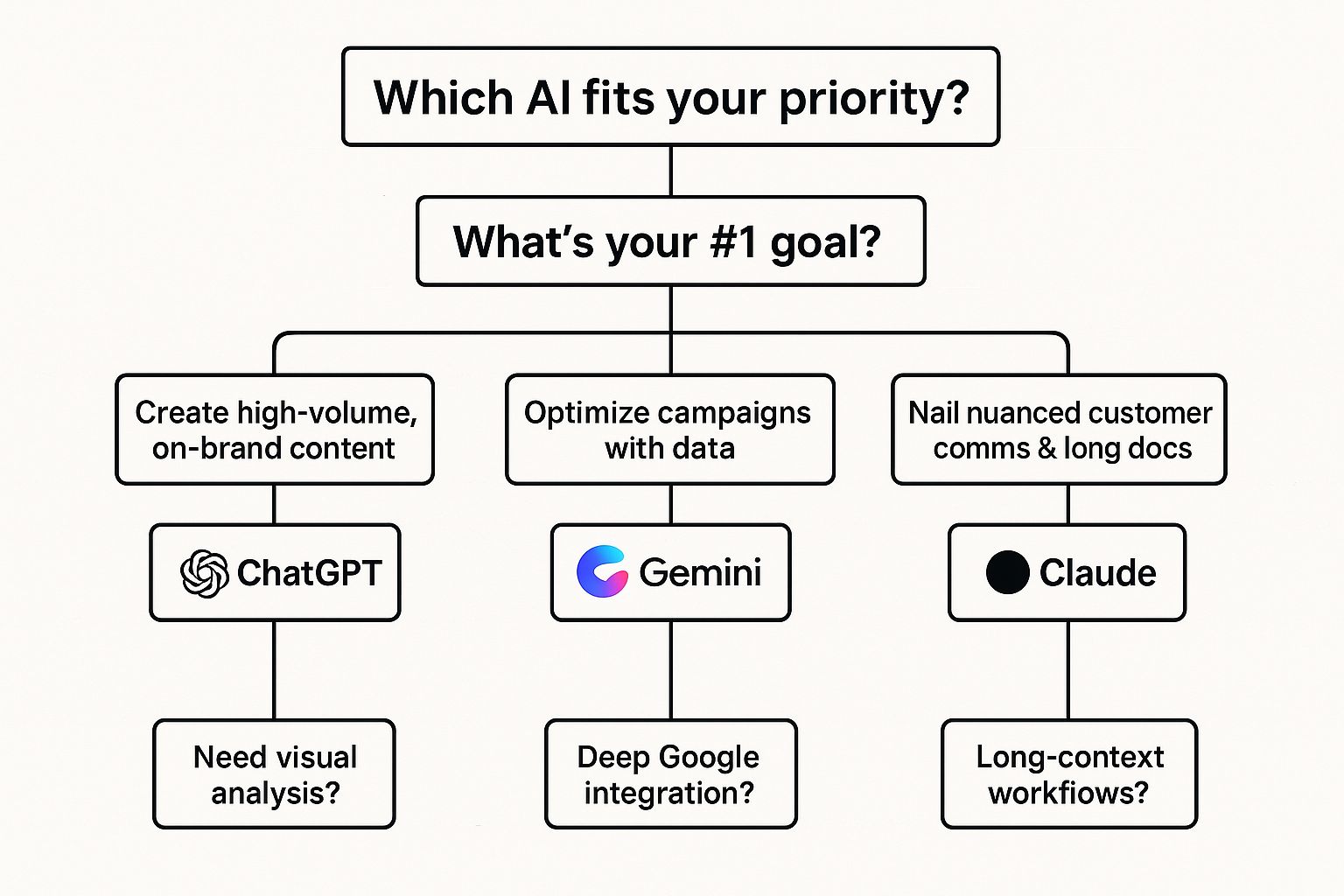
- ChatGPT excels at content creation and versatile marketing tasks, making it ideal for SMBs needing an all-in-one solution.
- Gemini offers superior data analysis and seamless Google Workspace integration, perfect for data-driven marketing campaigns.
- Claude provides exceptional contextual understanding and document analysis capabilities that enhance customer engagement strategies.
- The right AI choice depends on your specific marketing priorities—content creation, data analysis, or customer communication.
- Implementation of AI marketing tools can save SMBs up to 15 hours per week on routine marketing tasks while improving campaign performance.
The marketing landscape for small and medium businesses has fundamentally transformed with AI tools that once required enterprise budgets now accessible to companies of all sizes. Today’s SMB marketers face the challenge of choosing between several powerful AI assistants that each bring unique strengths to the table.
As competition intensifies, the right AI marketing tool can be the difference between struggling to keep up and outpacing larger competitors with fewer resources. Cadence SEO has been tracking how these tools reshape small business marketing strategies, helping companies identify which AI assistant best addresses their specific marketing challenges.
Let’s dive into how ChatGPT, Gemini, and Claude compare when it comes to empowering your SMB marketing efforts—analyzing their strengths, pricing models, and which marketing tasks they handle best.
AI Marketing Assistants That Supercharge Small Business Growth
AI assistants have evolved from simple chatbots to sophisticated marketing partners capable of handling everything from content creation to customer insights analysis. For SMBs with limited marketing staff, these tools effectively function as additional team members at a fraction of the cost.
The market for AI marketing solutions has grown by 35% since 2023, with small business adoption increasing dramatically as costs decrease and capabilities expand. This surge reflects how essential these tools have become for companies trying to maximize their marketing impact with minimal resources.
The most successful small businesses today operate with a hybrid approach—combining human creativity and strategic thinking with AI-powered execution and analysis. This combination allows even single-person marketing departments to produce enterprise-quality campaigns and content consistently.
ChatGPT: The Jack-of-All-Trades for Content Creation
ChatGPT has emerged as perhaps the most versatile AI assistant for small business marketing teams. Its ability to generate everything from social media posts to comprehensive marketing plans makes it particularly valuable for businesses that need to create large volumes of content across multiple channels. For those interested in how AI can enhance different sectors, enhancing e-commerce experiences is another area where AI is making significant strides.
What sets ChatGPT apart is its remarkable contextual understanding and ability to adapt its tone to match your brand voice. This means the content it produces feels less “robotic” and more aligned with your existing marketing materials—a crucial factor for maintaining brand consistency.
GPT-4o’s Marketing Capabilities
The latest GPT-4o model takes ChatGPT’s marketing capabilities to new heights with multimodal processing that can analyze images, interpret data visualizations, and even understand marketing videos. This allows marketers to generate content based on visual inspiration or analyze competitor visual materials for strategic insights. GPT-4o also demonstrates improved understanding of marketing jargon and concepts, making its outputs more relevant to specific campaign objectives. For content-focused marketing strategies, its ability to maintain consistent brand voice across thousands of words gives it a significant advantage over earlier AI models.
Pricing Structure from Free to Enterprise
ChatGPT’s tiered pricing model makes it accessible to businesses at virtually any budget level. The free tier offers basic GPT-3.5 functionality that handles simple content creation tasks, though with significant limitations during peak usage times. The $20/month Plus subscription provides reliable access to more powerful models, including limited access to GPT-4o, making it the sweet spot for most small businesses. For marketing agencies or businesses with heavy usage requirements, the Team ($30/user/month) and Enterprise (custom pricing) plans offer additional features like longer context windows and advanced data controls. This flexibility allows businesses to start with minimal investment and scale their AI capabilities as marketing needs grow. For more insights, check out this comparison of AI tools.
Best Use Cases for Small Business Marketing
- Creating consistent social media content across multiple platforms
- Drafting marketing emails with compelling subject lines and calls to action
- Generating blog post outlines and first drafts based on keyword research
- Developing ad copy variations for A/B testing
- Creating personalized response templates for customer inquiries
Integration with Marketing Tools
ChatGPT shines in its growing ecosystem of integrations with popular marketing platforms. Through the OpenAI API and various third-party connectors, small businesses can incorporate ChatGPT into tools like Mailchimp for email marketing automation, Hootsuite for social media scheduling, and WordPress for content management. The recently launched GPT Builder also allows marketers to create custom GPTs tailored to specific marketing functions without requiring coding knowledge. For example, a small e-commerce business might create a dedicated Product Description GPT that maintains consistent brand language while highlighting key selling points across their entire catalog.
Gemini: Google’s AI Powerhouse for Data-Driven Marketing
Why Small Businesses Choose Gemini
“Gemini’s ability to analyze our campaign performance data and suggest targeted improvements has increased our conversion rates by 23% while actually reducing our ad spend by 15%. For a small business with limited marketing budget, that ROI is game-changing.” — Sarah Chen, Founder of Artisan Candle Co.
Google’s Gemini (formerly Bard) represents a significant advancement for marketers who prioritize data analysis and performance optimization. Its deep integration with Google’s ecosystem gives it unique advantages for businesses already using Google Workspace, Google Ads, or Google Analytics.
Where Gemini truly differentiates itself is in its ability to process and analyze marketing data, making it particularly valuable for campaign optimization and performance analysis. Its understanding of search trends and consumer behavior patterns is unmatched thanks to Google’s vast data resources.
Gemini becomes especially powerful when handling marketing tasks that require pulling insights from multiple data sources or identifying patterns in customer behavior that might inform campaign strategy adjustments.
Gemini’s Advanced Analytics Features
Gemini excels at extracting actionable insights from marketing data that might otherwise require an experienced analyst. The AI can identify performance trends across Google Ads campaigns, spot correlations between different marketing channels, and highlight opportunities for optimization that human marketers might miss. For small businesses without dedicated analytics staff, Gemini effectively serves as a marketing data interpreter, translating complex metrics into clear recommendations. Its ability to process data from multiple sources simultaneously gives marketers a more comprehensive view of their performance across channels.
Google Workspace Integration Benefits
For SMBs already operating within the Google ecosystem, Gemini’s deep integration with Google Workspace creates powerful marketing workflows. Marketers can seamlessly pull data from Google Sheets, analyze customer feedback in Google Docs, and generate presentations in Google Slides—all without switching between platforms. This integration extends to Google Analytics and Google Ads, allowing Gemini to analyze campaign performance and suggest optimization strategies based on real-time data.
The productivity gains from this integration are substantial, with many small businesses reporting time savings of 5-10 hours per week on reporting and analysis tasks alone. Gemini can automatically generate weekly marketing reports by pulling data directly from Google Analytics, saving marketers from manual data compilation and giving them more time for strategic planning.
Pricing Tiers for Small Businesses
Gemini offers a competitive pricing structure that scales with business needs. The free tier provides access to basic functionality suitable for simple marketing tasks and research. For more serious marketing applications, Gemini Advanced at $19.99/month delivers enhanced analytical capabilities, longer context windows, and priority access during high-usage periods. Google Workspace Business customers can access Gemini through their existing subscriptions, with enterprise-level features available through Google Cloud AI solutions for larger marketing operations. The flexible pricing model allows small businesses to start with minimal investment while maintaining the option to scale as marketing requirements grow.
Claude: The Conversational Marketing Expert
Anthropic’s Claude has carved out a distinctive niche in the AI marketing landscape as the specialist in nuanced customer communications and long-form content analysis. Where Claude truly shines is in handling complex customer interactions that require sophisticated understanding of context, tone, and emotional intelligence.
Claude’s exceptional document processing capabilities make it particularly valuable for marketers who need to analyze large volumes of customer feedback, market research reports, or competitor content. Its ability to maintain context across 100,000+ tokens allows it to process entire marketing campaigns or customer journey documents at once.
For SMBs focused on relationship marketing or those operating in industries where communication nuance is critical, Claude offers capabilities that more generalized AI tools struggle to match.
Claude 3’s Contextual Understanding
Claude 3’s advanced contextual understanding makes it exceptionally good at maintaining consistent brand voice across customer touchpoints. The AI can analyze existing customer communications to identify key brand language patterns and emotional tones, then replicate these in new marketing materials. For businesses where brand personality is a key differentiator, Claude’s ability to capture and maintain subtle communication styles provides a competitive edge. This makes it particularly valuable for luxury brands, professional services, and other businesses where communication style significantly impacts customer perception.
This contextual intelligence extends to understanding customer intent in conversations, allowing Claude to power marketing chatbots that feel remarkably human. Small businesses using Claude for customer engagement report significantly higher satisfaction rates compared to traditional chatbot solutions.
Document Analysis Capabilities
Claude’s ability to process and analyze lengthy marketing documents sets it apart for research-intensive marketing tasks. The AI can ingest entire competitor websites, industry reports, or customer survey datasets, then extract actionable insights that inform marketing strategy. For content-heavy marketing approaches, Claude can analyze existing blog content to identify gaps in keyword coverage, suggest content refresh opportunities, and even draft comprehensive content calendars based on performance data. Small businesses with limited research resources find Claude’s document analysis particularly valuable for staying competitive in content-driven marketing channels.
Cost Structure for Marketing Teams
Claude offers a tiered pricing approach that accommodates different marketing needs. The free tier provides basic capabilities sufficient for simple customer communications and content drafting. Claude Pro at $20/month delivers increased processing capacity and priority access, suitable for most small business marketing applications. For marketing agencies or businesses with more intensive needs, Claude Team ($30/user/month) and enterprise options provide collaborative features and more robust security controls. While slightly more expensive than some competitors at the higher tiers, Claude’s specialized capabilities in customer communication and document analysis often justify the investment for businesses focusing on these areas.
Customer Service Applications
Claude excels in customer-facing marketing applications where understanding complex customer needs is essential. Small businesses can deploy Claude to create personalized follow-up messages that address specific customer concerns raised during sales interactions, significantly improving conversion rates. The AI can also analyze customer support tickets to identify recurring themes, helping marketers address common objections in future campaigns. For more insights on how Claude compares with other AI tools, you can read this comparison of AI tools for small businesses.
For businesses with seasonal demand fluctuations, Claude provides an effective way to scale customer communication capabilities without hiring temporary staff. During peak periods, the AI can handle routine customer inquiries, qualify leads, and even process simple orders, freeing human staff to focus on complex cases requiring personal attention. To further enhance eCommerce experiences, businesses can integrate AI solutions that streamline operations and improve customer satisfaction.
Many small businesses report that Claude-powered customer interactions achieve satisfaction ratings within 5-10% of human agents—a remarkable achievement that translates to significant cost savings without compromising the customer experience.
|
Marketing Function |
Claude’s Capability |
Business Impact |
|---|---|---|
|
Lead Qualification |
Evaluates customer queries to determine purchase readiness |
30-40% reduction in time spent on non-qualified leads |
|
Customer Onboarding |
Creates personalized welcome sequences based on purchase history |
25% increase in product adoption rates |
|
Feedback Analysis |
Processes survey responses to identify sentiment patterns |
Identifies product improvement opportunities missed by manual review |
Head-to-Head Feature Comparison
When selecting an AI assistant for your marketing needs, understanding the relative strengths of each platform is crucial. While all three tools continue to evolve rapidly, clear patterns emerge in their specialized capabilities that make each better suited for different marketing functions.
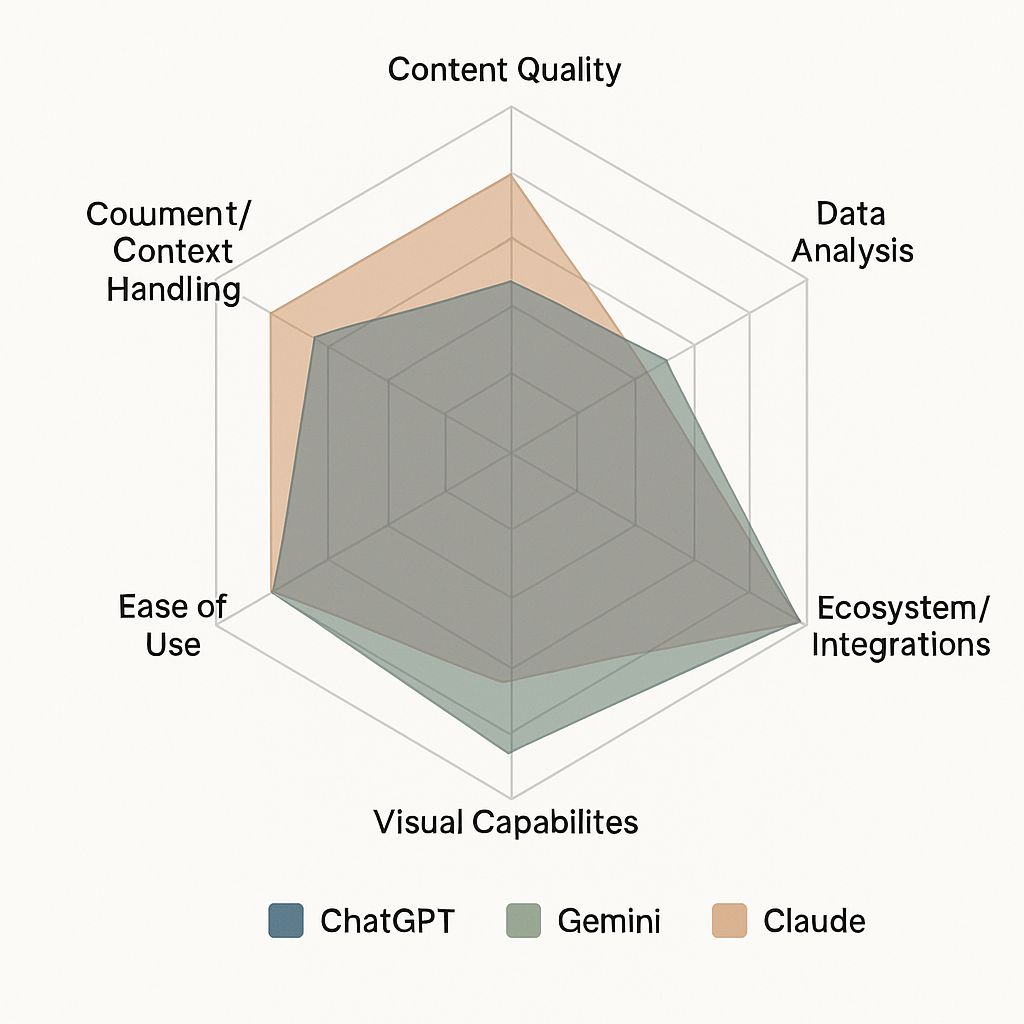
The most successful SMB marketers often employ a multi-AI approach—using each tool for the tasks where it demonstrates clear advantages. This strategy maximizes efficiency while ensuring the highest quality output across all marketing activities. For instance, enhancing eCommerce experiences can be significantly improved by selecting the right AI tools tailored to specific marketing needs.
Content Generation Quality
For pure writing quality, Claude consistently produces the most natural, human-like marketing copy with sophisticated understanding of brand voice and audience-appropriate language. Its outputs typically require the least editing, particularly for long-form content like blog posts, case studies, and white papers where nuance and coherence matter.
ChatGPT offers the most versatile content generation, excelling at producing varied content types from social media posts to product descriptions with a good balance of creativity and marketing focus. It particularly shines at generating conversion-focused copy like email subject lines and ad headlines that drive clicks.
Gemini delivers the most factually accurate content with excellent integration of current market trends and data. While sometimes less creative than its competitors, its outputs are consistently well-researched and aligned with SEO best practices, making it excellent for data-driven content marketing strategies.
Data Processing Speed
Gemini takes the clear lead in processing marketing data, particularly when analyzing campaign performance metrics, customer behavior patterns, and competitive market positioning. Its direct integration with Google Analytics and other data platforms allows for near real-time analysis and recommendation generation that significantly outpaces other AI assistants for data-intensive marketing tasks.
Image and Visual Content Handling
ChatGPT’s GPT-4o currently offers the most advanced visual content capabilities, with the ability to analyze marketing images, interpret brand visual elements, and provide feedback on design assets that aligns with marketing objectives. While Gemini is rapidly improving in this area with its multimodal capabilities, ChatGPT maintains an edge in understanding the marketing implications of visual content rather than just describing what it sees. For businesses looking to enhance their e-commerce experiences, leveraging such advanced AI tools can be a game-changer.
Ease of Use for Marketing Teams
For marketing teams with limited technical expertise, ChatGPT provides the most intuitive interface and requires minimal training to achieve useful results. Its conversation-based interaction model makes it accessible even to marketers with no AI experience, while its ability to learn from feedback helps it quickly adapt to specific marketing requirements and brand guidelines.
Customer Support Options
Claude offers the most robust support for businesses implementing AI in their marketing operations, with detailed documentation, responsive email support, and an active user community sharing marketing-specific prompts and workflows. For SMBs without technical staff, this comprehensive support ecosystem significantly reduces the learning curve and accelerates time-to-value for AI marketing investments.
5 Real SMB Marketing Tasks These AI Tools Can Handle Today
AI marketing assistants aren’t just theoretical tools—they’re already transforming real marketing operations for thousands of small businesses. Understanding the concrete tasks these tools can handle helps SMB marketers identify immediate implementation opportunities for measurable results.
1. Automated Social Media Content Creation
All three AI assistants excel at generating engaging social media content, but each brings different strengths to this critical marketing task. ChatGPT typically produces the most creative and varied posts, making it ideal for businesses that need to maintain an active presence across multiple platforms. Simply provide your product details, target audience information, and brand voice guidelines, and ChatGPT can generate weeks of social content in minutes.
Many SMBs use a batching approach, setting aside just 1-2 hours monthly to generate all their social content with AI assistance. This approach has helped businesses increase their posting consistency by an average of 70% while reducing content creation time by over 80% compared to fully manual methods.
2. SEO Optimization and Keyword Research
Gemini shines in SEO-focused marketing tasks, leveraging Google’s deep understanding of search patterns and ranking factors. Small businesses can use Gemini to analyze top-performing competitor content, identify keyword opportunities, and optimize existing website copy for better search visibility. The AI can also suggest content improvements that align with current SEO best practices, helping businesses without dedicated SEO specialists compete effectively in organic search.
For maximum effectiveness, marketers should combine Gemini’s SEO insights with Claude’s content enhancement capabilities. This combination allows SMBs to identify valuable keyword opportunities and then create exceptionally well-written content optimized for those terms—a strategy that has helped many small businesses achieve significant organic traffic growth without specialized SEO staff.
3. Customer Email Response Templates
Claude’s nuanced understanding of customer communication makes it particularly effective for creating personalized email response templates. The AI can analyze your existing customer communications, identify common inquiries, and develop response frameworks that maintain consistent brand voice while addressing specific customer needs. These templates significantly reduce response time while ensuring all customer communications reflect your brand personality.
Small businesses implementing Claude-generated email templates report 40-60% time savings in customer communication management while simultaneously seeing improved customer satisfaction scores. The key to success is providing Claude with examples of your best customer interactions to help it understand the specific tone and approach that resonates with your audience.
4. Competitor Analysis Reports
All three AI assistants can transform competitor monitoring from an occasional task to a systematic marketing advantage. Provide the AI with competitor website content, social media posts, pricing information, and product details, and it can generate comprehensive analysis reports identifying competitive strengths, weaknesses, and market positioning.
Gemini excels at data-focused competitive analysis, identifying patterns and market gaps that might otherwise go unnoticed. ChatGPT produces the most actionable competitor reports, with clear recommendations for positioning adjustments. Claude provides the most thorough analysis of competitor messaging and brand positioning, helping businesses identify communication opportunities that differentiate them in crowded markets.
5. Marketing Campaign Performance Analysis
For data-driven marketing optimization, Gemini’s analytical capabilities make it the standout choice. The AI can process campaign performance data across channels, identify conversion patterns, and suggest specific adjustments to improve marketing ROI. Small businesses can upload campaign reports from various platforms, and Gemini will extract actionable insights without requiring advanced analytical expertise.
This capability transforms marketing optimization from a specialized skill to an accessible process for businesses of any size. Many SMBs report 15-30% performance improvements after implementing Gemini’s campaign optimization suggestions—a significant advantage in competitive markets where small efficiency gains can substantially impact bottom-line results.
How to Choose the Right AI for Your Marketing Needs
Selecting the optimal AI marketing assistant requires evaluating your specific business context rather than simply choosing the “best” tool. Each platform offers distinct advantages that may align differently with your particular marketing challenges, team structure, and business goals.
Budget Considerations
For businesses with tight marketing budgets, starting with free tiers can provide immediate value while testing capabilities before committing to paid subscriptions. ChatGPT’s free version offers substantial marketing utility despite its limitations, particularly for basic content creation and marketing research tasks. Gemini’s free tier provides excellent value for data analysis and SEO research, while Claude’s free offering excels at customer communication templates and content enhancement.
When evaluating paid tiers, consider not just the subscription cost but the potential time savings and capability enhancements. Many small businesses find that the $20/month premium tiers of any platform deliver 10-15 hours of monthly time savings for marketing tasks—making them extremely cost-effective investments compared to additional staff or freelancer costs. For a deeper understanding of how these platforms can benefit your business, check out this comparison of AI tools.
The most cost-efficient approach for many SMBs is selecting a single paid subscription for your primary marketing needs while utilizing free tiers of other platforms for supplementary tasks. This hybrid approach maximizes capabilities while maintaining reasonable costs.
Team Size and Technical Expertise
Smaller marketing teams with limited technical expertise typically find ChatGPT the most accessible starting point, with its intuitive interface and conversational interaction model requiring minimal training. The platform’s versatility also makes it valuable across diverse marketing functions, allowing small teams to consolidate multiple tasks in a single tool.
For marketing teams with more specialized roles, matching AI tools to specific functions often delivers better results. Content specialists may benefit most from Claude’s writing capabilities, while performance marketers might extract more value from Gemini’s analytical strengths.
Primary Marketing Channels
Businesses focusing primarily on content marketing (blogs, newsletters, social media) typically extract the most value from ChatGPT’s content generation capabilities. The platform’s versatility across content formats and excellent understanding of different channel requirements makes it particularly valuable for content-centric strategies.
Companies emphasizing paid advertising and performance marketing often benefit more from Gemini’s data analysis strengths and direct integration with Google’s advertising ecosystem. The platform’s ability to analyze campaign performance and suggest optimization strategies delivers immediate ROI improvements for ad-focused marketing approaches.
Businesses where customer relationships and communication quality significantly impact success (such as professional services, luxury brands, or complex B2B products) frequently find Claude’s communication refinement capabilities deliver the greatest marketing impact. The platform’s nuanced understanding of communication tone and audience perception helps these businesses maintain the sophisticated messaging their markets demand. For example, enhancing e-commerce experiences can greatly benefit from such refined communication strategies.
Implementation Guide: Getting Started in Under 2 Hours
The fastest path to AI marketing success starts with implementing a single high-impact use case rather than attempting complete transformation. Most small businesses can establish their first AI marketing workflow in under two hours by focusing on a specific pain point where automation would deliver immediate value.
Setting Up Your First AI Marketing Assistant
Begin by creating accounts on your chosen platform(s), setting up a simple organizational system for prompts and outputs, and documenting your initial use cases. For marketing teams, creating shared prompt libraries significantly accelerates adoption by allowing team members to use pre-tested prompts for common marketing tasks. Start with 2-3 specific marketing workflows (such as social media content generation or email response templates) rather than attempting to implement AI across all marketing functions simultaneously.
Training Tips for Better Results
Providing clear examples of your desired outputs dramatically improves AI performance for marketing tasks. Share samples of your best-performing marketing content, customer communications that received positive feedback, and examples of your brand voice in action. For recurring tasks, refine your prompts based on results, creating a continuous improvement cycle that enhances output quality over time. Most small businesses report that their AI outputs improve by 30-40% after just 2-3 iterations of prompt refinement.
Common Pitfalls to Avoid
The most frequent implementation mistake is treating AI outputs as final products rather than first drafts that require human review. Establish clear review workflows for all AI-generated marketing materials, particularly for customer-facing content or materials making specific product claims. Another common pitfall is overcomplicating initial prompts—start with simple, clear instructions and add complexity only as your team becomes more familiar with the AI’s capabilities and limitations. For example, enhancing eCommerce experiences can be simplified by using straightforward prompts initially.
The Bottom Line: Best AI Tool for Different SMB Types
Rather than a one-size-fits-all recommendation, the optimal AI marketing assistant depends on your business type and marketing priorities. E-commerce businesses typically extract the most value from ChatGPT’s versatile content generation for product descriptions, email marketing, and social content. Service-based businesses often benefit most from Claude’s sophisticated communication capabilities for proposal development, service descriptions, and customer correspondence.
Local businesses with physical locations generally find Gemini’s location-based marketing strengths and Google Business Profile integration deliver the greatest impact on customer acquisition and retention. B2B companies with longer sales cycles frequently report that Claude’s document analysis and long-form content capabilities provide the most significant marketing advantage.
Best AI Match by Business Type
E-commerce: ChatGPT for product descriptions, email marketing, and ad copy
Professional Services: Claude for thought leadership content and client communications
Local Businesses: Gemini for location-based marketing and Google integration
B2B Companies: Combined approach using Claude for communication and Gemini for market analysis
Many of the most successful SMB marketers implement a hybrid approach, using different AI tools for specific marketing functions where they demonstrate clear advantages. This multi-AI strategy allows businesses to maximize the strengths of each platform while mitigating their individual limitations.
The marketing technology landscape continues evolving rapidly, with new AI capabilities emerging regularly. Businesses that establish flexible AI implementation frameworks today position themselves to quickly adopt new capabilities as they emerge—creating sustainable competitive advantages in increasingly AI-enhanced marketing environments.
Frequently Asked Questions
As small businesses increasingly adopt AI for marketing functions, several common questions arise about implementation approaches, limitations, and best practices. These insights address the most frequent concerns marketers express when integrating AI assistants into their workflows.
Can AI tools completely replace human marketers in small businesses?
While AI tools dramatically enhance marketing productivity, they function best as collaborators rather than replacements for human marketers. The most successful implementation approach positions AI as handling routine production tasks (content drafting, data analysis, research) while humans focus on strategy, creative direction, and relationship management—areas where human judgment and empathy remain essential.
Small businesses typically find that AI allows them to execute more sophisticated marketing programs with existing staff rather than reducing headcount. Many report that implementing AI marketing tools enables their teams to shift from production-focused activities to more strategic work that delivers greater business impact.
- Tasks where AI excels: content production, data analysis, research, formatting, and routine communications
- Tasks requiring human oversight: strategy development, brand positioning, creative direction, relationship management, and final approval of customer-facing materials
- Hybrid tasks: campaign development, messaging frameworks, and performance optimization benefit from human-AI collaboration
The ideal approach combines human creativity and strategic thinking with AI-powered execution—allowing small businesses to produce enterprise-quality marketing with limited resources.
How much time can these AI tools save my marketing team each week?
Small businesses implementing AI marketing assistants typically report time savings of 10-15 hours per week for a single marketing professional. These efficiency gains come primarily from automating routine content creation, research, and analysis tasks that previously consumed significant staff time. The actual time savings vary based on your specific marketing activities, with content-heavy strategies seeing the most dramatic efficiency improvements.
Do I need coding knowledge to use ChatGPT, Gemini, or Claude for marketing?
No coding knowledge is required to implement any of these AI marketing assistants for standard marketing functions. All three platforms offer intuitive interfaces designed for business users without technical backgrounds. ChatGPT offers the most accessible interface for non-technical users, while Gemini and Claude provide straightforward web interfaces that require no specialized knowledge.
For more advanced implementations involving API integration with existing marketing systems, some technical expertise becomes beneficial but remains optional for most small business applications. Many marketing platforms are also adding native AI integrations that eliminate the need for custom development entirely.
What privacy concerns should I be aware of when using AI for customer data?
When using AI marketing assistants, avoid sharing personally identifiable customer information unless the platform explicitly offers appropriate data protection measures. All three major platforms have implemented data privacy controls, but their specific policies regarding training data retention and usage vary. For marketing materials containing sensitive business information or customer data, Claude and ChatGPT’s enterprise tiers offer the most robust data protection guarantees, including options to prevent your data from being used for model training. Additionally, for businesses looking to enhance their e-commerce experiences, it’s crucial to ensure that any AI tools used are compliant with data protection regulations.
How often are these AI tools updated with new features?
The AI marketing landscape is evolving at an extraordinary pace, with major platforms typically releasing significant capability updates every 3-4 months. ChatGPT has maintained the most aggressive release schedule, introducing new features and models approximately every quarter. Gemini follows a similar update cadence, while Claude typically releases fewer but more substantial updates.
This rapid evolution makes it essential for SMB marketers to stay informed about new capabilities that might impact their marketing strategies. Most platforms provide release notes and feature announcements through their websites and email newsletters.
The continuing advancement of these platforms means that implementation strategies should build in flexibility to adopt new capabilities as they emerge. Many small businesses designate a team member to monitor AI developments and identify new marketing applications as capabilities expand.
For SMB marketers looking to gain a competitive edge, Cadence SEO provides customized AI marketing implementation strategies that match the right tools to your specific business needs while establishing sustainable workflows that evolve with the technology.
Ready to build the right AI stack for your SMB—without the guesswork?
Catalyst Pro sets up your best-fit combo of ChatGPT, Gemini, and Claude, then trains your team and hardwires it into your tools to save 10–15 hours a week.
Get your AI Marketing Blueprint

