
Key Takeaways
- Lead scoring systems can increase sales conversion rates by up to 30% for small businesses by focusing time on qualified prospects.
- Small businesses typically waste 50% of their sales efforts on leads that will never convert, but automated prioritization fixes this problem.
- The most effective lead scoring models for SMBs combine demographic, behavioral, and intent data with point values.
- Setting up your first automated lead scoring system takes less than a week with the right tools and approach. Want our plug-and-play scoring rubric and routing flow? Grab the template at trycatalystpro.com and launch in days, not weeks.
- Salesforce’s lead scoring tools offer SMBs enterprise-level capabilities at affordable price points, helping businesses identify sales-ready prospects faster.
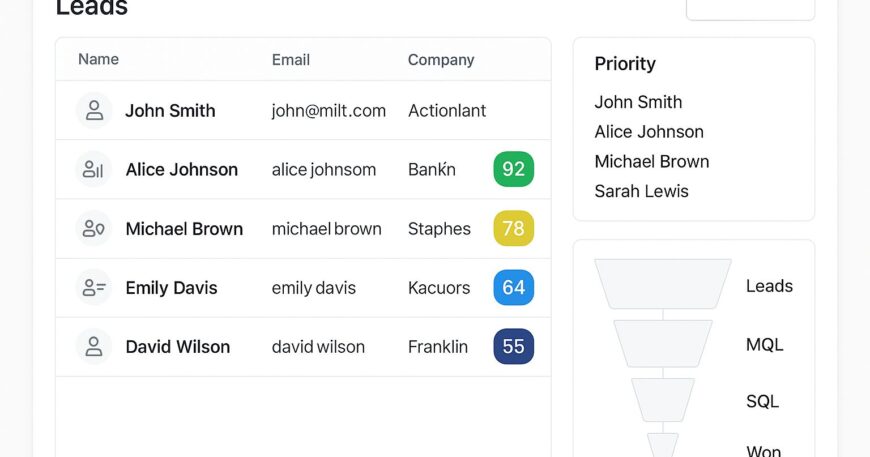
Ever wonder which of your prospects is actually worth pursuing? You’re not alone. For small business owners, deciding where to focus limited sales resources is a constant challenge. Lead scoring automates this decision-making process, giving you back valuable hours while increasing your conversion rates.
Implementing an effective lead scoring system is like having an AI-powered assistant that tells you exactly which prospects deserve your immediate attention. Salesforce’s research shows that companies using lead scoring see 30% higher close rates and 18% larger deal sizes, proving this isn’t just a nice-to-have—it’s a critical sales tool for growing SMBs.
Why Most Small Businesses Waste Time on the Wrong Leads
The typical sales rep spends only 34% of their time actually selling. The rest goes to administrative tasks, research, and—most problematically—chasing leads who will never convert. Without a systematic approach to prioritization, your team is essentially guessing which prospects deserve attention.
Most small businesses use gut feeling or basic “first-come, first-served” approaches to work through their lead queue. This outdated method means your best opportunities often sit untouched while your team exhausts themselves on prospects with little chance of conversion. To improve efficiency, consider enhancing your sales approach with automated lead scoring tools.
The math is simple: when you pursue every lead equally, you waste approximately half your sales resources. A structured lead scoring system changes this equation dramatically by helping you identify which prospects are most likely to convert based on objective criteria rather than hunches.
What Is Lead Scoring and Why Your SMB Needs It Now
Lead scoring is a systematic approach to ranking prospects based on their likelihood to become customers. It assigns point values to various prospect attributes and behaviors, creating a prioritized list that guides your sales efforts. For small businesses, it’s the difference between random prospecting and strategic selling.
The Real Definition of Lead Scoring for Small Businesses
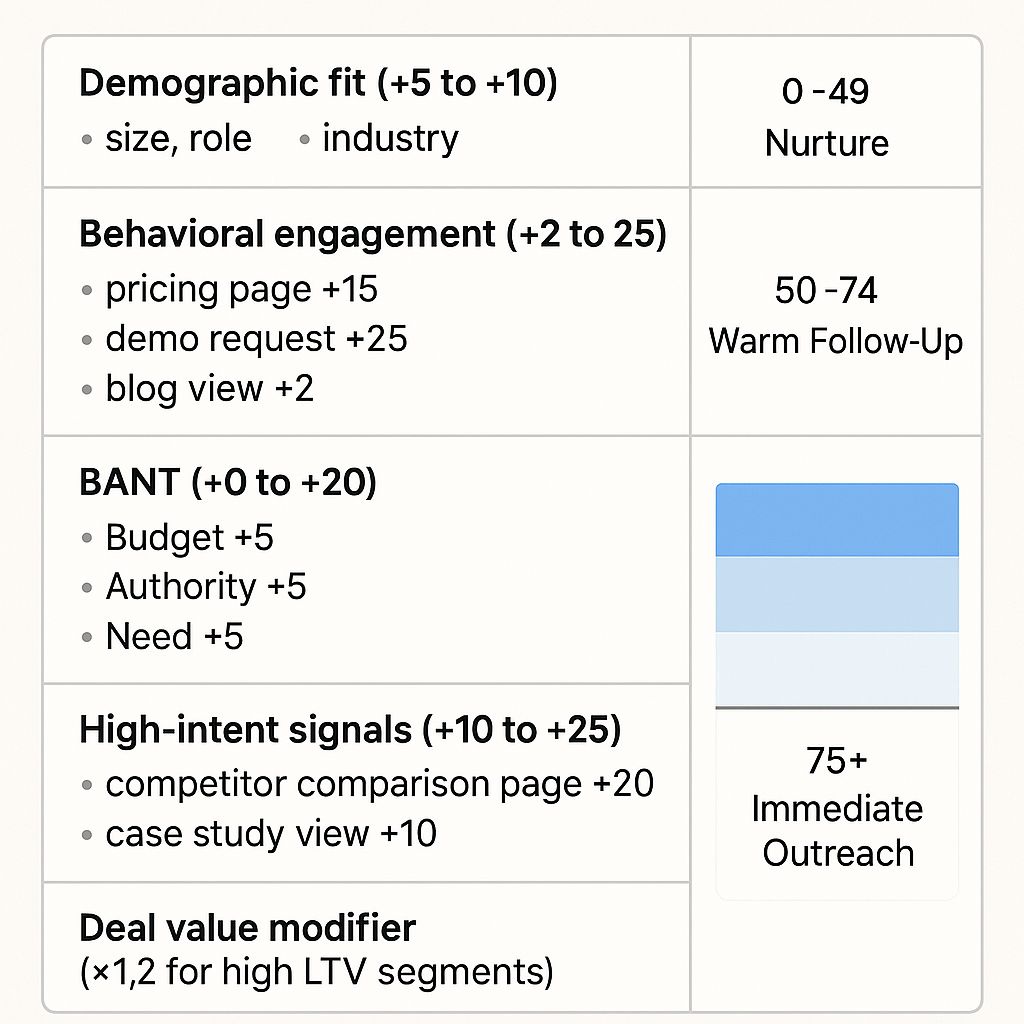
For SMBs specifically, lead scoring isn’t about complex algorithms or enterprise-level data science. It’s about creating a simple, consistent framework that helps you answer: “Who should my team contact first?” A good lead scoring system combines demographic information (company size, industry, role) with behavioral signals (website visits, content downloads, email opens) to create a holistic view of each prospect’s sales-readiness.
The beauty of lead scoring is its objectivity. Rather than relying on sales rep intuition or arbitrary rules, you establish clear criteria that apply consistently across your entire pipeline. This brings transparency to the sales process and ensures no high-potential leads fall through the cracks.
How Lead Scoring Directly Increases Your Sales Conversions
When you prioritize high-scoring leads, your conversion rates naturally improve. Your team spends more time with prospects who match your ideal customer profile and have demonstrated genuine interest. This focused approach yields several measurable benefits, especially when enhancing e-commerce experiences to better align with customer needs.
- Shorter sales cycles (by 23% on average)
- Higher conversion rates (typically 30% improvement)
- Increased average deal size (18% larger)
- Better sales and marketing alignment
- Improved customer retention (qualified leads become better customers)
The Cost of Not Scoring Your Leads
Without lead scoring, your team faces a daily struggle to identify which leads deserve attention. This reactive approach has real costs that directly impact your bottom line. Sales reps waste hours pursuing unqualified prospects while high-value opportunities grow cold.
Beyond the obvious time waste, there’s also the opportunity cost. Every hour spent on a poor-quality lead is an hour not spent nurturing a potential high-value customer. Over time, this inefficiency can cost small businesses tens of thousands in lost revenue and unnecessary labor expenses. For a deeper understanding of effective lead management, you can explore lead scoring strategies that can help prioritize high-value customers.
For businesses with limited sales resources, this inefficiency is particularly damaging. Your team can only handle so many leads per day—if they’re focusing on the wrong ones, your growth potential is severely limited.
Simple Lead Scoring Models That Work for SMBs
The best lead scoring systems for small businesses balance simplicity with effectiveness. You don’t need enterprise-level complexity to see significant improvements in your sales process. These proven models deliver results without overwhelming your team or requiring sophisticated technology.
Lead Scoring ROI Example:
Average SMB with 500 monthly leads
Without scoring: 5% conversion rate = 25 customers
With basic scoring: 7.5% conversion rate = 37 customers
Revenue increase: 12 additional customers per month
1. Basic Demographic Scoring
Start with fundamental data about your prospects and their organizations. Assign point values based on how well each attribute aligns with your ideal customer profile. This approach provides a solid foundation for more sophisticated scoring later. The most common demographic factors include company size, industry type, geographic location, annual revenue, and decision-maker role.
2. Behavioral Engagement Scoring
Actions speak louder than demographics. Behavioral scoring tracks what prospects actually do—website visits, email interactions, content downloads, and social media engagement. This approach captures intent signals that often predict conversion better than static profile data.
For example, a prospect who visits your pricing page three times, downloads a case study, and watches a product demo video is showing clear buying intent. Assign higher point values to these high-intent actions compared to passive behaviors like opening a newsletter. Most SMBs find that behavioral scores provide the clearest picture of which leads are ready for sales contact.
3. BANT Framework for B2B Sales
The BANT framework (Budget, Authority, Need, Timeline) provides a structured approach to qualifying leads based on their readiness to purchase. Each component receives its own score, creating a comprehensive view of sales readiness. A prospect with budget approval, decision-making authority, a clear need, and an urgent timeline represents your ideal sales opportunity.
Implementing BANT scoring doesn’t require complex technology. You can gather this information through strategic form fields, discovery calls, and email engagement tracking. Many SMBs start with simple 1-5 ratings for each BANT component before moving to more nuanced scoring systems, similar to how e-commerce platforms enhance user experiences with tailored solutions.
4. Buyer Intent Signals That Actually Matter
Not all prospect actions carry equal weight. Certain behaviors—like viewing pricing pages, requesting demos, or reading customer testimonials—indicate serious purchase consideration. Your scoring model should heavily weight these high-intent signals compared to general website browsing or blog reading.
Industry research reveals that prospects comparing your solution to competitors or researching implementation details typically convert at 3-5 times the rate of general leads. By identifying and tracking these specific intent signals, you can create a scoring model that accurately predicts purchase readiness.
5. Deal Size and Revenue Potential Scoring
For many SMBs, lead quality isn’t just about likelihood to convert—it’s about potential value. Incorporating estimated deal size or lifetime value into your scoring system ensures you prioritize not just easy wins, but profitable ones. This approach is particularly valuable for businesses with limited sales resources who must maximize revenue per sales hour.
Consider factors like company size, industry averages, product interest, and historical customer data to estimate potential deal values. Then weight your lead scores to reflect both conversion probability and revenue potential. This balanced approach prevents your team from chasing high volumes of low-value deals while neglecting fewer but more valuable opportunities.
Setting Up Your First Automated Lead Scoring System
Creating an effective lead scoring system doesn’t require a data science degree. With a methodical approach, you can build a system that dramatically improves your sales prioritization in less than a week. The key is starting simple and refining based on results.
Begin by analyzing your recent sales history. Look for patterns among your successful conversions—what traits do these customers share? Which actions did they take before purchasing? This retrospective analysis provides the foundation for your initial scoring model.
Next, collaborate with both marketing and sales teams to identify key indicators of qualified leads. Sales reps often have intuitive knowledge about which prospects are worth pursuing, while marketing teams understand digital engagement patterns. Combining these perspectives creates a more robust scoring system.
Implementation requires choosing the right technology solution for your business size and needs. Modern CRM systems like Salesforce offer built-in lead scoring capabilities, while standalone tools provide specialized features. Select a solution that balances functionality with ease of use.
- Analyze your customer conversion history
- Identify demographic and behavioral patterns
- Create a point-based scoring system
- Implement using appropriate technology
- Review and refine regularly based on results
Essential Data Points You Must Track
Effective lead scoring depends on capturing the right data points. At minimum, your system should track basic demographic information (company size, industry, location), engagement metrics (email opens, website visits, content downloads), and explicit interests (product pages viewed, demo requests). More advanced systems might incorporate social media engagement, technographic data (current tech stack), or predictive attributes based on successful customer patterns.
Creating Your Scoring Criteria and Point Values
Assign point values based on correlation with actual sales conversions, not assumptions. Start with a 0-100 scale where higher scores indicate greater sales readiness. Demographic matches might earn 5-10 points each, while high-intent actions like pricing page visits could earn 15-25 points. The key is consistency and regular calibration, based on which scored leads actually convert to customers.
When to Hand Off Leads to Sales (Setting the Right Threshold)
Determining your sales-ready threshold requires balancing opportunity cost with sales capacity. Too high a threshold means missing potential customers; too low means wasting sales resources. Most SMBs start with a threshold that delivers their sales team’s maximum capacity of qualified leads, then adjust based on conversion rates. Monitor sales feedback closely during the first few months and be prepared to adjust your threshold as you gather performance data.
Remember that different products or services may require different thresholds. A complex enterprise sale might need a higher score threshold than a transactional product with a shorter sales cycle. Your scoring system should reflect these nuances. For more detailed guidance, check out this lead scoring article.
Top Lead Scoring Tools SMBs Can Actually Afford
Enterprise-level lead scoring tools often come with enterprise-level price tags, but affordable options exist for SMBs. These solutions provide the essential functionality you need without breaking your budget or requiring technical expertise.
The ideal tool integrates with your existing CRM and marketing automation platforms, creating a seamless workflow from lead capture to sales outreach. Look for solutions that offer visual reporting, customizable scoring models, and integration capabilities with your existing tech stack.
CRM-Based Options Under $100/Month
Your existing CRM likely offers lead scoring capabilities at a reasonable price point. Salesforce Essentials includes basic lead scoring for $25/user/month, while HubSpot’s Marketing Hub Starter provides similar functionality at $45/month. These integrated solutions eliminate the need for separate tools and simplify data management.
Zoho CRM offers perhaps the most affordable option at just $14/user/month for their Professional plan, which includes lead scoring capabilities. For small teams with straightforward needs, these CRM-based options provide excellent value without sacrificing essential functionality.
|
CRM Solution |
Starting Price |
Key Features |
Best For |
|---|---|---|---|
|
Salesforce Essentials |
$25/user/month |
Lead scoring, automation rules, email tracking |
Growing SMBs needing scalability |
|
HubSpot Marketing Hub |
$45/month total |
Behavior tracking, lead forms, basic automation |
Content-focused businesses |
|
Zoho CRM Professional |
$14/user/month |
Scoring rules, workflow automation, sales signals |
Budget-conscious small teams |
Many of these platforms offer free trials or starter plans that let you test their lead scoring capabilities before committing. This approach allows you to validate the system’s effectiveness with your specific sales process before making a financial investment.
Standalone Solutions for Specific Industries
Industry-specific lead scoring tools offer pre-configured scoring models tailored to your business type. These specialized solutions often deliver faster implementation and better results than generic platforms because they understand your industry’s unique buying signals and sales cycles.
- For B2B services, LeadSquared ($25/month) offers industry-specific templates
- For eCommerce: Klaviyo ($20/month) provides purchase intent scoring
- For SaaS companies: MadKudu (custom pricing) specializes in product-led growth scoring
- For financial services: Leads360 (now Velocify) provides compliance-friendly scoring
- For real estate: BoomTown ($750/month) offers property interest-based scoring
These specialized tools typically require less customization than general-purpose solutions because they’re pre-configured for your industry’s specific needs. This advantage can significantly reduce implementation time and improve accuracy from day one.
The tradeoff comes in flexibility—industry-specific tools may not adapt well if your business model evolves beyond their core focus. Consider your long-term growth plans when evaluating these specialized options.
Free Tools to Get Started Today
If budget constraints prevent investing in paid solutions, several free options can help you implement basic lead scoring. HubSpot offers a free CRM with limited scoring capabilities, while Google Sheets, combined with form tools like Typeform, can create a manual scoring system. These no-cost solutions require more manual management but provide a practical way to prove the concept before investing in more sophisticated tools like enhancing e-commerce experiences.
How to Integrate Lead Scoring With Your Sales Process
Even the most sophisticated scoring system fails without proper integration into your existing sales workflow. Successful implementation requires clear processes for how scored leads move through your pipeline and how your team should respond to different score thresholds.
Start by mapping your current sales process and identifying where lead scoring provides the most value. Typically, scoring has the greatest impact at the qualification and prioritization stages, helping sales teams focus on prospects with the highest conversion potential.
“Lead scoring increased our sales team’s productivity by 37% in the first quarter after implementation. They stopped chasing unqualified leads and focused entirely on prospects with genuine buying intent.” — Sarah Martinez, Sales Director at Midwest Manufacturing Solutions
Remember that lead scoring complements rather than replaces human judgment. The best systems combine algorithmic scoring with sales rep input, creating a balanced approach that leverages both data and experience. This collaborative model typically yields better results than either automated or intuitive approaches alone.
Creating Clear Sales Handoff Protocols
Develop specific protocols for how leads at different score thresholds should be handled. High-scoring leads might receive immediate sales contact, while mid-tier scores enter nurture campaigns with periodic sales check-ins. Document these protocols clearly and ensure both marketing and sales teams understand their responsibilities at each stage of the process. For more on optimizing workflows, explore how Catalyst Pro is transforming healthcare workflows.
Training Your Team on the New System
Sales rep adoption makes or breaks your lead scoring initiative. Invest time in comprehensive training that explains not just how the system works, but why it matters. Show concrete examples of how lead scoring will save time, increase conversions, and ultimately help reps meet their quotas more efficiently.
Ongoing coaching reinforces proper system usage. Schedule regular reviews to discuss which scored leads converted and which didn’t, using these insights to refine your scoring criteria. This feedback loop ensures your system improves over time while maintaining team buy-in. For more on enhancing business processes, explore enhancing e-commerce experiences with Catalyst Pro.
Measuring and Optimizing Your Lead Scoring Results
Once your lead scoring system is in place, regular measurement becomes critical. Track key metrics like lead-to-opportunity conversion rate, sales cycle length, and average deal size before and after implementation. Most SMBs see significant improvements within 60-90 days of proper lead scoring implementation. Schedule monthly reviews to analyze which leads converted and which stalled, using these insights to refine your scoring criteria.
Real Results: How SMBs Increased Sales With Lead Scoring
The impact of lead scoring on small business sales performance is remarkable across industries. Companies implementing even basic scoring systems typically report 30-40% increases in conversion rates and 20-25% reductions in sales cycle length. These improvements directly translate to revenue growth without requiring additional marketing spend or sales headcount.
What makes these results particularly valuable for SMBs is the efficiency gain. Rather than generating more leads (which costs money), lead scoring helps you extract more value from your existing lead flow. This optimization approach delivers a significantly higher ROI than most lead generation tactics, especially for businesses with limited marketing budgets.
Case Study: Local Service Business Triples Conversions
Southwest Plumbing Services, a 12-person operation in Arizona, implemented a basic lead scoring system after struggling with low conversion rates despite generating hundreds of monthly leads. Their scoring model prioritized emergency service inquiries, property managers (versus homeowners), and leads from specific zip codes where they had historically closed larger deals.
Within three months, their qualified lead conversion rate jumped from 11% to 37%, while their average time from lead to booking decreased by 62%. Most importantly, their revenue per marketing dollar spent increased by 215%, allowing them to reduce their overall marketing budget while growing sales. For more insights, explore how enhancing e-commerce experiences can contribute to similar success.
The company’s owner noted that the most significant change was psychological—sales staff stopped feeling overwhelmed by unqualified leads and instead focused their energy on high-potential opportunities. This shift not only improved results but reduced burnout and increased employee satisfaction.
“Before lead scoring, we were drowning in leads but starving for sales. Our team was making 50+ calls daily with minimal results. After implementing scoring, we make fewer calls but close three times more business. Our sales team is happier, our customers get better service, and our profit margins have never been healthier.”
— James Rodriguez, Owner, Southwest Plumbing Services
Before and After: Conversion Rate Improvements
The table below shows typical performance improvements SMBs experience after implementing lead scoring. While individual results vary based on industry and execution quality, these benchmarks provide realistic expectations for what your business might achieve with a well-designed scoring system.
Start Prioritizing Your Best Leads Today
Lead scoring doesn’t need to be complicated to be effective. Even a simple system that identifies your most promising prospects can dramatically improve your sales results. The key is starting with clear criteria based on your successful customer patterns, then refining your approach as you gather more data.
Begin by examining your recent sales wins and identifying common characteristics across these customers. Look for demographic patterns, behavioral signals, and engagement indicators that separate your buyers from non-buyers. These insights form the foundation of your scoring model, which you can implement using any of the affordable tools mentioned earlier.
- Analyze your last 20-30 successful sales to identify patterns
- Choose a scoring approach that matches your sales complexity
- Select an affordable tool that integrates with your existing systems
- Start simple and refine based on performance data
- Commit to regular review and optimization
Remember that implementation quality matters more than scoring complexity. A straightforward model that your team consistently uses will outperform a sophisticated system that’s poorly implemented or inconsistently applied. Focus on adoption and continuous improvement rather than perfection from day one.
Frequently Asked Questions
As you begin your lead scoring journey, you’ll likely have questions about implementation details and best practices. Below are answers to the most common questions small business owners ask when setting up their first lead scoring system. For more insights, consider exploring how enhancing e-commerce experiences can complement your lead scoring strategies.
These practical insights address real-world challenges you might encounter and provide actionable solutions based on successful implementations across various industries. Remember that while general principles remain consistent, your specific implementation should reflect your unique business model and customer journey.
How much time does it take to set up a lead scoring system?
For most SMBs, setting up a basic lead scoring system takes 2-5 business days, including planning, implementation, and initial testing. The majority of this time involves analyzing existing customer data to identify meaningful scoring criteria. The actual technical setup usually requires only a few hours with modern CRM platforms. More complex scoring models involving multiple products or sophisticated behavioral tracking may require 1-2 weeks of setup time.
Can lead scoring work for businesses with small lead volumes?
Absolutely. In fact, businesses with modest lead volumes (20-100 monthly leads) often see the most dramatic benefits from lead scoring. With limited sales resources, ensuring those resources focus exclusively on high-potential prospects creates significant efficiency gains. For very small lead volumes (under 20 monthly), simple manual scoring systems can work effectively until volumes increase enough to justify automated solutions.
Should I use the same scoring model for different products or services?
|
Scenario |
Recommendation |
Rationale |
|---|---|---|
|
Similar products, similar buyers |
Single scoring model |
Streamlined approach, consistent process |
|
Different products, different buyers |
Separate scoring models |
Captures unique buying signals for each audience |
|
Tiered services (basic vs. premium) |
Base model with tier multipliers |
Recognizes common patterns while accounting for value differences |
The decision depends primarily on how similar the buying processes are for your different offerings. Products with similar decision-makers, sales cycles, and purchase criteria can usually share a scoring model. However, offerings targeting fundamentally different customers or with vastly different sales processes benefit from separate models.
For example, a marketing agency offering both small business websites ($5,000) and enterprise branding campaigns ($100,000) should use different scoring models since these services involve different decision-makers, budgeting processes, and purchase criteria. Conversely, a SaaS company offering tiered pricing plans to similar buyer personas could use a single model with value adjustments based on plan interest.
When in doubt, start with a unified model and split it only if you see significant performance differences across product lines. Maintaining a single scoring system is always easier from an administrative standpoint, especially when enhancing e-commerce experiences.
How often should I update my lead scoring criteria?
For new scoring systems, conduct a thorough review after 60 days to identify any major calibration issues or missed signals. After this initial adjustment, quarterly reviews are typically sufficient to maintain optimal performance. These reviews should examine which high-scoring leads didn’t convert (false positives) and which low-scoring leads did convert (false negatives), using these insights to refine your criteria.
Additionally, any major changes to your product offerings, target market, or competitive landscape should trigger an immediate scoring review. These business shifts often change what constitutes a qualified lead, requiring corresponding updates to your scoring model.
What’s the difference between manual and predictive lead scoring?
Manual lead scoring uses human-defined criteria and point values based on historical patterns and sales team input. This approach provides complete transparency and control but requires regular maintenance to remain effective. Most SMBs start with manual scoring due to its simplicity and low implementation cost.
Predictive lead scoring employs machine learning algorithms to analyze thousands of data points and automatically identify conversion patterns. These systems continuously self-optimize based on results, potentially uncovering non-obvious signals that human analysts might miss. While more powerful, predictive scoring requires larger data volumes (typically 1,000+ conversions) and more sophisticated technology.
For most small businesses, manual scoring provides an excellent starting point, with 80% of the potential benefits at 20% of the complexity. As your lead volume and conversion history grow, you can gradually introduce predictive elements to enhance your manual framework.
The hybrid approach—starting with manual scoring and progressively adding predictive elements—offers the best combination of immediate results and long-term sophistication. This evolutionary path allows your team to understand the fundamentals before leveraging more advanced technology, such as enhancing e-commerce experiences with predictive analytics.
Stop guessing and start closing. Implement automated lead scoring and instant routing inside your CRM. Get a working build tailored to your pipeline at em2bos.com.

