
Key Takeaways
- Neil Patel’s omnipresence strategy focuses on the Content-Ads-Convert framework that has generated over $300M in revenue for clients
- Instead of exhausting yourself creating content for every platform, the omnipresence approach transforms one piece of content into an entire marketing ecosystem
- The strategy prioritizes meeting prospects where they are with tailored messaging rather than broadcasting the same content everywhere
- By creating less but more strategic content, marketers can actually generate more qualified leads and conversions
- Catalyst Pro automates the omnipresence formula, enabling businesses of all sizes to implement Neil’s proven system without burning out
Feeling overwhelmed by marketing? Posting everywhere and still not seeing results? You’re not alone. The traditional approach of creating unique content for every platform is exactly why most marketers burn out before seeing meaningful ROI.
The game has changed. Neil Patel’s omnipresence strategy isn’t about being everywhere—it’s about being everywhere that matters, with the right message, at the right time. This revolutionary approach has generated over $300M in revenue for clients using what Neil calls the Content-Ads-Convert framework. Catalyst Pro has transformed this methodology into an automated system that works for businesses of all sizes.
Let’s dive into why this approach is fundamentally different from what you’ve been taught about digital marketing.
Neil Patel’s $100M Secret: Why Digital Omnipresence Beats Traditional Marketing
Traditional marketing advice tells you to create platform-specific content for every channel. Post daily on LinkedIn. Create fresh TikTok videos. Write unique blog posts. The problem? This approach treats marketing as a volume game rather than a strategic one. It’s exhausting, expensive, and surprisingly ineffective. For those looking to streamline their strategy, Catalyst Pro offers a solution for achieving digital omnipresence without the burnout.
Neil’s omnipresence formula flips this concept on its head. Instead of creating more, you create smarter. The strategy begins with a single piece of high-quality content—typically video—that becomes the source material for an entire marketing ecosystem. By focusing on quality over quantity, businesses can maintain consistent messaging while adapting to each platform’s unique requirements.
This isn’t about shortcuts—it’s about leverage. The most successful marketers aren’t creating more content; they’re getting more mileage from strategic content. They understand that omnipresence isn’t about frequency but about strategic visibility where your ideal customers already spend their time.
“Stop chasing every platform. The secret isn’t being everywhere—it’s being everywhere that matters to your specific customer, with messaging that addresses their exact stage in the buying journey.” – Neil Patel
Inside the Omnipresence Formula That Built Neil Patel’s Empire
At its core, Neil’s strategy revolves around three fundamental stages: Content, Ads, and Convert. This framework isn’t complicated, but its execution requires a systematic approach that most marketers miss.
The formula begins with creating cornerstone content addressing every question and objection your sales team regularly encounters. This isn’t about creating more content—it’s about creating the right content that directly addresses the barriers preventing prospects from becoming customers. One deeply valuable piece can outperform dozens of surface-level posts.
The 3 Core Pillars of Digital Omnipresence
Neil’s strategy stands on three foundational pillars that work together to create true digital omnipresence without requiring a massive team or budget. The first pillar is strategic visibility—appearing on platforms where your ideal customers already spend time rather than trying to be everywhere at once. The second is message consistency—maintaining your core value proposition across all touchpoints while adapting format to each platform. The third pillar is conversion optimization—ensuring every piece of content has a clear path to the next step in your customer journey.
What makes this approach different is how these pillars work together. Most marketers focus on just one or two aspects—perhaps visibility and messaging—while neglecting the crucial conversion component. When all three work in harmony, the result is a marketing system that compounds results over time rather than requiring constant feeding with new content.
How Patel Leverages Content Multiplication
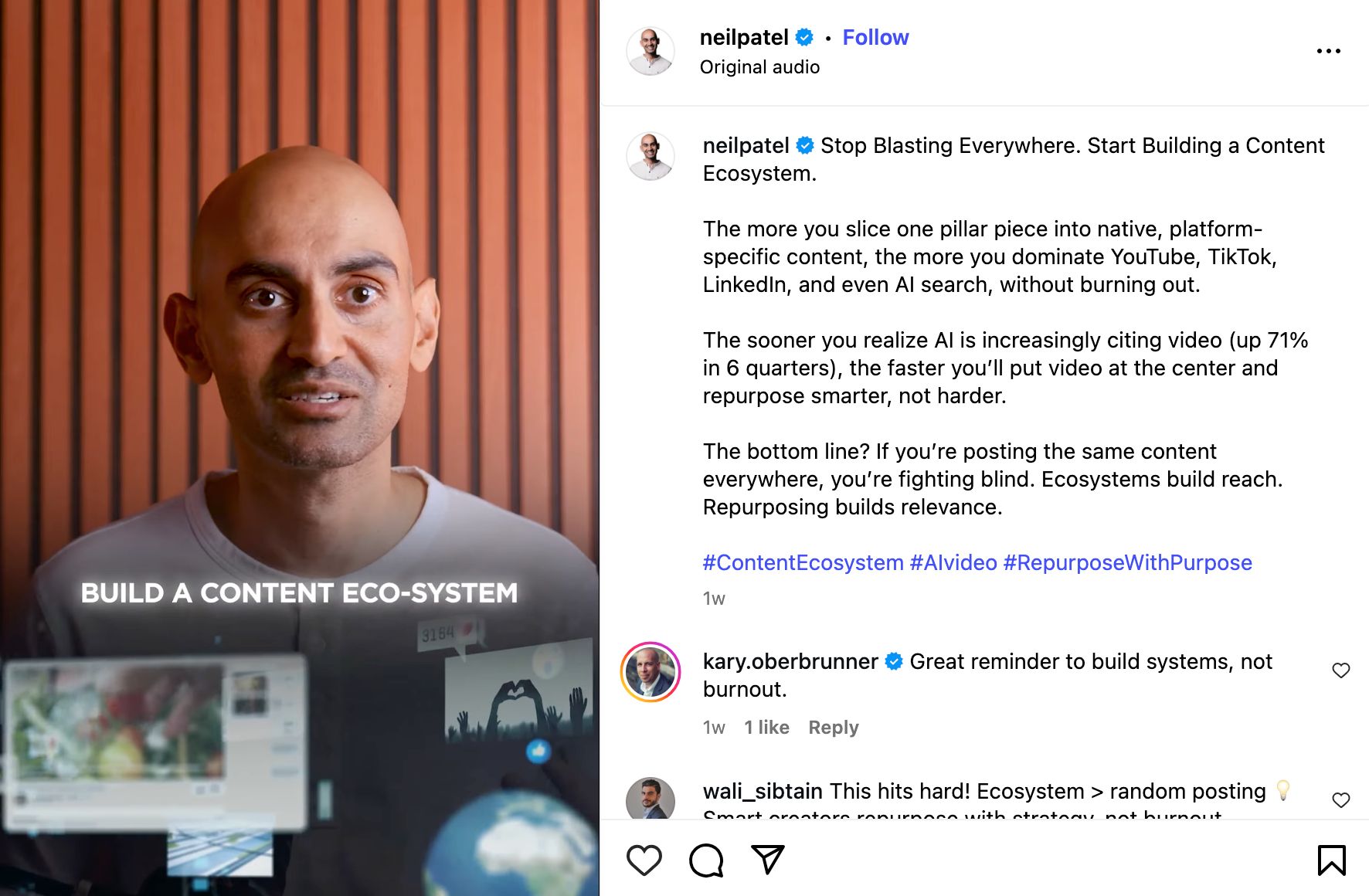
Content multiplication—not just repurposing—is the secret sauce behind Neil’s approach. While most marketers simply resize or slightly modify content for different platforms, Neil’s system transforms one core piece into dozens of unique assets tailored to each platform’s algorithm and user behavior patterns.
For example, a single 30-minute video interview can become a long-form blog post, a series of short-form videos, multiple social posts with different hooks, an email sequence, and even ad creative—all without losing the core message. This multiplication approach ensures consistent messaging while respecting the native format of each platform.
The key difference lies in optimization. Each piece isn’t just reformatted—it’s restructured to perform optimally on its specific platform. A LinkedIn post derived from the video will emphasize different aspects than a TikTok clip from the same source material. This platform-specific optimization is what separates true omnipresence from scattered presence.
The Counter-Intuitive Timing Strategy That Amplifies Reach
Contrary to popular belief, Neil’s approach doesn’t rely on posting frequency. Instead, it leverages strategic timing and platform algorithms. Rather than posting daily across all channels, the omnipresence formula identifies optimal posting windows based on audience engagement patterns and platform-specific algorithm behaviors.
By coordinating the release of related content across platforms, the strategy creates a reinforcement effect. A prospect might see a short video on Instagram, then encounter a deeper dive on YouTube, followed by a case study on LinkedIn—all within a short timeframe. This coordinated approach creates the impression of omnipresence without requiring constant content creation.
What Is Catalyst Pro and How Does It Work?
Catalyst Pro is the automated implementation of Neil Patel’s omnipresence formula, designed specifically for businesses that want enterprise-level marketing results without the enterprise-level team. It transforms the labor-intensive process of maintaining omnipresence into a streamlined system that runs with minimal oversight.
At its foundation, Catalyst Pro solves the biggest challenge faced by marketers today: creating consistent, high-quality presence across multiple platforms without burning out. It accomplishes this through an AI-powered content multiplication engine that maintains your authentic voice while optimizing for each platform’s unique requirements.
The AI Engine Behind Catalyst Pro
The core technology driving Catalyst Pro is an advanced AI system trained on Neil Patel’s decade-plus of marketing data across thousands of campaigns. Unlike generic AI tools, this engine understands the nuances of platform-specific optimization, audience engagement patterns, and conversion psychology. It doesn’t just repurpose content—it strategically adapts it to maximize performance on each platform while maintaining message consistency.
The AI analyzes each piece of content for key messages, emotional triggers, and conversion elements, then restructures them for optimal performance across platforms. This means your LinkedIn content will emphasize professional value, while your Instagram content from the same source material will highlight visual storytelling—all without losing your core message or authentic voice.
Content Creation vs. Content Multiplication: The Key Difference
The distinction between creation and multiplication is crucial to understanding Catalyst Pro’s effectiveness. Traditional marketing requires creating unique content for each platform—a resource-intensive approach that often leads to inconsistent messaging and marketer burnout. Content multiplication, by contrast, starts with one high-quality piece (typically video) and transforms it into dozens of platform-optimized assets.
This approach solves multiple problems simultaneously. It maintains consistent messaging across all platforms, reduces the creation burden on marketing teams, and ensures each piece is optimized for its specific platform rather than being awkwardly repurposed. The result is content that performs better while requiring significantly less production time.
By focusing on multiplication rather than creation, Catalyst Pro enables even small teams to maintain an enterprise-level digital footprint without sacrificing quality or authenticity.
Real-Time Analytics and Performance Tracking
What truly separates Catalyst Pro from other marketing tools is its integrated analytics system. Rather than simply distributing content, the platform continuously monitors performance across all channels, identifying patterns and opportunities for optimization. This closed-loop system means your omnipresence strategy becomes increasingly effective over time as the AI learns which messages, formats, and timing patterns drive the best results for your specific audience.

The analytics dashboard provides both high-level campaign performance metrics and granular engagement data, giving marketers actionable insights without requiring advanced data analysis skills. This democratizes access to sophisticated marketing intelligence that was previously available only to enterprises with dedicated analytics teams. For those interested in further enhancing their marketing strategies, consider exploring marketing automation workflows that require no technical skills.
5 Ways Catalyst Pro Automates the Omnipresence Strategy
Catalyst Pro transforms Neil Patel’s labor-intensive omnipresence formula into an automated system accessible to businesses of all sizes. By handling the most time-consuming aspects of digital marketing, it frees marketers to focus on strategy and creative direction rather than execution details. Learn how to build your first marketing automation workflow with no tech skills required.
1. Multi-Platform Content Distribution
Catalyst Pro eliminates the tedious process of manually adapting and posting content across different platforms. Once you create a core piece of content, the system automatically transforms it into platform-specific formats optimized for each channel’s unique requirements. This includes not just resizing but restructuring content to match the engagement patterns of each platform.
The distribution system also handles optimal posting schedules, ensuring your content appears when your specific audience is most active and engaged. This timing optimization alone can increase content visibility by 30-40% without any change to the content itself.
2. Audience Engagement Optimization
Beyond simply posting content, Catalyst Pro actively monitors engagement signals and adjusts your strategy in real-time. The system identifies which content elements are resonating with your audience and amplifies those aspects in future content iterations. This creates a continuous improvement loop that makes your marketing progressively more effective without requiring constant manual tweaking. For more strategies on optimizing engagement, explore the Google Business Profile Optimization guide.
3. Personalized Content Scaling
As your audience grows, Catalyst Pro automatically segments your content strategy to address different audience segments with tailored messaging. Rather than creating separate content streams for different customer types, the system intelligently adapts your core content to emphasize aspects most relevant to different segments. This personalization at scale was previously only possible for enterprise companies with large marketing departments.
4. Conversion Path Automation
Converting visibility into actual business results is where most marketing strategies falter. Catalyst Pro solves this by implementing Neil’s proven conversion frameworks across all content touchpoints. Each piece of content includes strategic calls-to-action optimized for both the platform and the viewer’s likely position in the buyer’s journey. The system then tracks conversion paths to identify which sequences most effectively turn engagement into leads and sales.
5. Data-Driven Performance Enhancement
Perhaps most valuable is Catalyst Pro’s ongoing optimization system. Rather than requiring marketers to manually analyze performance data, the platform automatically identifies underperforming content and suggests specific improvements based on patterns observed across your entire content ecosystem. These AI-driven recommendations become increasingly sophisticated as the system gathers more data about your specific audience’s preferences and behaviors.
Real Results: Case Studies of Catalyst Pro Users
The true measure of any marketing system is the results it generates for real businesses. Catalyst Pro has compiled an impressive track record across various industries and business sizes. These case studies illustrate not just the platform’s versatility but also the concrete ROI it delivers.
E-commerce Brand Triples Visibility in 60 Days
A mid-sized skincare brand struggling with rising acquisition costs implemented Catalyst Pro to maximize their content investment. Prior to adoption, the brand was creating unique content for each platform—a resource-intensive approach that stretched their three-person marketing team to breaking point while delivering inconsistent results.
After implementing the omnipresence formula through Catalyst Pro, the brand reduced their content creation load by 70% while tripling their overall digital visibility. By focusing on creating one high-quality product demonstration video per week and allowing the system to multiply it across platforms, they maintained consistent messaging while reaching customers at multiple touchpoints.
The results were dramatic: a 127% increase in social engagement, 215% growth in website traffic, and most importantly, a 43% reduction in customer acquisition costs. Their conversion rate improved from 1.8% to 4.3% as prospects encountered their messaging across multiple platforms, building the trust necessary for purchase decisions.
Service Business Cuts Ad Spend While Doubling Leads
A B2B consulting firm had been investing heavily in LinkedIn ads with diminishing returns as competition increased. Their cost per lead had risen to $420, putting significant pressure on their marketing budget. After implementing Catalyst Pro, they shifted from a platform-centric approach to a true omnipresence strategy.
The consulting firm recorded a series of in-depth expert interviews addressing common customer pain points. Catalyst Pro transformed these videos into platform-specific content across LinkedIn, YouTube, Instagram, and email. This coordinated approach created multiple touchpoints with prospects before they ever saw an ad.
Within 90 days, their cost per lead dropped to $225 while lead volume increased by 115%. The most significant insight was that prospects who encountered their content on at least two platforms converted at 3.8x the rate of those who only saw them on one channel. This multiplier effect is the essence of the omnipresence advantage.
Solo Creator Builds 6-Figure Authority Brand
Not all Catalyst Pro success stories come from established businesses. A solo financial advisor with limited marketing experience used the system to build a six-figure authority brand from scratch. Starting with just one weekly video discussing retirement planning topics, he leveraged Catalyst Pro to establish presence across YouTube, TikTok, Instagram, and LinkedIn.
By focusing his limited time on creating one high-quality piece of content per week and allowing Catalyst Pro to handle multiplication and distribution, he built an audience of over 50,000 followers across platforms within six months. More importantly, this visibility translated directly to business growth, with 42 new high-value clients attributing their discovery to his omnipresent content strategy.
His success demonstrates that the omnipresence formula isn’t just for marketing teams—it’s a viable strategy for solo entrepreneurs and creators who need to maximize their limited time and resources.
Implementation Blueprint: Your 30-Day Omnipresence Roadmap
While Catalyst Pro automates much of the omnipresence formula, successful implementation still requires strategic planning. This 30-day roadmap provides a structured approach to launching your omnipresence strategy using Neil Patel’s proven framework.
Week 1: Core Content Strategy Setup
Begin by identifying the 3-5 most common questions and objections your sales team encounters. These will form the foundation of your core content strategy. Rather than creating random content, focus exclusively on addressing these critical conversion barriers. Next, determine your primary content format based on your team’s strengths—whether video, audio, or written. For most businesses, video provides the most versatile source material for multiplication.
Create your first piece of cornerstone content addressing one key question or objection comprehensively. This doesn’t need to be technically perfect—authenticity matters more than production value. Once created, upload this content to Catalyst Pro to begin the multiplication process.
Week 2: Platform Integration and Optimization
With your first core content piece created, focus on optimizing your presence on the 3-4 platforms most relevant to your audience. Catalyst Pro will automatically adapt your content for each platform, but you’ll need to ensure your profiles and business pages are properly configured for maximum impact. Update all bio sections, profile images, and business information for consistency across platforms.
Review the platform-specific content variations generated by Catalyst Pro, making any necessary adjustments to maintain your brand voice. Approve the distribution schedule, which will strategically release content across platforms to create the impression of omnipresence without overwhelming your audience.
Week 3: Engagement Automation and Scaling
As your omnipresence strategy generates engagement, configure Catalyst Pro’s response templates to ensure timely interactions with your audience. Create template responses for common questions and comments while setting aside time to personally address unique or high-value engagement. This balance ensures you maintain authentic connection while scaling your presence.
Create your second piece of cornerstone content, focusing on another key question or objection from your list. As this enters the multiplication process, you’ll begin seeing the compounding effect of having multiple content pieces working simultaneously across platforms. For more strategies, check out 50 strategies that actually work.
Week 4: Analytics Configuration and Performance Tuning
By week four, you’ll have enough data to begin optimizing your strategy based on performance metrics. Configure your Catalyst Pro dashboard to track the KPIs most relevant to your business goals—whether that’s engagement rates, click-throughs, lead generation, or direct sales. Review platform-specific performance to identify where your content is resonating most strongly and which message elements drive the best results.
Common Pitfalls to Avoid When Building Omnipresence
Even with powerful automation tools like Catalyst Pro, certain strategic errors can undermine your omnipresence efforts. Understanding these common pitfalls will help you implement Neil’s formula more effectively and avoid costly mistakes.
The biggest mistake marketers make is confusing omnipresence with omnipublishing. True omnipresence isn’t about publishing everywhere—it’s about being visible where it matters to your specific customers with messaging tailored to their needs and the platform context.
Platform Overextension: Quality vs. Quantity
A fundamental error in implementing omnipresence is attempting to maintain presence on too many platforms simultaneously. Even with Catalyst Pro’s automation, each platform requires some level of monitoring and optimization. Focus on mastering 3-4 platforms where your ideal customers are most active rather than maintaining a mediocre presence across a dozen channels. Quality and relevance of presence always outperform raw quantity of touchpoints.
Message Inconsistency Across Channels
While content should be adapted for each platform’s format requirements, your core message and value proposition must remain consistent. Many marketers create disparate content strategies for different platforms, resulting in confused prospects who encounter seemingly different brands across channels. Ensure your fundamental positioning and promise remains consistent even as the presentation varies by platform. This consistency is what builds the trust necessary for conversion.
Neglecting Audience Feedback Loops
The most powerful aspect of digital omnipresence is the continuous feedback it generates about your messaging effectiveness. Failing to monitor and adapt to this feedback neutralizes much of the strategy’s potential value. Configure Catalyst Pro to flag engagement patterns and sentiment indicators across platforms, and establish a regular review process to incorporate these insights into your content strategy. This creates a virtuous cycle where your omnipresence becomes increasingly effective over time.
Why Most Digital Marketers Fail at Omnipresence (And How You Won’t)
Despite its proven effectiveness, most marketers who attempt omnipresence strategies fail to achieve Neil Patel’s level of results. Understanding these failure points is critical to ensuring your implementation succeeds where others fall short.
The primary reason for failure is approaching omnipresence as a tactical challenge rather than a strategic one. Marketers focus on the mechanics of posting across platforms without addressing the more fundamental questions of message coherence, audience relevance, and conversion optimization. Without these strategic elements, even perfect tactical execution will yield disappointing results.
- Manual execution creates inconsistency and burnout, while Catalyst Pro maintains systematic implementation
- Most marketers focus on platform mechanics rather than messaging psychology
- Traditional approaches neglect the critical timing elements that create true omnipresence
- Without proper analytics, marketers can’t identify what’s working across their ecosystem
- Many prioritize quantity of content over strategic relevance to customer questions
By leveraging Catalyst Pro’s automated implementation of Neil’s proven formula, you’ll avoid these common failure points and build a sustainable omnipresence that drives consistent business results without requiring constant reinvention.
Frequently Asked Questions
As more businesses discover the power of Neil Patel’s omnipresence formula, certain questions consistently arise about its implementation through Catalyst Pro. Here are the answers to the most common inquiries from marketers considering this approach.
These responses reflect real-world experience from hundreds of businesses successfully implementing the system across diverse industries and business models.
How much does Catalyst Pro cost compared to hiring a marketing team?
Catalyst Pro’s pricing model is designed to make enterprise-level marketing accessible to businesses of all sizes. The platform costs a fraction of a single marketing specialist’s salary while performing functions that would typically require a team of 3-5 specialists. Most businesses implementing Catalyst Pro report 80-90% reduction in content production costs while achieving better results than their previous approach.
The exact pricing varies based on business size and implementation scope, but even the most comprehensive enterprise package typically costs less than one full-time marketing hire. This cost efficiency is a core reason why the platform has seen rapid adoption among small and medium businesses seeking to compete with larger competitors.
Can Catalyst Pro work for small businesses with limited budgets?
The omnipresence formula was specifically designed to level the playing field between resource-constrained businesses and their larger competitors. Many of the most dramatic success stories come from small businesses and solo entrepreneurs who previously struggled to maintain consistent marketing presence due to time and budget limitations.
By focusing your limited resources on creating one high-quality piece of content and letting Catalyst Pro handle multiplication and distribution, even one-person operations can maintain professional-level omnipresence across multiple platforms. The system scales efficiently with your business growth, allowing you to start small and expand your presence as results justify increased investment. To learn more about automating your marketing efforts, check out this complete guide to AI marketing automation.
Small businesses typically begin with a focused approach on 2-3 platforms most relevant to their audience, then expand to additional channels as their capacity and results grow. This progressive approach ensures sustainable implementation without overwhelming limited resources. To learn more about optimizing your presence on platforms, check out this Google Business Profile Optimization guide.
- Start with video, even if it’s simple smartphone footage—authenticity beats production value
- Focus on answering your prospects’ most common questions first
- Repurpose existing content before creating new material
- Leverage the analytics to double down on what’s working fastest
How much technical knowledge do I need to use Catalyst Pro effectively?
Catalyst Pro was designed with accessibility as a core principle, requiring minimal technical expertise to implement effectively. If you can create basic content and use social media, you already have the technical skills needed to leverage the platform. The interface uses intuitive workflows and visual editors rather than complex technical configurations.
For businesses with more technical resources, advanced API integrations and custom workflows are available, but these are entirely optional. Most users operate entirely within the standard interface, which handles all the complex technical aspects of content multiplication and cross-platform optimization behind the scenes.
What makes Catalyst Pro different from other marketing automation tools?
Unlike generic scheduling or posting tools, Catalyst Pro implements a comprehensive marketing strategy developed through Neil Patel’s work with thousands of businesses. The difference lies in the strategic intelligence built into the system rather than just the automation mechanics. While other tools might help you post content across platforms, only Catalyst Pro optimizes that content based on platform-specific algorithms, audience behavior patterns, and conversion psychology.
The platform’s AI engine continuously learns from performance data across your entire content ecosystem, becoming increasingly effective at optimizing your specific messaging for your unique audience. This creates a compounding advantage that generic tools simply cannot match, regardless of how efficiently they handle posting mechanics.
How long does it typically take to see results with the Neil Patel Omnipresence Formula?
Most businesses implementing the omnipresence formula through Catalyst Pro report seeing measurable improvements in engagement metrics within the first 14 days. Conversion metrics typically begin showing significant improvement within 30-45 days as the cumulative effect of omnipresence begins influencing prospect behavior. The full impact on revenue metrics generally becomes apparent within 60-90 days, though this varies based on your sales cycle length and average time to purchase. For those interested in further optimizing their marketing efforts, check out the guide to building your first marketing automation workflow.
What’s particularly valuable about the omnipresence approach is that results compound over time. Unlike paid advertising, where results stop immediately when spending pauses, the content ecosystem built through omnipresence continues generating results for months or years with minimal maintenance. This creates a sustainable marketing asset that appreciates rather than depreciates with time.
Neil Patel’s omnipresence strategy is a game-changer for businesses looking to expand their reach and influence. By leveraging multiple platforms and automating key processes, companies can effectively engage with their target audience. For small and medium-sized businesses, adopting AI marketing automation can be a crucial step. Learn more about how to implement these strategies in this comprehensive guide.
Ready to scale your brand’s visibility and authority using the same AI-powered system behind Neil Patel’s $100M strategy? Experience the full Catalyst Pro Omnipresence Platform today at trycatalystpro.com.

